
HCW Biologics’ CAR-T Innovations and Licensing Deals Amid Financial Rebound
HCW Biologics leverages CAR-T advances and strategic licensing to fuel clinical progress amidst improving financial footing.
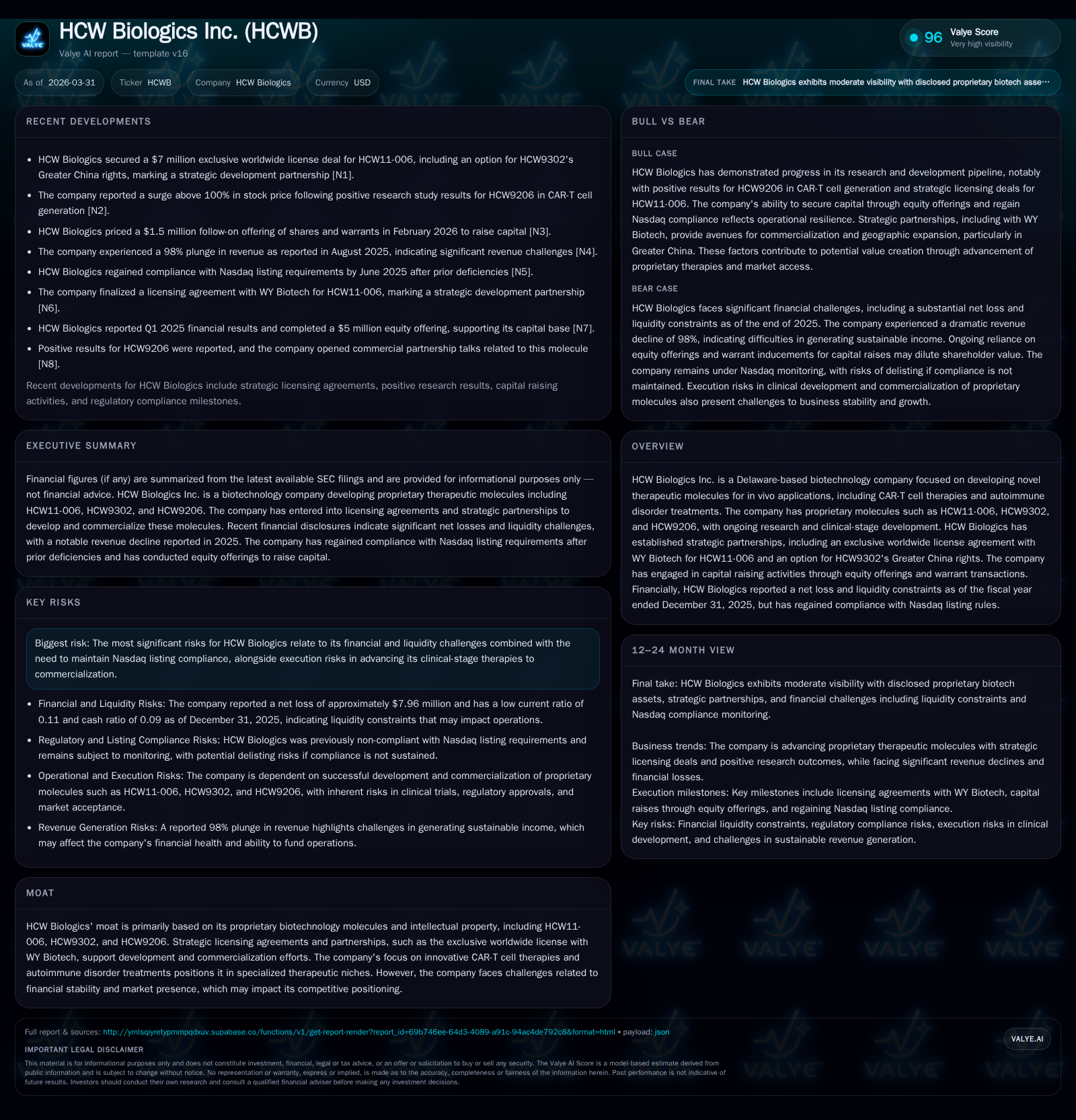
HCW Biologics, a clinical-stage biotech specializing in immunotherapeutics including CAR-T therapies, has seen its stock double following promising research on its proprietary molecule HCW9206. Despite a history of operational losses and liquidity challenges, the company achieved key licensing agreements for HCW11-006 generating $7 million upfront and secured follow-on capital raising totaling over $5 million in early 2026. Nasdaq listing compliance was restored through equity-enhancing warrant inducements, reflecting a financial rebound. Going forward, closely watching clinical milestones, licensing option exercises, and cash runway metrics will be essential to assess the company’s developmental trajectory amid inherent execution risks.
Historical Performance Reflects Development Stage Focus
HCW Biologics operates as a pre-commercial biotechnology company focused on immunotherapeutic development, reflected in its modest revenue base and significant net losses. For fiscal year 2025, the company reported revenues just over $4.1 million[F1], consistent with collaborative agreements rather than product sales. The net loss narrowed to approximately -$7.96 million in 2025 from -$30 million in 2024[F1], signaling some improvement in cost management or spending levels.
Operating income remained negative at -$13.16 million for 2025[F1], an improvement compared to prior years (-$29.48M in 2024). Operating cash flow also stayed negative at -$13.39 million[F1], indicative of ongoing investment primarily in research and development without offsetting commercial cash inflows.
Liquidity pressures are evident with a current ratio near 0.11 at the end of 2025 (current assets approximately $2.28 million versus current liabilities about $21.06 million)[F1], underscoring short-term solvency challenges addressed through capital raises.
Historical performance (annual)
| FY | Net ($mm) | CFO ($mm) | OpInc ($mm) | Capex ($mm) | Net YoY |
|---|---|---|---|---|---|
| 2025 | -8 | -13 | -13 | 0 | +73.5% |
| 2024 | -30 | -14 | -29 | 0 | -20.1% |
| 2023 | -25 | -23 | -26 | 6 | -67.7% |
| 2022 | -15 | -10 | -15 | 10 |
Source: SEC companyfacts cache [F1].
Capital returns and efficiency (annual)
| FY | FCF ($mm) | ROE% |
|---|---|---|
| 2025 | -13 | -287.9 |
| 2024 | -14 | 443.5 |
| 2023 | -29 | -185.7 |
| 2022 | -21 | -39.8 |
Source: SEC companyfacts cache [F1].
Note: Financials are consolidated full-year results per latest SEC filings[F1].
Proprietary Pipeline and Strategic Partnerships
HCW Biologics' core assets include proprietary molecules such as HCW11-006, HCW9302, and HCW9206 targeting immunotherapy applications including CAR-T cell technologies and autoimmune disorders[S1]. Research collaborations leverage hybridoma technology for antibody discovery and cell line improvements enhancing manufacturing productivity[S1]. Intellectual property ownership spans internally developed sequences and those generated under contract research agreements.
A pivotal licensing agreement grants WY Biotech exclusive worldwide rights to develop and commercialize HCW11-006[S22], enhancing resource capabilities beyond what the company could deploy alone—common practice among emerging biotechs seeking global reach.
Additionally, WY Biotech holds an option for exclusive licensing across Greater China for HCW9302 targeting autoimmune indications[N2][S22], positioning HCWB to capitalize on regional market expansion opportunities.
Clinical Advances Spark Investor Optimism
March 2026 research results on HCW9206 demonstrated enhanced CAR-T cell generation efficiency preclinically[N1], triggering a stock price surge exceeding +100%. This data suggests potential breakthroughs addressing manufacturing bottlenecks associated with autologous CAR-T therapies via improved effector T cell yields under GMP protocols.
Such validation is critical for investor confidence in platform viability, often serving as inflection points influencing valuation trajectories for specialized biotech firms dependent on innovation efficacy.
Licensing Deal Structure Balances Near-Term Cash and Long-Term Milestones
The February-March 2026 licensing deal generated $7 million upfront from WY Biotech for HCW11-006[N2][S21], providing immediate liquidity relief amid operating burn pressures but eliciting cautious market reaction due to deferred royalty streams or milestone dependencies embedded within the agreement.
The option arrangement for Greater China rights to HCW9302 adds optionality but defers substantive revenue recognition pending exercise[N2]. Such structures typify early-stage biotech approaches balancing non-dilutive monetization against future upside participation risks.
Capital Raising Initiatives Support Liquidity Amid Cash Burn
To address liquidity constraints highlighted by suboptimal current ratios earlier in FY25[F1], HCWB executed multiple financing actions:
- A November 2025 warrant inducement reduced exercise prices from $7.45 to $2.66 prompting warrant exercises raising approximately $3.8 million[S16][S23]
- A February 2026 follow-on offering raised gross proceeds of $1.5 million with attached warrants exercisable upon shareholder approval[S4][N3]
- Additional share issuances via standby equity lines generated about $364k net proceeds[S5]
These efforts extended operational runway amidst challenging funding conditions typical for lower-tier Nasdaq biotechs during volatile markets[S4–S7]. While dilutive impacts occurred, such measures were necessary given persistent negative free cash flow approximating -$13.4 million excluding capex[F1].
Nasdaq Listing Compliance Restored Through Equity Enhancements
Nasdaq’s minimum equity requirement of $2.5 million was breached mid-2025 due to accumulated losses pushing stockholders’ equity negative (-$6.77M)[F1][S6]. Following panel-granted extensions through December ’25 and into early ’26[S6], compliance was regained chiefly via warrant conversions injecting fresh capital alongside accounting settlements relieving ~$7+ million legal payables which increased equity by ~$5.4M[S5].
This reinstatement preserves crucial public listing status enabling continued capital market access vital for developmental biotech relying on equity funding over product revenue[S17].
Capital Allocation Prioritizes Development Over Shareholder Returns
Reflecting its developmental stage profile marked by significant net losses (-$7.96M FY25) and negative operating cash flows (-$13.39M)[F1], HCWB has not declared dividends nor repurchased shares recently[S4][S6].
Capital deployment focuses entirely on sustaining R&D programs advancing pipeline molecules without material investments outside core scientific infrastructure (zero capex in FY25)[F1]. This approach aligns with sector norms prioritizing cash conservation until viable commercialization prospects emerge.
Upcoming Catalysts To Monitor Closely
While explicit guidance remains limited consistent with emerging growth biotech caution, several milestones warrant attention:
- Further clinical or preclinical data releases validating HCW9206 efficacy/safety profiles[N1]
- Exercise of Greater China licensing options by WY Biotech contingent on trial progress or regulatory approvals[N2]
- IND filings or study initiations evidencing translational progress toward human trials[S1]
- Achievement of contingent milestones triggering promissory note payments outlined in licensing agreements[N2]
These developments will be key value drivers influencing investor sentiment amid capital runway constraints requiring milestone-driven progression.
Risk Considerations: Liquidity Constraints, Execution Complexity, Legal Legacy
Substantial risks persist including:
- Low liquidity with current ratio near 0.11 presents vulnerability if capital markets access tightens or clinical timelines slip undermining confidence[S1][F1]
- Execution risk remains high given complexities advancing multiple immunotherapeutic candidates through regulatory pathways requiring sustained innovation continuity[S1]
- Legal settlement obligations exceeding $7 million impact cash flows though partially mitigated through structured payment plans including contingent promissory notes[S1]
- Dilution concerns arise from extensive warrant modifications affecting shareholder base stability[S16]
Investors should weigh these factors carefully alongside operational advances when assessing valuation sustainability.
Disclaimer: This report is based on publicly available information up to March 31, 2026 and does not constitute investment advice.
Disclaimer: This is research-only, informational analysis and not investment advice. It may include AI-generated interpretation and general industry context. Always verify important details using primary sources.

Comments