
Dawson Geophysical: Managing Contract Risks and Capital Investment in North American Seismic Services
Dawson Geophysical balances growth and risk through its turnkey and term contract mix, focused North American operations, and strategic capital allocation in seismic data acquisition.
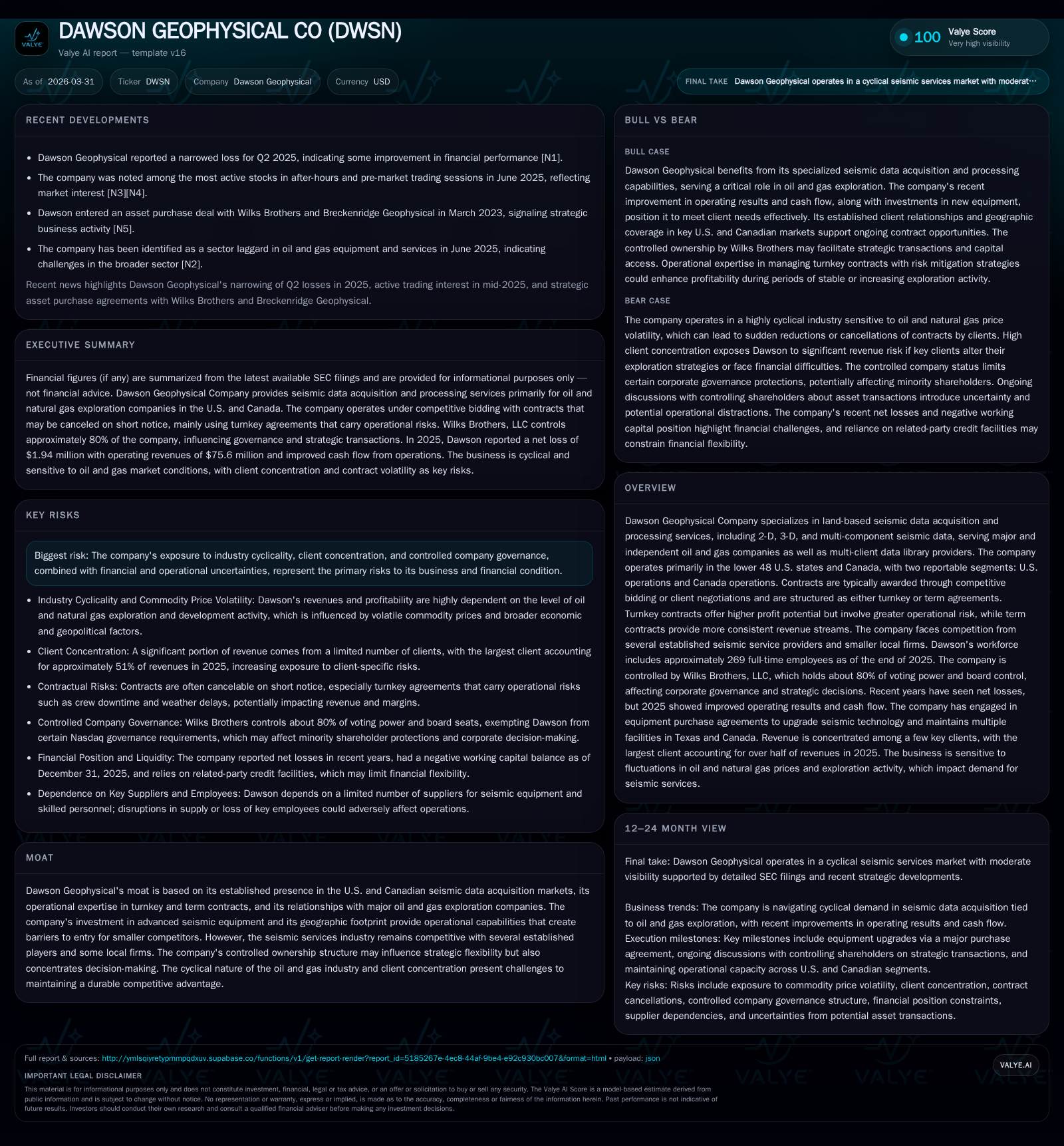
Dawson Geophysical Company operates primarily in the U.S. and Canadian land seismic markets, offering turnkey and term service contracts that balance profitability against operational risk. The company has narrowed operating losses while investing heavily in advanced seismic technology, supported by secured notes and a revolving credit facility. Future growth depends on exploration activity, contract mix management, and navigating cyclical industry dynamics amid concentrated customer exposure.
Growth Trajectory and Profitability Trends
Dawson Geophysical has experienced a gradual recovery in revenue since 2019, reflecting cyclical improvements within the oil and gas exploration sector. Revenue was approximately $33.6 million in FY2019 [F1], increasing over 20% through subsequent years despite significant industry volatility. Operating income remained negative but improved from a loss exceeding $24 million in FY2022 to an approximate deficit of $1.7 million in FY2025 [F1]. Similarly, net losses narrowed from over $20 million to just under $2 million in the latest fiscal year [F1]. These results illustrate operational leverage effects typical of seismic service providers managing cyclical demand fluctuations.
Contractual Framework: Turnkey vs Term Agreements
Dawson's business primarily operates under two contract types: turnkey agreements and term agreements [S1]. Turnkey contracts fix fees per unit of seismic data acquired and carry operational risks such as weather-related crew downtime or delays, which may impact profitability if not mitigated by negotiated weather downtime protections on a project-by-project basis [S1]. Term contracts provide time-based fees (hourly/daily), offering steadier revenue streams but limited upside potential.
Turnkey contracts dominate Dawson’s revenue mix due to market preferences especially across midwestern and southwestern U.S. regions where these contracts are prevalent [S1][S15][S18]. The company dynamically allocates resources across contract types to balance risk exposure with revenue consistency, recognizing that factors like inclement weather, permitting delays, and equipment productivity significantly impact operational outcomes.
North American Operations and Competitive Landscape
Dawson’s operations are divided into U.S. and Canadian segments, with the majority of revenue derived from U.S.-based clients [S5][S7]. Canadian activities are seasonal due to thawing periods that limit operations during the second and third quarters annually [S14]. The competitive environment includes established peers such as SAE, ECHO, and Paragon alongside smaller regional firms focused on lower channel count projects [S1].
High barriers to entry exist due to capital intensity associated with multi-component seismic equipment and energy source vehicle fleets essential for large-scale projects [S15][S22]. Increasing client demand for higher resolution subsurface imaging drives growth in average channel counts per project, favoring operators like Dawson who invest continuously in advanced recording technology [S15][S18].
Capital Allocation and Financial Position
Capital expenditures surged to approximately $6.8 million in FY2025 from about $1.9 million the previous year as Dawson invested heavily in new single point node channel equipment pursuant to a roughly $24.2 million purchase agreement with Geospace Technologies executed progressively throughout 2025 [S15][S23][F1]. Financing for this equipment acquisition includes promissory notes totaling about $14.7 million at fixed annual interest rates of 8.75%, secured by equipment assets and owned properties in Midland, Texas [S6][S8][S17].
Liquidity is further supplemented by a related-party revolving credit facility capped at just over $5 million bearing a high interest rate of 13%, secured by vibrator energy source vehicles integral to seismic operations [S4][S8][S17]. While no amounts were outstanding on this revolver at year-end 2025, the company utilized it during the year to manage working capital needs.
Operating cash flow showed a marked improvement reaching nearly $14 million for FY2025 compared to negative $1.9 million the prior year, driven by better crew utilization and billing collections amid exploration spending recovery [F1][S11][S24]. After capital expenditures, free cash flow approximated $7.1 million supporting debt servicing despite ongoing net losses.
Historical Financial Summary
Historical performance (annual)
| FY | Net ($mm) | CFO ($mm) | OpInc ($mm) | Capex ($mm) | Net YoY |
|---|---|---|---|---|---|
| 2025 | -2 | 14 | -2 | 7 | +52.9% |
| 2024 | -4 | -2 | -5 | 2 | +66.1% |
| 2023 | -12 | 1 | -13 | 4 | +40.6% |
| 2022 | -20 | -9 | -24 | 1 |
Source: SEC companyfacts cache [F1].
Capital returns and efficiency (annual)
| FY | FCF ($mm) | ROE% |
|---|---|---|
| 2025 | 7 | -12.3 |
| 2024 | -4 | -23.8 |
| 2023 | -3 | -38.6 |
| 2022 | -10 | -49.7 |
Source: SEC companyfacts cache [F1].
Note: Revenue values for recent years beyond 2019 are not available from current data; operating metrics reflect available annual data.
Outlook and Strategic Considerations
Dawson’s future performance depends heavily on sustained or increased upstream exploration budgets across its core North American markets [S1]. Volatility driven by geopolitical tensions affecting commodity pricing and regulatory changes impacting land access remain key risks [S22]. Client concentration poses material exposure risk given one U.S.-based customer accounted for approximately 51% of revenue during calendar year 2025 [S7][S16].
Ongoing technological advancement requirements necessitate continuous fleet modernization aligned with increasing channel count demands—supporting recurring capital intensity relative to smaller competitors [S15][S18]. Effective management of seasonal Canadian operations alongside balancing turnkey contract upside against term agreement stability will be critical for margin resilience.
Key Metrics for Monitoring Going Forward
Investors should track:
- Shifts in revenue composition between turnkey and term contracts indicating evolving risk-return balance.
- Operating cash flow conversion post-capital investments reflecting working capital efficiency.
- Progress toward client diversification reducing single-customer dependency.
- Debt servicing progress on Geospace promissory notes alongside revolver usage affecting liquidity costs.
- Utilization rates of newly acquired advanced seismic equipment driving productivity gains.
By closely monitoring these indicators within the context of upstream spending trends, Dawson can leverage its niche position amid the cyclicality inherent to oilfield service markets.
This analysis is based solely on publicly filed financial statements and disclosures from Dawson Geophysical Company as of March 31, 2026. It is not investment advice or a recommendation regarding securities trading or investment decisions.

Comments