
Nuo Therapeutics Advances Chronic Wound Care Commercialization Amid Financial and Competitive Constraints
Nuo Therapeutics markets the FDA-cleared Aurix System for chronic wound treatment, progressing commercialization after Medicare coverage reinstatement but facing material financial and market challenges.
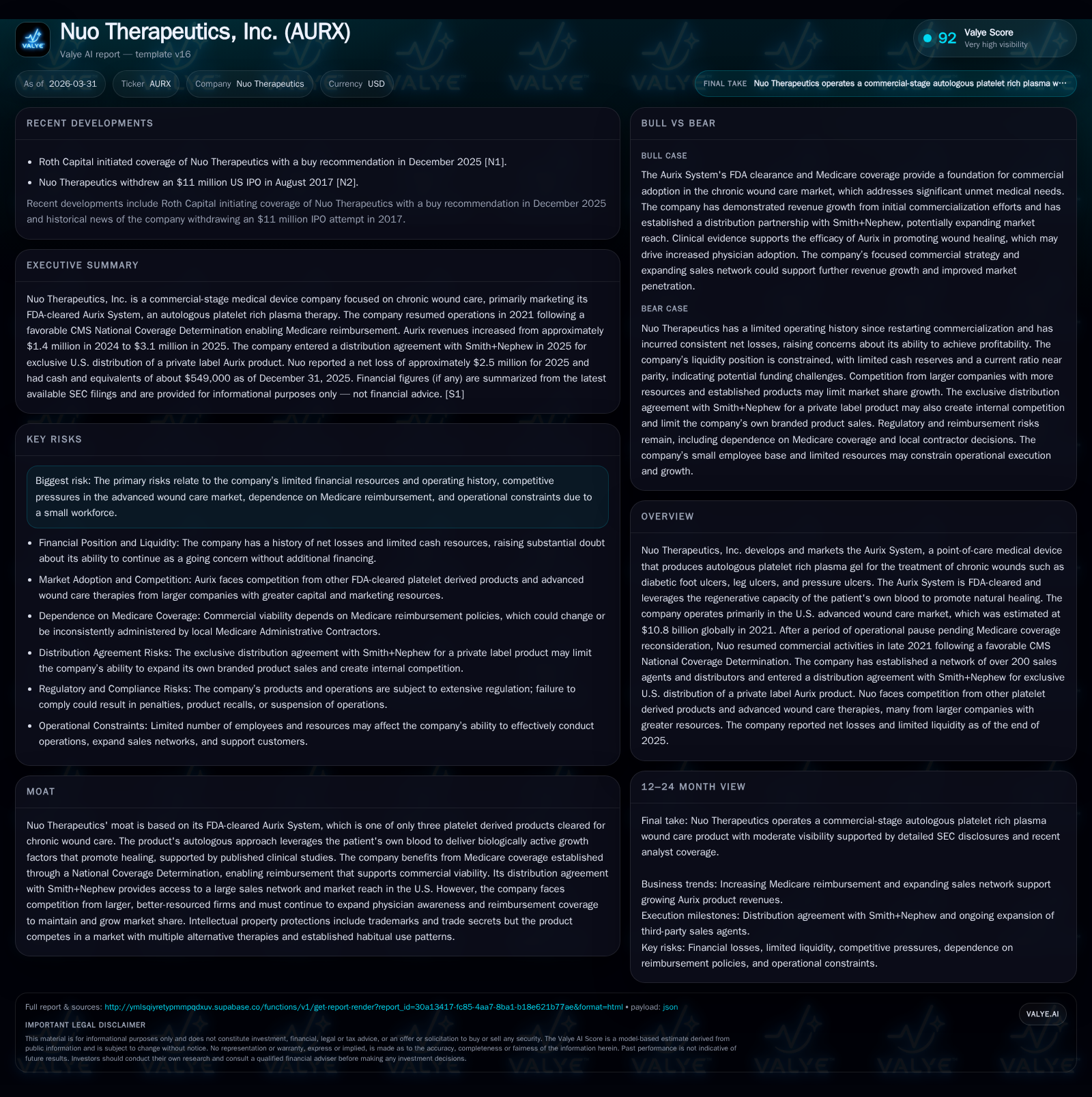
Nuo Therapeutics, Inc. develops the Aurix System, an autologous platelet-rich plasma device cleared by the FDA for chronic wounds such as diabetic foot ulcers and pressure ulcers. The company restarted commercialization following a favorable Medicare National Coverage Determination in 2021, growing revenues to approximately $3.1 million in 2025, yet remains unprofitable with ongoing operating losses. Nuo’s strategic partnership with Smith+Nephew expands market reach via private-label distribution but introduces competition risks. Financially, Nuo confronts liquidity constraints with limited cash reserves and recurring negative operating cash flows, raising going concern doubts. Future progress hinges on expanding reimbursement coverage, physician adoption, and securing additional capital.
Company Overview
Nuo Therapeutics, Inc., headquartered in Houston, Texas, has developed the Aurix System, a point-of-care medical device that produces autologous platelet-rich plasma gel used to treat chronic wounds including diabetic foot ulcers, leg ulcers, and pressure ulcers [S1]. This technology harnesses patients' own blood components to stimulate natural healing processes. The Aurix System received FDA clearance under Section 510(k) in 2007 and has since been positioned within the ~$10.8 billion global advanced wound care market (2021 estimate).
The company’s trajectory has been defined by a protracted operational pause tied to CMS reimbursement uncertainties that delayed commercial activities until late 2021 when favorable Medicare National Coverage Determination (NCD) was granted [S1][S11]. Since recommencing sales efforts thereafter, Nuo has aimed to penetrate the US outpatient wound care sector through an expanding network of over 200 sales agents and third-party distributors.
A significant facet of Nuo’s commercial strategy includes its Distribution Agreement with Smith+Nephew established March 31, 2025 [S11]. Under this contract, Smith+Nephew exclusively distributes a private-label version of Aurix in the United States while Nuo retains rights to market its branded product alongside.
Historical Performance
Nuo’s revenue history prior to suspension of operations was modest and intermittent due to operational stoppages and market access factors. Financial data indicate:
Historical performance (annual)
| FY | Net ($mm) | CFO ($mm) | OpInc ($mm) | Capex ($) | Net YoY |
|---|---|---|---|---|---|
| 2025 | -3 | -1 | -3 | 274756 | -8.1% |
| 2024 | -2 | -2 | -2 | 154962 | +26.7% |
| 2023 | -3 | -3 | -3 | 7244 | +0.0% |
| 2022 | -3 | -4 | -3 | 59992 |
Source: SEC companyfacts cache [F1].
Capital returns and efficiency (annual)
| FY | FCF ($mm) | ROE% |
|---|---|---|
| 2025 | -1 | 262.6 |
| 2024 | -2 | -452.3 |
| 2023 | -3 | -305.2 |
| 2022 | -4 | -144.7 |
Source: SEC companyfacts cache [F1].
*Approximate revenue for 2025 combining product revenue (~$3.1M) plus distribution fees [S11][S14]. **Calculated from partial available comparisons given business pauses affecting earlier years [F1][S11].
The operational relaunch post-2021 NCD spurred sequential increases from limited revenues in second half of 2022 through growth in 2024 ($1.4 million revenue) and further into 2025 [$S11]. Nonetheless, despite this top-line improvement the company has recorded consistent annual operating losses ranging between $2.3 million to $3.3 million over recent years [F1]. Negative cash flow has accompanied these losses with continued use of working capital posing liquidity pressures.
The inability to generate sustained positive EBITDA or net income is influenced by constrained revenues from a single marketed product and ongoing costs related to commercialization infrastructure rebuilding following the prior hiatus.
Market Position and Industry Context
The chronic wound care segment features diverse players including large-scale medical technology firms like Smith+Nephew (Nuo's distributor partner), 3M, ConvaTec as well as biologics specialists such as MiMedx and Organogenesis [S27]. Within this landscape Aurix's value proposition rests on documented efficacy — clinical studies cite healing rates notably superior to controls in diabetic foot ulcers — and its autologous mechanism reducing immunogenic complications [S12].
However,
- Competition is intense from both established dressing/device manufacturers offering broad wound management products and emerging biologic therapies.
- Many competitor firms have substantially larger capital bases enabling more aggressive marketing and pipeline development efforts.
- Established usage patterns among clinicians favor proven legacy treatments which may slow Aurix uptake.
Efforts to expand awareness among physicians through education programs remain ongoing with an emphasis on demonstrating cost-effectiveness and integration within existing clinical protocols [S8][S17]. The Aurix platform targets various exuding wound types but faces hurdles typical in advanced wound care innovation adoption — including payor reimbursement clarity beyond Medicare pathways.
Future Growth Prospects
Nuo’s future growth chiefly depends upon several interrelated factors:
- Reimbursement expansion: While Medicare coverage exists (per April 2021 NCD), broader private insurer adoption is pivotal for significant revenue scale-up [S8][S17]. Gaining further payor acceptance may require additional clinical evidence or health economic data.
- Market penetration: Increasing usage among outpatient clinics and physician offices beyond hospital outpatient settings can drive volume. The current sales agent network growth aims at this objective [S11].
- Smith+Nephew partnership: This distribution deal extends reach but also cannibalizes some direct branded sales potential; managing coexistence dynamics will be critical [S15][S18].
- Product innovation & pipeline: As of fiscal year-end 2025 there were no significant R&D expenditures or new products launched indicating a current commercial focus rather than product development [S1][F1].
- Supply chain reliability: Dependence on Pfizer as sole supplier for bovine thrombin reagent carries risk; supply disruptions or price hikes could adversely affect production costs or availability [S22].
Potential growth is capped by:
- Limited financial resources constraining marketing scale.
- Regulatory complexities that could delay international expansion where approvals may require additional trials or pricing negotiations [S13].
- Intense competition that could erode market share.
Financial Forecasts and Milestones
Though formal guidance is not publicly disclosed by Nuo Therapeutics [N# absent], investors should monitor several indicators:
- Quarterly revenue trajectory relative to incremental sales agent network expansion.
- Updates on payer coverage negotiations aiming beyond CMS reimbursement.
- Performance measures related to Smith+Nephew's minimum purchase commitments (~$500K/year) under private label terms [S18].
- Capital raising activities or debt refinancings given tight cash flows evidenced by CFO deficits exceeding capital expenditures (~$1.14 million negative free cash flow in FY25) [F1][S21].
Returns Profile and Capital Allocation
Due to ongoing losses the Company has negative equity levels (-$956K at FY end 2025), generating an approximate return on equity figure that is not meaningful as an investment profitability metric [F1]. No dividends have been paid historically nor any stock buybacks aside from nominal repurchases years ago apparent through very limited repurchase figures circa FY2017-FY2018.
Operating cash flow remains negative—approximately minus $865 thousand in FY25—but shows improvement compared with prior years’ steeper outflows [F1]. The company deployed modest capital expenditures ($275 thousand in FY25) reflecting manufacturing scaling needs but no major capital projects.
In January 2026 Nuo secured a loan agreement providing up to $1.6 million (with $1 million drawn initially) for working capital purposes [S3], underscoring financing dependency amid persistent negative earnings.[S21] Additional funding will likely be required before self-sustaining profitability can be achieved.
There is no publicly stated repurchase program or dividend plan as yet; allocation priorities appear focused on supporting commercial expansion rather than shareholder returns at this stage.
Risks Summary
Key risk vectors noted in SEC filings include:
- Concentrated reliance on a sole product line for all revenues elevates business continuity risks if adoption stalls or reimbursement changes occur.[S4]
- Limited financial reserves coupled with history of net losses raise going concern questions.[S21]
- Dependence on Medicare reimbursement may restrict revenue upside especially if policy shifts reduce payment levels.[S8][S17]
- Supply chain concentration around a single reagent supplier introduces vulnerability.[S22]
- Competitive disadvantage versus larger peers with more robust marketing budgets and broader product suites.[S27]
- Possible contractual dependence and competitive tension embedded by Smith+Nephew’s exclusive private label distribution rights – such dynamics could limit Nuo’s brand growth or pricing power.[S15][S18]
- Rigorous regulatory environment governing medical devices requires compliance vigilance; failures could lead to fines or market restrictions.[S10][S14]
- Risk of adverse events related to product use exposing the company to liability despite insurance coverage limitations.[S9]
- Small workforce scale (10 full-time employees as of end FY25) may constrain operational agility.[S4]
Industry Analysis Note
The advanced wound care field’s complexity arises from heterogeneous patient populations often suffering multiple comorbidities necessitating tailored care regimens combining multiple modalities—dressings, biologics like PRP gels or cellular therapies, debridement devices—all competing for therapeutic adoption under cost-containment pressures by payors aiming for demonstrable health outcomes improvements.
Autologous PRP formulations like Aurix offer distinct biological rationales compared with off-the-shelf biologics but face challenges around consistent procedural standardization by clinicians and skepticism around reimbursability beyond Medicare where bundled payments might obscure explicit benefits attribution.
Additionally, penetration into outpatient settings requires overcoming provider inertia borne of entrenched formularies or clinical preferences for more familiar advanced dressings or negative pressure wound therapy devices marketed heavily through hospital systems.
Conclusion
Nuo Therapeutics continues advancing commercialization of its FDA-cleared autologous platelet-rich plasma device Aurix following regulatory reimbursement milestones achieved after extended operational hiatus. While top-line growth resumed robustly in recent years reaching over $3 million in revenue alongside expansion of its direct sales channel and collaboration with Smith+Nephew for private-label distribution, it remains significantly challenged by persistent net losses near $2.5 million annually, cash flow deficits that raise going concern flags, and competitive dynamics against well-capitalized peers. Future progress is contingent upon securing broader payer reimbursements beyond CMS, elevating physician awareness and clinical adoption, and stabilizing working capital through financing initiatives. As it stands, Nuo is primarily focused on scaling what remains effectively a single-product enterprise within a highly competitive advanced wound care market characterized by evolving reimbursement landscapes and technological heterogeneity.
This analysis synthesizes publicly filed regulatory disclosures and financial data as of March 31, 2026. It does not constitute investment advice nor recommendations regarding securities transactions.
Disclaimer: This is research-only, informational analysis and not investment advice. It may include AI-generated interpretation and general industry context. Always verify important details using primary sources.

Comments