
PDS Biotechnology’s Immunotherapy Pipeline Drives Transition from Losses to Value Creation
PDS Biotechnology’s innovative Versamune® technology marks critical clinical progress amid ongoing financial challenges, shaping its future growth trajectory.
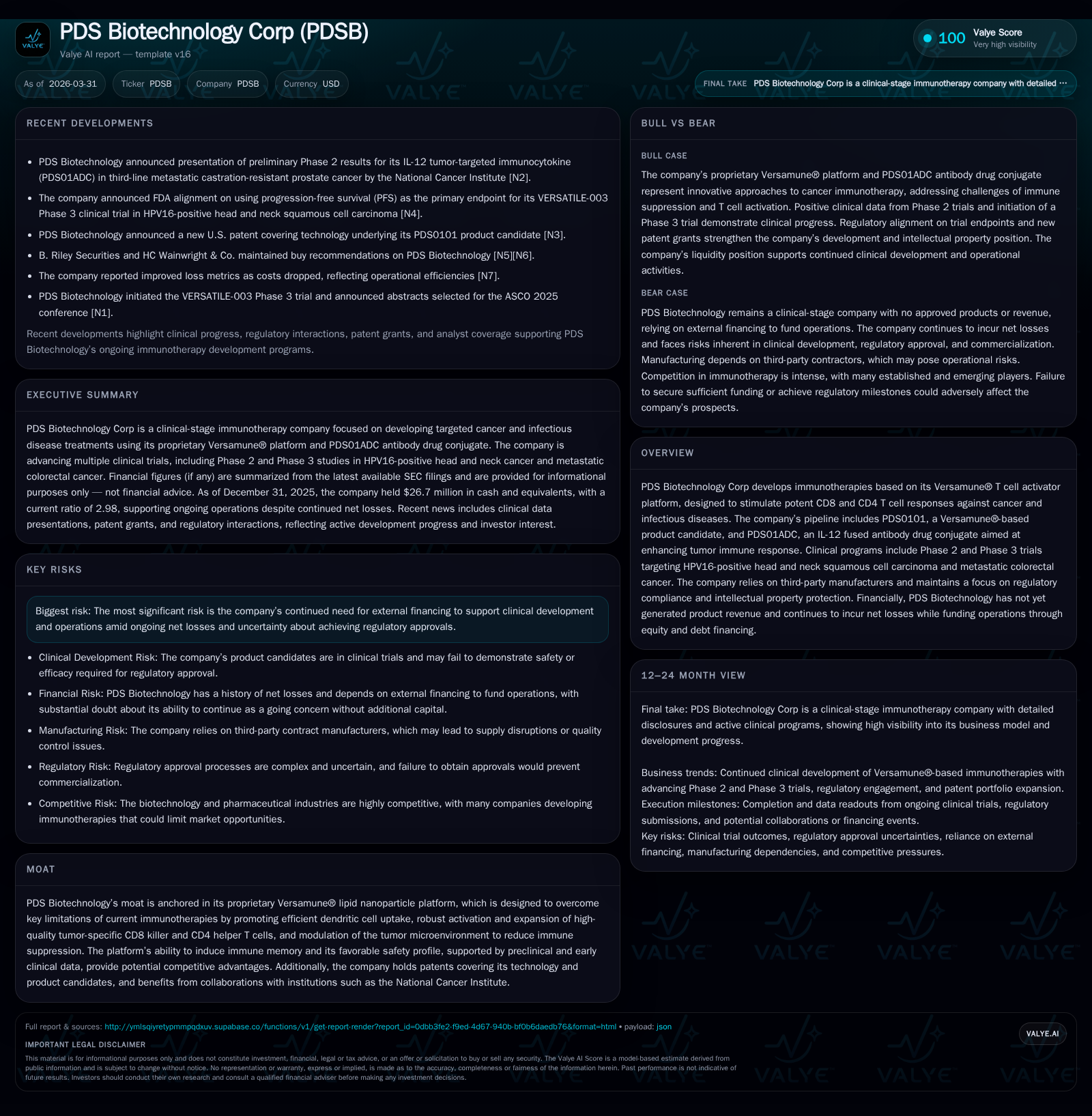
PDS Biotechnology Corp leverages its proprietary Versamune® T cell activator platform to advance a pipeline targeting HPV16-positive head and neck cancers and metastatic colorectal cancer. Despite sustained net losses and negative operating cash flows consistent with clinical-stage biotech norms, the firm has progressed key trials including Phase 3 initiations anticipated to enhance clinical visibility. Capital structure tensions exist driven by outstanding secured convertible debt and associated covenants, raising going concern considerations, but collaborations and intellectual property position the company for potential immuno-oncology value creation. Investors should monitor upcoming regulatory milestones and data readouts as catalysts for transition from development mode toward commercial viability.
Building on the Versamune® Platform: Historical Clinical Performance and Pipeline Evolution
PDS Biotechnology Corp’s scientific foundation lies in its proprietary Versamune® lipid nanoparticle platform, engineered to stimulate robust immune activation by enhancing dendritic cell uptake and inducing polyfunctional disease-specific CD8 killer T cells alongside CD4 helper T cells. This immunological profile exhibits potential advantages over conventional therapies by actively remodeling the immune suppressive tumor microenvironment into an immunogenic milieu. Key preclinical validations highlighted induction of durable immune memory cells producing cytokines such as IFN-γ and TNF-α that are crucial for effective tumor clearance.
The lead candidate PDS0101 couples Versamune® with antigens targeting HPV16-positive malignancies, supporting trials in recurrent/metastatic head and neck squamous cell carcinoma (HNSCC) as well as locally advanced cervical cancer. Complementing this is PDS01ADC, an IL-12 fused antibody drug conjugate designed to enhance tumor immune response through proliferation and longevity improvements of antigen-specific T cells within the tumor microenvironment while curtailing suppressive components such as regulatory T cells. The portfolio also includes Infectimune® for infectious disease prophylaxis leveraging similar T cell activation mechanisms.
Pipeline evolution reflects structured advancement through clinical phases, characterized by multiple trial initiations between 2024–2025 including the transition of VERSATILE-003 to Phase 3 status evaluating PDS0101 in first-line treatment settings alongside positive expansions of colorectal cancer cohorts treated with PDS01ADC [S1]. This evidences a deliberate strategy of leveraging both mono-therapeutic and combination immunomodulatory modalities intrinsic to the platform’s versatility.
Key Clinical Milestones and Phase Transitions in 2024–2025
Recent clinical achievements crystallize PDS Biotechnology’s forward momentum. In September 2024, updated VERSATILE-002 Phase 2 data presented at ESMO underscored survival benefits in HPV16-positive HNSCC patients. Subsequently, IMMUNOCERV Phase 2 results incorporating PDS0101 combined with chemoradiation were showcased at ASTRO’s annual meeting in October 2024—highlighting synergy between immunotherapy and radiochemotherapy in cervical cancer.
March 2025 marked the commencement of the pivotal VERSATILE-003 Phase 3 trial targeting recurrent/metastatic HNSCC, an essential inflection point for eventual regulatory filing prospects. July’s announcement expanding colorectal cancer cohorts post-positive phase 2 stage 1 outcomes indicates broadening indications for the IL-12 ADC platform. August-September updates delivered final topline survival data from VERSATILE-002 including subpopulation analyses stratified by PD-L1 CPS status [S1].
These progressive transitions not only validate therapeutic hypotheses but intensify cross-trial synergies among Versamune®, PDS01ADC, and checkpoint inhibitors envisioned within combination regimens—together enhancing antigen-specific T cell proliferation while mitigating immune suppression.
Financial Trajectory: Operating Losses and Cash Flow Dynamics Over Recent Years
Financially, PDS Biotechnology has maintained consistent R&D investment aligning with its clinical-stage profile yet remains firmly loss-making without revenue generation. Operating income trended from -$41.7 million in FY2022 deepening slightly to -$43 million in FY2023 before improving to -$31.5 million at end-FY2025—a roughly 13% narrower loss reflecting cost control or programmatic efficiencies [F1].
Net income similarly improved from -$19.1 million in FY2022 to -$7.6 million in FY2025—an approximate 5% YoY improvement maintaining significant negative earnings yet indicating some margin progression possibly linked to reduced non-operating items or finance costs.
Operating cash flow remains negative but moderated from -$35 million in FY2024 to -$27.75 million in FY2025 (+20.8% YoY), illustrating ongoing cash burn primarily funding clinical studies rather than fixed asset growth given nil capital expenditures beyond minor spending previously reported [F1].
Liquidity metrics reveal a current ratio near 3x ($28.25 million current assets vs $9.48 million liabilities), suggesting adequate short-term resource sufficiency; however, going concern disclosures flag pronounced funding dependency amidst uncertain capital markets access [F1][S9].
Historical performance (annual)
| FY | Net ($mm) | CFO ($mm) | OpInc ($mm) | Capex ($) | Net YoY |
|---|---|---|---|---|---|
| 2025 | -8 | -28 | -32 | 0 | +4.9% |
| 2024 | -8 | -35 | -36 | 29000 | +27.0% |
| 2023 | -11 | -34 | -43 | +43.1% | |
| 2022 | -19 | -26 | -42 |
Source: SEC companyfacts cache [F1].
Capital returns and efficiency (annual)
| FY | FCF ($mm) | ROE% |
|---|---|---|
| 2025 | -28 | -81.7 |
| 2024 | -35 | -41.8 |
| 2023 | -41.7 | |
| 2022 | -43.5 |
Source: SEC companyfacts cache [F1].
Note: Operating income trends reflect narrowing losses potentially tied to streamlining; cash flows affirm substantial investment activity focused on R&D.
Capital Structure Constraints: Debt Covenants Impact Operational Flexibility
PDS Biotechnology's equity declined markedly from $44 million at end-FY2022 to approximately $9.25 million by FY2025—a reflection of accumulated deficits or financing activities eroding shareholder base [F1]. Since April 2025 the company carries over $22 million in senior secured convertible debentures subject to covenants requiring maintenance of minimum cash balances relative to outstanding principal plus buffer amounts held under account control agreements [S9][S12].
These covenants restrict discretionary financial actions such as incurring additional debt or capital expenditures without lender approval—critical given persistent negative operating cash flow necessitating external funding or partnerships.
Breach of these covenants could trigger defaults accelerating repayment obligations that may jeopardize ongoing operations absent swift capital solutions [S9][S12]. Management disclosures explicitly note substantial doubt regarding ability to continue as a going concern within one year absent successful financing [S9].
Regulatory Approval Risks Amid Complex Healthcare Environment
PDSB faces multifaceted regulatory risks spanning clinical trial uncertainties through heterogeneous approval standards across U.S., European Union and other jurisdictions requiring extensive safety and efficacy evidence [S4–S7]. Pricing pressures stem from evolving government healthcare reforms imposing reimbursement constraints alongside complex fraud-and-abuse statutes—including False Claims Act compliance—and privacy regulations such as HIPAA impacting marketing conduct and physician relationships [S6][S10].
Product liability exposures inherent to immunotherapy trials present additional risks necessitating robust insurance coverage though litigation costs could still impact launch or adoption dynamics post-approval [S20]. Intellectual property enforcement challenges remain a material risk due to patent validity disputes or infringement claims common in biotech sectors [S17].
Growth Outlook Anchored in Combination Immunotherapies and Strategic Collaborations
The company's growth strategy emphasizes leveraging Versamune®’s capability to induce multifunctional CD8 killer T cells synergistically combined with PDS01ADC’s IL-12 antibody-drug conjugate enhancing tumor microenvironment immunogenicity—a multi-pronged approach designed for durable antitumor effects supportive of combination regimens with checkpoint inhibitors [N1][S1].
Collaborations with research institutions bolster scientific validation potentially accelerating translational progress underpinning upcoming pivotal readouts critical for regulatory submissions and commercial viability assessments [S1].
Upcoming Catalysts: Data Readouts and Regulatory Milestones Expected To Drive Valuation Trajectory
Near-term focus centers on maturation of overall survival data from VERSATILE-002 Phase 2 trial including subgroup analyses alongside enrollment progression in VERSATILE-003 Phase 3 trial targeting HPV16-positive recurrent/metastatic HNSCC patients [N1][S3]. These data releases will inform FDA/EMA submission timelines influencing investor sentiment.
Manufacturing scale-up reliance on third parties requires process validation aligned with regulatory standards ensuring commercial readiness—a key operational consideration ahead of market launch [S1]. Lifecycle management plans include label expansions leveraging Versamune® versatility across additional oncologic indications.
Investors should monitor updates regarding regulatory acceptances and partnering announcements which may de-risk funding pathways essential for sustained development execution.
This analysis synthesizes publicly available financial disclosures including SEC filings up to March 30, 2026 ([F1],[S#]) along with recent industry news ([N1]). It is intended solely for informational purposes without any investment recommendations.
Disclaimer: This is research-only, informational analysis and not investment advice. It may include AI-generated interpretation and general industry context. Always verify important details using primary sources.

Comments