
Ensysce Biosciences Pursues Breakthrough Opioid Safety Amid Clinical and Financial Hurdles
The clinical-stage biotech leverages proprietary prodrug platforms to tackle opioid abuse and overdose risks but faces significant operational and regulatory challenges.
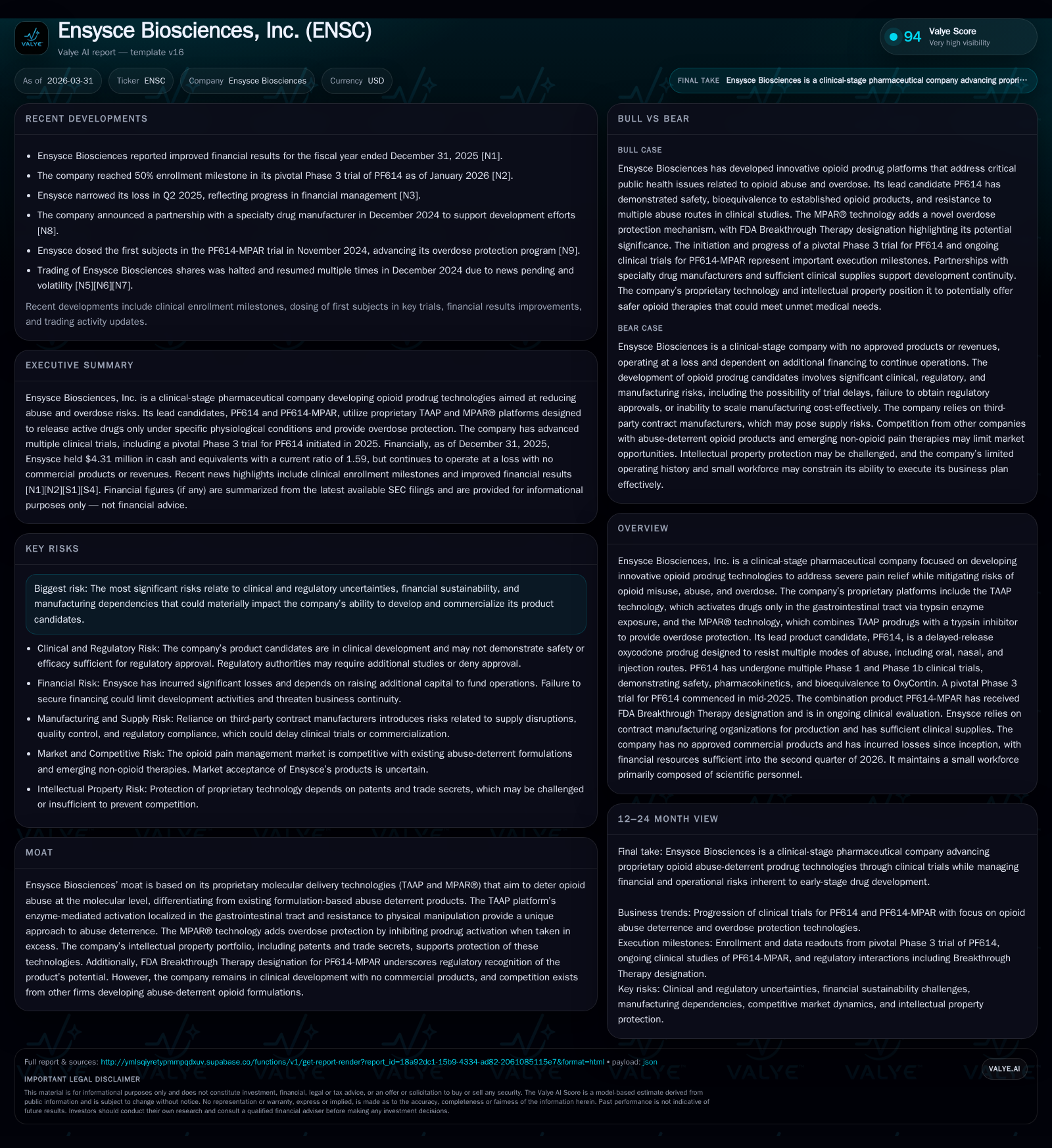
Ensysce Biosciences, Inc. is a clinical-stage pharmaceutical company focused on developing abuse-resistant opioid prodrugs using innovative enzyme-activated TAAP and MPAR® technologies. The firm has advanced its lead candidate PF614 through Phase 1 trials and initiated a pivotal Phase 3 study in mid-2025, supported by FDA Breakthrough Therapy designation. Despite technological promise, Ensysce remains pre-revenue with ongoing operating losses and liquidity concerns that cast doubt on its going concern status. The company’s future growth hinges on successful clinical outcomes, regulatory approvals, and financing availability.
Company Overview and Proprietary Technology
Ensysce Biosciences, Inc., originally incorporated as PharmacoFore in 2003 and subsequently rebranded through mergers culminating in its present form by 2021, operates as a clinical-stage pharmaceutical firm focused on innovating safer opioid therapies. The core aim is addressing the pressing societal problem of opioid misuse and overdose by developing molecularly engineered prodrugs that provide effective pain relief yet minimize avenues for abuse [S1].
The intellectual hallmark is Ensysce's dual-platform approach: the Trypsin Activated Abuse Protection (TAAP) technology that triggers drug activation exclusively in the gastrointestinal tract via trypsin enzyme exposure; and the Multi-Pill Abuse Resistant (MPAR®) platform combining TAAP prodrugs with a trypsin inhibitor to provide a safeguard against overdose by inhibiting activation when dosed excessively [S1],[N1].
Their lead candidate PF614 embodies this approach—a delayed-release oxycodone prodrug chemically designed to resist various abuse methods such as oral tampering, nasal insufflation, or injection. It has undergone multiple Phase 1 and Phase 1b clinical trials showing safety profiles, pharmacokinetics, and bioequivalence compared to OxyContin [S1],[N1]. Importantly, the PF614-MPAR combination was granted FDA Breakthrough Therapy designation—an expedited pathway acknowledging its potential to address unmet medical needs [S1],[N1]. Mid-2025 saw the initiation of a pivotal Phase 3 trial for PF614 aiming to generate confirmatory efficacy data needed for regulatory approval.
Historical Financial Performance
Since inception, Ensysce has remained pre-commercial with no products approved for sale or revenues derived from product sales. The business model heavily prioritizes research and development expenditures towards advancing its clinical pipeline.
Operating income has been persistently negative reflecting ongoing investment in product development:
Historical performance (annual)
| FY | CFO ($mm) | OpInc ($mm) |
|---|---|---|
| 2025 | -8 | -10 |
| 2024 | -8 | -7 |
| 2023 | -11 | -11 |
| 2022 | -18 | -24 |
Source: SEC companyfacts cache [F1].
Operating income worsened after improvement in FY2024 but remained negative by over $10 million in FY2025 [F1].
Cash from operations remains negative hovering near $7.8 million annually indicative of continued cash burn for trial costs [F1]. Equity improved slightly to $3.2 million at FY end 2025 marking recovery from prior years of negative equity positions [F1]. The current ratio was approximately 1.59x as of December 31, 2025 denoting moderate short-term liquidity coverage but fragile overall financial footing.
Net income was last positive in FY2020 at $4.31 million but company does not expect material revenues until regulatory approval and commercialization can be achieved [F1],[S1].
Growth Prospects and Development Pipeline
The pivotal growth catalyst rests solely on achieving successful regulatory milestones for PF614 and its combination PF614-MPAR. Demonstrating strong efficacy along with robust abuse-deterrent properties distinct from existing formulations is essential to gain FDA approval under increasingly stringent standards implemented since the opioid crisis heightened scrutiny [S11],[S12].
If PF614 completes Phase 3 trials successfully—expected timeline based on mid-2025 start being critical—the company could advance toward new drug application (NDA) filings. These filings will be scrutinized particularly for safety given opioids are Schedule II controlled substances regulated tightly by DEA and state authorities [S5],[S26]. Approval would unlock commercialization opportunities potentially enhanced by the FDA Breakthrough Therapy designation which may facilitate accelerated review [S14].
Product commercialization will require establishing or partnering for manufacturing scale-up compliant with cGMP regulations and developing sales & marketing infrastructure—a non-trivial endeavor given current status as purely clinical stage without commercial operations [S26].
Furthermore, Ensysce pursues additional preclinical candidates leveraging its TAAP platform potentially expanding its therapeutic scope within abuse-deterrent opioids or adjacent areas such as opioid use disorder treatments [S1]. Continuation of government grant funding and partnerships could supplement R&D financing but remains uncertain given fluctuating budgets [S12].
Company acknowledges substantial risks including likelihood of clinical failure due to unforeseen side effects or insufficient efficacy; regulatory hurdles; patent challenges possibly leading to infringement litigation; intense competition including from pharmaceutical majors like Purdue Pharma developing alternative abuse deterrents; manufacturing reliability issues; potential reputational harm; and financial sustainability dependent on capital raises or collaborations [S4]-[S10],[S16]-[S20],[S24]-[S25],[S29].
Guidance and Milestones To Watch (Analysis)
No explicit revenue or earnings guidance was provided in public filings up to Q4 2025 or early 2026 disclosures [N1],[S2],[S3]. Key upcoming milestones include:
- Readouts from the ongoing pivotal Phase 3 clinical trial for PF614—likely reported post-2026.
- Potential NDA submission timing contingent on trial success.
- Announcement of any strategic collaboration or licensing deals that could provide non-dilutive capital.
- Updates on manufacturing arrangements ahead of launch readiness.
- Progression of preclinical candidates further down development pipeline.
- Additional FDA communications on approval timelines influenced by policy shifts around opioids.
Monitoring these events will offer insights into whether Ensysce can transition from developmental expenditures toward revenue generation.
Capital Allocation and Returns Profile
Ensysce Biosciences currently invests nearly all available cash flow into R&D activities given absence of commercial products. Capital allocation focuses predominantly on advancing PF614 through late-stage trials while sustaining pipeline discovery efforts.
The company’s cash balance of approximately $4.31 million at fiscal year-end provides short runway amid continuing negative operating cash flow exceeding $7.8 million annually [F1], indicating an imperative need for external financing soon to avoid operational curtailment or downsizing.
Historical share repurchases peaked notably in FY2020 with over $184 million spent but no recent buybacks have been disclosed consistent with preservation of cash resources required for development [F1].
Shareholders currently encounter negative returns driven by sustained losses with implied return on equity approximated at an elevated percentage owing primarily to small equity base rather than profitability foundations [F1].
Future returns hinge heavily on successful regulatory approvals translating into commercialization revenues. Absent significant capital infusion or partnership structures enabling efficient scaling of production and market entry activities, enabling positive free cash flow remains a distant prospect.
Risks Summary
The company’s filing extensively details risks germane to clinical-stage biopharmaceuticals specializing in controlled substances:
- Going concern uncertainty predicated on need for continuous funding rounds;
- Clinical trial risks including participant retention issues/lack of efficacy/adverse events;
- Regulatory complexities given evolving opioid scrutiny by FDA/DEA;
- Intellectual property challenges encompassing possible infringement litigation;
- Manufacturing compliance risks under cGMP during scale-up;
- Competitive pressure from established pharma entities with broader resource bases;
- Reputational risks linked to adverse product perceptions even post-approval;
- Dependence on third-party contractors for manufacturing and trial execution;
- Legislative/regulatory changes outside company control impacting market dynamics;
- Cybersecurity breaches threatening confidential data integrity;
- Potential volatility due to shareholder dilution from inevitable future financings [S1],[S4]-[S29].
Conclusion (Analysis)
Ensysce Biosciences occupies a technically differentiated niche targeting crucial unmet needs in the opioid epidemic via advanced molecular prodrug technologies tailored to reduce abuse/misuse while preserving analgesic efficacy. Its first-in-class composition granted breakthrough therapy recognition suggests potential market impact if substantiated.
Nevertheless,the journey ahead is precarious: the firm lacks revenue streams presently relies extensively on capital markets amid persistent losses; compound risks related to complex clinical pathways regulatory scrutiny intellectual property landscape manufacturing scale-up and competitive pressures abound. Success pivots chiefly on upcoming pivotal trial outcomes plus securing sufficient patient enrollment maintaining quality controls navigating FDA requirements negotiating partnerships potentially orchestrating commercial rollouts versus licensing alternatives.
For analysts tracking innovation-driven smaller pharma entities focusing on controlled substances innovation these dynamics illustrate how breakthrough science confronts customary biotech operational & financial execution challenges intrinsically tied to long development timelines fighting stigma & regulation within high-risk therapeutic domains.
Disclaimer: This analysis is intended solely for informational purposes summarizing publicly available data and does not constitute investment advice.
Disclaimer: This is research-only, informational analysis and not investment advice. It may include AI-generated interpretation and general industry context. Always verify important details using primary sources.

Comments