
Allurion Technologies’ Market Entry and Financial Recovery Post-FDA Approval
Allurion transitions from regulatory validation to commercialization amid financial and listing challenges.
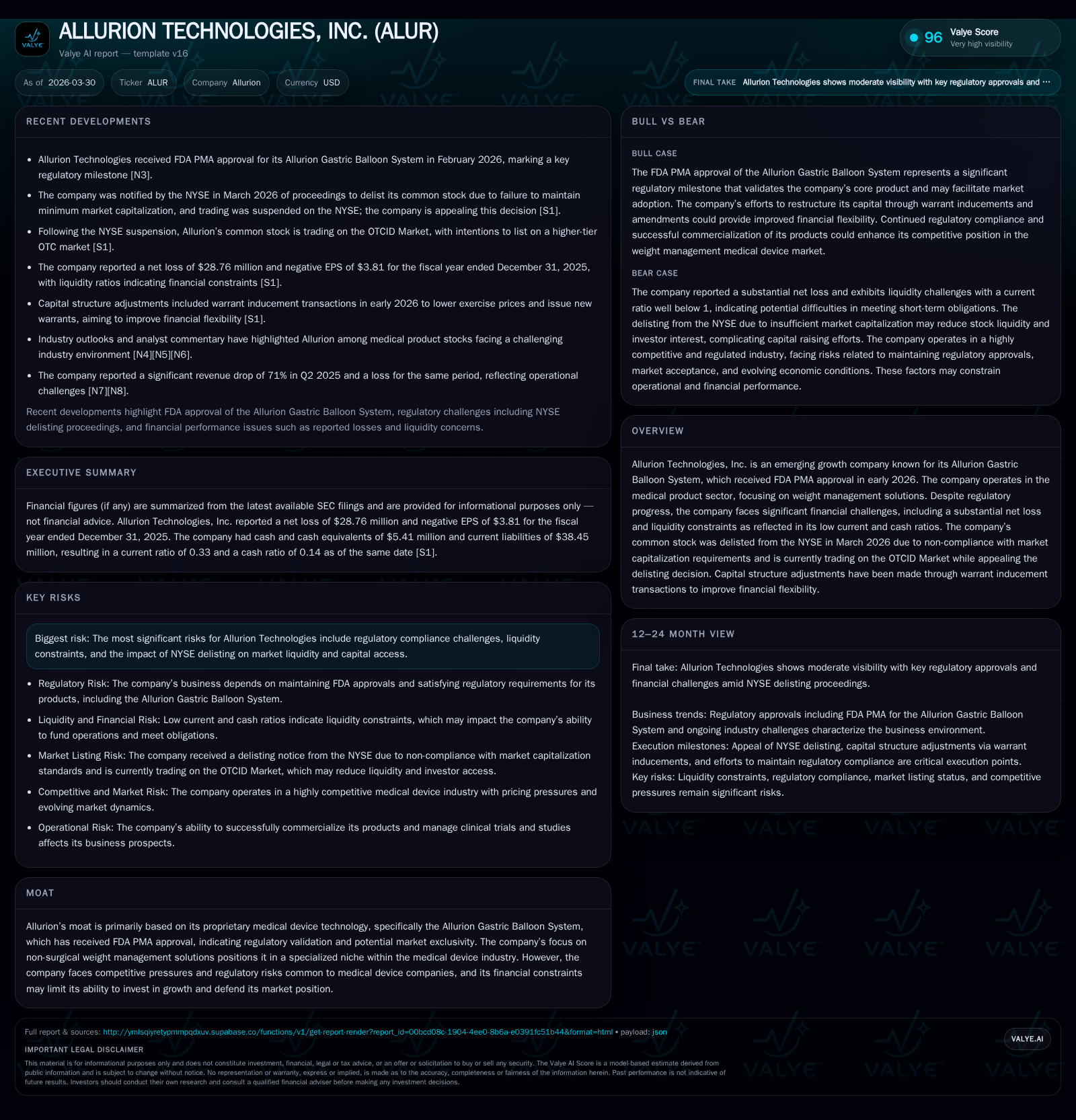
In early 2026, Allurion Technologies secured FDA PMA approval for its flagship Allurion Gastric Balloon System, marking a pivotal regulatory milestone that validates its proprietary device in the competitive weight management sector. However, despite this breakthrough, the company grapples with significant financial strain, reflected in persistent net losses, constrained liquidity with a current ratio of only 0.33, and operational cash flow deficits. Adding to these pressures, Allurion was delisted from the NYSE due to sustained market capitalization deficiencies but is actively appealing the decision while executing capital structure adjustments to stabilize its balance sheet. Future growth hinges on successful commercialization of the FDA-approved device within a non-surgical obesity treatment niche complicated by reimbursement and market adoption dynamics.
FDA PMA Approval Marks Crucial Regulatory Breakthrough
Allurion Technologies achieved a watershed moment in February 2026 when the U.S. Food and Drug Administration granted Premarket Approval (PMA) for its Allurion Gastric Balloon System featuring the Allurion Smart Capsule ([N4],[N2]). This approval validates not only the safety and efficacy profile but also confers potential market exclusivity given the PMA's rigorous clinical evidence requirements compared to less stringent clearances. The device targets adults aged 22 to 65 with obesity defined by BMI between 30 and 40 who have unsuccessfully attempted prior weight loss programs ([N4]).
This regulatory milestone distinguishes Allurion within the medical device sector by authorizing commercial-scale deployment in the lucrative U.S. weight management market—an area where non-surgical interventions with strong clinical backing are increasingly sought after ([N3]). However, while this cements the product’s foundational credibility, translating approval into sustainable revenue streams will require overcoming entrenched adoption barriers and competitive forces.
Historical Financial Trajectory: Losses Narrow Despite Mounting Pressures
Examining recent fiscal years through SEC XBRL data reveals a trajectory of improving yet still challenged profitability metrics ([F1]):
Historical performance (annual)
| FY | Net ($mm) | CFO ($mm) | OpInc ($mm) | Capex ($) | Net YoY |
|---|---|---|---|---|---|
| 2025 | -29 | -29 | -30 | 611000 | -299.5% |
| 2024 | -7 | -42 | -50 | 611000 | +91.3% |
| 2023 | -83 | -64 | -79 | 1606000 |
Source: SEC companyfacts cache [F1].
Capital returns and efficiency (annual)
| FY | FCF ($mm) | ROE% |
|---|---|---|
| 2025 | -30 | 37.3 |
| 2024 | -43 | 9.2 |
| 2023 | -66 | 116.2 |
Source: SEC companyfacts cache [F1].
*The notable net income deterioration in FY2025 relative to FY2024 reflects factors such as non-operating expenses or one-time charges detailed in filings but coincides with overall operating loss reduction indicating ongoing cost discipline.
Operating cash flows remain deeply negative reflecting persistent burn typical of emerging med-tech firms scaling commercialization under constrained revenue climates ([F1]). Capital expenditures have remained modest at approximately $600k annually since reducing from higher pre-commercial investment levels.
Allurion Gastric Balloon System: Technology Spotlight and Competitive Positioning
The Allurion Gastric Balloon System represents a proprietary minimally invasive gastric device designed for temporary intra-gastric volume occupation to promote satiety and reduce caloric intake in obese patients ([N2],[N4]). Its inclusion of the Allurion Smart Capsule adds diagnostic precision enhancing patient monitoring during therapy duration.
Such technologies compete against both surgical bariatric procedures and pharmacologic regimens; however, they benefit from being non-surgical with favorable risk profiles which can drive better patient adherence—an essential commercial lever given clinical outcomes depend significantly on user compliance.
Allurion's proprietary design and FDA PMA clearance form the core moat distinguishing it amid competitors offering earlier-stage or less validated weight management solutions.
Capital Structure Transformations to Address Liquidity Gaps
Liquidity stress has compelled Allurion to enact several equity-linked capital actions predominantly via warrant inducement programs executed in early 2026 ([S14],[S15],[S21],[S28]). These structures effectively lower exercise prices on outstanding warrants coupled with offering new warrants incentivizing holders to convert existing instruments into common equity providing roughly $3 million gross proceeds as near-term capital infusion.
Despite these efforts current assets at fiscal year-end totaled $12.8 million overshadowed by current liabilities near $38.4 million resulting in a severely constrained current ratio of approximately 0.33 ([F1]). This inadequate short-term liquidity profile heightens default risk absent further capital raises or operational cash flow improvement.
The NYSE delisting announcement intensified urgency around balance sheet restoration as equity financing options narrow when trading shifts exclusively to OTC markets which typically reduce investor participation levels ([S3],[S25]).
Market and Operational Challenges Post-NYSE Delisting
On March 6th, 2026 the NYSE suspended trading of Allurion’s common stock after failing to meet minimum average global market capitalization thresholds of $15 million over thirty trading days prompting formal delisting proceedings ([S3],[S25]). This demotion precipitates migration to OTCID markets where liquidity is thinner and visibility among institutional investors declines.
The company has filed appeals targeting a narrow window for regaining compliance either on NYSE or another nationally recognized exchange ([S17],[S27]). The delisting also impairs share-based compensation attractiveness for employee retention—a critical factor in med-tech firms reliant on scientific talent.
Such listing status transitions underscore severe operational challenges now intersecting with early commercialization efforts potentially constraining growth capital access.
Growth Prospects in Non-Surgical Weight Management Niche
Post-FDA nod news coverage portrays upgraded optimism about commercial scalability citing expanding payor acceptance trends and clinical evidence accelerating adoption cycles ([N3],[N4]). Global obesity prevalence combined with patient preference shifts towards less invasive therapeutic options underpin sizable addressable markets for devices like Allurion’s balloon system.
Yet reimbursement environment complexities remain non-trivial hurdles requiring strategic payer negotiations alongside evidence generation through ongoing post-market studies mandated by FDA PMA frameworks ([S5],[S11]). The interplay between real-world outcomes data deployment and insurer willingness will materially influence revenue ramp speed.
Financial Metrics Reflect Strain but Signal Stabilization
Return on equity calculations based on reported net income versus negative equity balances create distorted high nominal ROE figures (~37%) that belie cash burn realities ([F1]). Persistent negative free cash flow nearing -$29.5 million annually highlights that operating losses have narrowed but actual cash liquidity depletion continues as core concern.
Capex spending has remained modest suggesting an operationally lean approach focused on commercial launch rather than product expansion thus far.
Close monitoring of quarterly CFO trajectories alongside incremental gross margin improvements will be critical indicators for underlying business viability amidst ongoing liquidity preservation efforts.
What Investors Should Monitor: Upcoming Milestones and Regulatory Risks
Given limited explicit forecast disclosures one must designate key focus areas including successful execution of FDA post-market commitments such as additional clinical studies potentially impacting label or reimbursement; progress towards relisting on major exchanges or alternative financings; material readouts from ongoing trials especially those addressing patient adherence metrics; plus watchful attention for any regulatory challenges or patent litigations common within medical devices ([N1],[S5],[S11],[S29]).
Investors should calibrate expectations recognizing that while FDA approval provides foundational legitimacy it is only first step amidst fund-raising volatility and competitive ecosystem contestation inherent in emerging medical technology commercialization.
This report synthesizes publicly filed financial data and regulatory disclosures without endorsing any investment action. Readers should consider broader market conditions alongside company-specific developments before forming conclusions about future performance.
Disclaimer: This is research-only, informational analysis and not investment advice. It may include AI-generated interpretation and general industry context. Always verify important details using primary sources.

Comments