
Williams-Sonoma Inc’s Multichannel Strategy Drives Steady Growth and Robust Returns
Williams-Sonoma combines premium brand equity, a multi-channel retail approach, and disciplined capital allocation to sustain growth amid industry pressures.
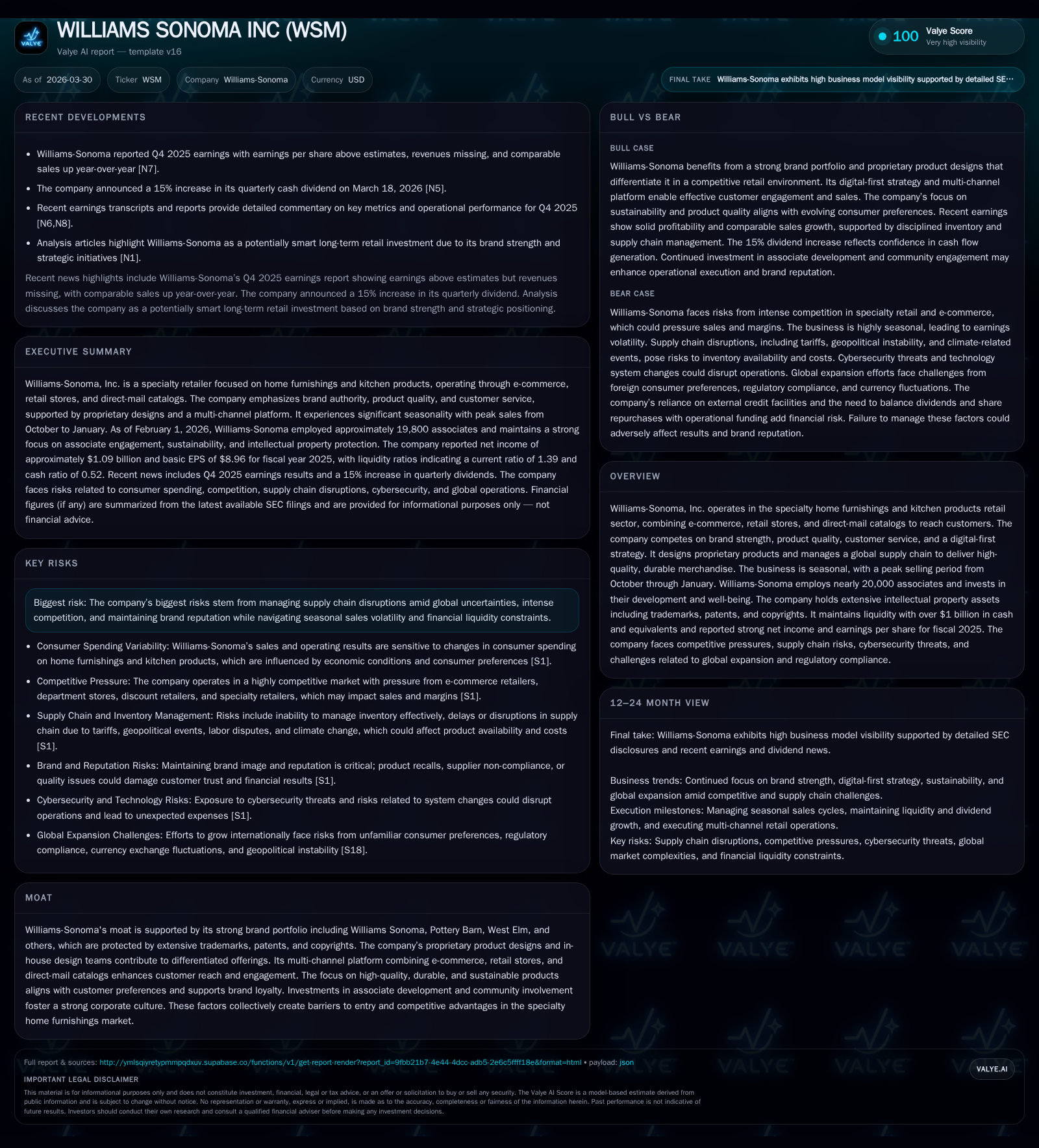
Williams-Sonoma, Inc. leverages its strong portfolio of proprietary home furnishings brands through an integrated omni-channel platform spanning e-commerce, retail stores, and direct-mail catalogs. Despite competitive pressures and supply chain disruptions, the company achieved 4.1% revenue growth in fiscal 2025, supported by a digital-first marketing strategy and sustained customer loyalty. Its robust capital deployment includes significant share repurchases and dividend increases, underpinning a reported approximate 52% return on equity. Looking forward, management signals further revenue expansion with heightened dividend payouts while navigating seasonality and global shipping complexities.
Historical Performance and Growth Drivers
Over the last several years, Williams-Sonoma has posted steady top-line expansion characterized by resilient consumer demand for specialty home furnishings. Fiscal 2025 revenue increased by approximately 4.1% compared to FY2024 according to company filings [F1]. However, operating income contracted marginally by around 1%, with net income reducing by roughly 3.3%. These shifts partly reflect the elevated cost structures tied to global supply chain pressures and ongoing investments in technology and fulfillment capabilities [S1]. Operating cash flow saw a moderate decline of about 3.3%, aligning with these trends. Capital expenditures grew materially by approximately 17%, highlighting targeted infrastructure development to support distribution capacity [F1]. This incremental capex points toward strategic fulfillment enhancements to accommodate evolving customer demands.
Historical performance (annual)
| FY | Net ($mm) | CFO ($mm) | OpInc ($mm) | Capex ($mm) | Net YoY |
|---|---|---|---|---|---|
| 2025 | 1088 | 1315 | 1416 | 259 | -3.3% |
| 2024 | 1125 | 1360 | 1430 | 222 | +18.5% |
| 2023 | 950 | 1680 | 1244 | 188 | -15.8% |
| 2022 | 1128 | 1053 | 1498 | 354 |
Source: SEC companyfacts cache [F1].
Capital returns and efficiency (annual)
| FY | Buybacks ($mm) | FCF ($mm) | ROE% |
|---|---|---|---|
| 2025 | 854 | 1055 | 52.3 |
| 2024 | 807 | 1139 | 52.5 |
| 2023 | 313 | 1492 | 44.6 |
| 2022 | 880 | 699 | 66.3 |
Source: SEC companyfacts cache [F1].
Table summarizes key annual financial metrics illustrating steady top-line growth with fluctuating profitability margins.
Competitive Moat from Brands and Product Design
Williams-Sonoma’s enduring competitive advantage centers on its family of iconic lifestyle brands including Williams Sonoma itself alongside Pottery Barn and West Elm [S19]. These brands command elevated consumer trust predicated on quality craftsmanship and proprietary design aesthetics that resonate with diverse demographic groups [S1]. Integral to this moat is Williams-Sonoma’s intellectual property leverage; rigorous trademark protections encompassing product patents and copyrights guard its unique designs against commoditization [S19]. The company benefits from internal design teams who craft differentiated product lines that underpin their premium positioning.
Complementing product exclusivity is a commitment to superior customer service experiences fueled by data-driven marketing capabilities targeting proprietary customer lists [S19]. Brand portfolio management is finely tuned to balance heritage with innovation—expanding into sustainable materials as consumer preferences evolve while nurturing consistent value perceptions among loyal buyers [S7][S11]. Such depth across branding and design renders entry barriers formidable for new competitors.
Supply Chain Dynamics and Inventory Management Challenges
Global supply chain disruption remains a persistent operational challenge as Williams-Sonoma sources much of its inventory internationally [S8]. Lead time variability has increased dramatically due to geopolitical factors including rerouted shipping lanes around the Cape of Good Hope following instability near the Suez Canal and Strait of Hormuz [S8]. These extended transit times elevate inventory holding requirements well ahead of seasonal peaks.
The company employs a regionalized fulfillment strategy investing capital in distribution centers optimized for both retail store replenishment and e-commerce direct-to-consumer shipments [S23]. Despite these efforts, forecast sensitivity remains high due to rapid shifts in customer preferences typical within specialty home products markets [S8][S9]. Inventory management requires balancing sufficient stocking against markdown risks should demand falter post-season peak.
Operational complexity is further influenced by transportation provider constraints encompassing labor disputes and fuel cost fluctuations impacting shipping reliability [S23][S29]. This complex interplay necessitates adaptive inventory planning leveraging predictive analytics but inherently limits responsiveness to short-term market changes.
Seasonality Effects on Sales and Operational Planning
Temporal concentration of revenue chiefly spans October through January—the peak selling season—aligning with holiday-driven spending patterns pervasive across the home furnishings industry [S1][S9]. This cyclical demand surge compels Williams-Sonoma to scale temporary staffing significantly across retail outlets, customer care centers, and distribution facilities premised on seasonal labor scaling models.
Seasonality imposes pronounced influences on cash flow cycles; working capital demands increase beforehand while promotional activity intensifies during the final quarter affecting margin profiles [S1]. The company’s operational planning rigorously anticipates these cycles through talent development initiatives designed for rapid onboarding of seasonal associates aligned with peak activity periods.
These practices ensure that service quality—and thereby customer experience—does not degrade despite substantial workforce fluctuations over short time horizons [S11][S19]. Williams-Sonoma’s reputation for quality extends beyond product features to encompass elevated human touchpoints at high-volume intervals.
Digital-First Sales Strategy and Multichannel Integration
Williams-Sonoma sustains approximately 35% of net revenues via traditional retail stores complemented by a growing e-commerce segment supported through direct-mail catalogs—forming an omnichannel platform that enhances customer reach while enabling service flexibility [S5][N1][N2]. This balanced channel mix reflects strategic hedging against shifting shopping habits favoring digital engagement beyond pure-play e-commerce competitors.
The firm’s digital-first approach encompasses mobile applications enriched with augmented reality features supporting experiential shopping as well as AI-enabled personalization tools facilitating search optimization and tailored recommendations [N7][N8][S27]. These innovations deepen brand engagement conducive to repeat purchase behavior amidst a fragmented competitive set dominated increasingly by disruptive entrants.
Operational integration ensures that customers can fluidly navigate between online platforms and physical stores—leveraging click-and-collect options or remote assistance from associates—to fulfill contemporary consumer expectations for convenience paired with informed choice [N2][N1]. This cross-channel synergy preserves proprietary data insights essential for refined targeting strategies sustaining high margins.
Capital Allocation: Dividends, Buybacks, and Liquidity Profile
Williams-Sonoma deploys notable capital discipline underscored by shareholder distributions including dividends which saw a recent increase of approximately 15% announced March 2026 reflecting confidence in cash flow stability [N5][S13]. Fiscal year ended February 2026 featured nearly $854 million in share repurchases—a sizeable program relative to net income levels—that underpin earnings per share enhancement ambitions alongside discipline in managing net leverage within credit covenant thresholds [F1][S4].
Liquidity remains robust with cash and equivalents exceeding $1 billion at fiscal year-end supporting buffering capacity amid global market volatility and supply chain uncertainties [F1][S16]. Estimated return on equity stands near an impressive ~52%, reflective of efficient capital deployment generating superior returns relative to equity base [F1].
Capital expenditure trends signal ongoing reinvestment into core distribution infrastructure enhancing operational resiliency while marketing spend emphasizes data-enabled customer acquisition investments ensuring durable top-line prospects without undisciplined expense inflation.
Near-Term Outlook and Key Milestones to Watch
Management projects continued revenue growth for fiscal year 2026 guided by sustained expansion efforts both domestically via enhanced digital penetration initiatives as well as selective international footprint enlargements leveraging known brand equities [N5][N7][N8]. Incremental quarterly dividend increases signal commitment toward shareholder value augmentation commensurate with earnings trajectory.
Key operational milestones include monitoring supply chain stabilization progress given geopolitical fluidity particularly shipping route adjustments; effectiveness of innovative AI tools deployed across sales channels; seasonal labor scaling efficiencies during approaching peak periods; plus maintenance of cost control amidst inflationary pressures [N2][N7][S29]. Analysts should scrutinize inventory turnover metrics given inherent forecast risk linked with multi-season lead times.
Risks Anchored in Global Uncertainty and Market Competition
Williams-Sonoma faces intensified competitive pricing pressure from both entrenched mass retailers offering discount campaigns on commoditized alternatives as well as nimble entrants exploiting direct-to-consumer models enabled by lean cost structures [S9][S19]. The fast-evolving landscape mandates vigilant brand stewardship alongside agile merchandise assortment adjustments supported by accelerated product development cycles.
Cybersecurity risks loom prominently due to extensive digital transaction handling exposing sensitive customer data; regulatory compliance costs concerning privacy laws such as GDPR & CCPA are escalating adding complexity to digital marketing execution; breaches could impair brand reputation causing potential loss of consumer confidence impacting revenues directly [S6][S21][S22].
Supply chain bottlenecks related to supplier disruptions triggered by geopolitical instability or labor unrest threaten timely merchandise procurement thereby exacerbating inventory imbalances or fulfillment delays adversely affecting customer satisfaction scores [S8][S23][S29].
Disclaimer: This is research-only, informational analysis and not investment advice. It may include AI-generated interpretation and general industry context. Always verify important details using primary sources.

Comments