
Carnival PLC’s Strategic Leap: From Dual-Listed Complexity to Unified Growth
Carnival PLC’s transition from a dual-listed company toward a unified entity marks a pivotal moment, characterized by improved profitability and a decisive capital return strategy in 2026.
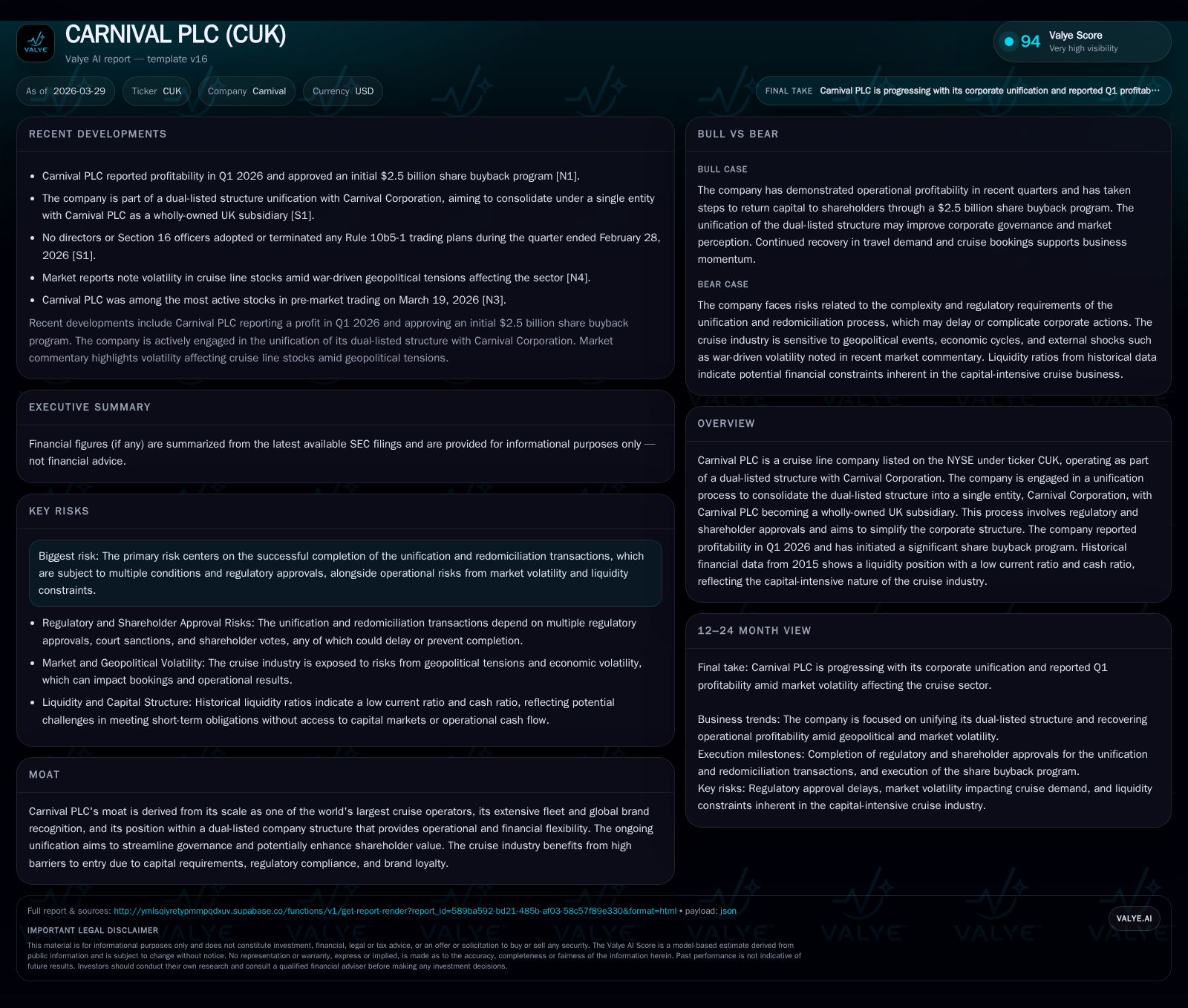
Carnival PLC emerged from years of structural and liquidity challenges with its first quarterly profit in Q1 2026, bolstered by an ongoing unification deal consolidating its dual-listed structure under Carnival Corporation. The strategic simplification intends to streamline governance and unlock operational flexibility while triggering substantial shareholder returns through a $2.5 billion buyback program. Regulatory approvals remain critical near-term milestones, with the larger industry still subject to macroeconomic volatility and capital intensity constraints.
Historic Operating Landscape: Grappling With Liquidity and Scale Challenges
Carnival PLC operated for years under a dual-listed company (DLC) structure paired with Carnival Corporation, creating complexity across governance, regulatory compliance, and capital markets accessibility. Its 2015 financial snapshot illustrates profound liquidity strain typical for cruise operators facing heavy capital expenditure demands associated with fleet maintenance and expansion. [F1] Carnival PLC reported operating income of $289 million and net income of $222 million for the fiscal year ended May 31, 2015; however, these earnings contrasted starkly with a precarious liquidity position characterized by cash & equivalents stood at $298 million against substantial current liabilities totaling approximately $7.68 billion — yielding an exceptionally low current ratio of approximately 0.19. This ratio signals short-term liquidity risks where current assets were insufficient to cover current liabilities by a wide margin.
Such low liquidity ratios are common in the sector given the extensive upfront investments in ships and infrastructure alongside fluctuating demand cycles. The capital-intensive nature demands robust free cash flow management; notably, free cash flow was estimated at $905 million (operating cash flow minus capex) during the same period [F1], underscoring operational cash generation despite balance sheet constraints.
Additionally, an approximate return on equity (ROE) near 1% reflects limited profitability relative to equity base [F1]. These historical conditions framed an imperative for structural reform targeted at improving governance simplicity and financial flexibility.
Unification Agreement: Simplifying Corporate Structure to Unlock Value
In February 2026, Carnival Corporation and Carnival PLC entered into a unification agreement intending to merge their DLC arrangement into a single legal entity named Carnival Corporation Ltd., domiciled in Bermuda [S9]. This restructuring entails Carnival PLC becoming a wholly-owned UK subsidiary under the new entity. The move addresses longstanding governance limitations imposed by the dual-listing framework which required parallel compliance with multiple regulatory regimes—each adding costs and complexity.
Completion depends on several key conditions: shareholder approval of the scheme of arrangement at respective meetings, UK High Court sanctioning without adverse modification, NYSE approval for listing New CCL Shares (common shares post-merger), and satisfaction of all necessary competition law approvals including confirmed antitrust clearance from U.S. authorities and Germany’s Federal Cartel Office in early 2026 [S5][S9]. The process also includes delisting Carnival PLC ADRs from NYSE after effective merger completion along with terminating existing ADR depositary agreements that facilitated cross-listing [S14][S16].
This consolidation anticipates improved operational flexibility resulting from unified decision-making powers, simplified legal structures facilitating capital raising or debt refinancing, as well as streamlined investor communication channels enhancing market perception.
Turning the Profit Corner: Q1 2026 Earnings Performance Analysis
Carnival PLC reported profitability in Q1 2026 according to filings and NASDAQ news releases [N2][S2], representing a meaningful rebound after several years affected heavily by COVID-19 pandemic disruptions which led to plummeting bookings globally.
The first quarter operating results evidenced recovering demand driven by easing travel restrictions and pent-up consumer interest in cruise vacations. This earnings momentum represents not only volume restoration but better cost absorption on fixed expenses due to improved utilization rates.
This profit resumption contrasts with extended prior quarters of operating losses where revenue declines outpaced cost reductions during lockdowns. It is also notable that these gains were realized while pursuing corporate reorganization efforts under the unification plan—signaling management’s success balancing operational recovery alongside strategic initiatives.
Capital Allocation Reshaped: The $2.5 Billion Buyback Initiative
Aligned with improved earnings visibility, Carnival announced an initial $2.5 billion share buyback program confirming management’s commitment to returning capital efficiently to shareholders rather than pivoting prematurely toward dividend payouts [N2][S8]. Historically modest ROE (~1% in 2015) underscored previously constrained capacity for robust shareholder returns [F1].
Buybacks reflect confidence in generating positive free cash flow sufficiently above reinvestment needs—including fleet upgrades—and can reduce equity dilution linked to past financings during crisis periods. While explicit dividend resumption details remain absent from public disclosures, the focus on share repurchases denotes prioritization of flexible capital deployment adaptable to evolving cash flow conditions.
Cash flow sustainability remains paramount given ongoing fleet maintenance capital intensity; partial restoration of net income supports this outlook though continued prudence is warranted given sector cyclicality.
Navigating Regulatory Hurdles and Shareholder Approval Risks
Despite regulatory advancements like antitrust clearances obtained early this year [S9], material uncertainty persists around successful completion of unification transactions tied closely to multiple conditional approvals:
- Approval votes at shareholder meetings must meet required majorities stipulated in scheme proposals.
- UK court sanctioning must confirm the arrangement without modifications detrimental to parties involved.
- NYSE must authorize listing new shares ensuring trading continuity post-merger.
- Foreign investment approvals remain necessary across German and Italian jurisdictions pending expiration of waiting periods.
Failure to satisfy these elements by December 31, 2026 risks termination of the agreement causing reversion to legacy complexities [S17]. Marketplace volatility or emergence of unforeseen facts potentially impacting the willingness or ability to complete transactions remains an execution risk.
Future Outlook: Growth Drivers and Operational Constraints Ahead
Post-merger growth could benefit from realized scale synergies such as consolidated purchasing power, more efficient marketing spend leveraging unified branding efforts, coupled with improved capital access enabling accelerated fleet modernization or expansion programs.
However, industry headwinds tied to geopolitical tensions have introduced market volatility with cruise stocks recently impacted by war-driven factors dampening investor sentiment [N4]. Operational leverage inherent in cruise companies means fluctuating fuel costs or consumer sentiment could pressure margins intermittently.
No explicit forward guidance has been promulgated for Carnival PLC alone due to ongoing restructuring uncertainties; therefore monitoring lease contracts renewal terms alongside competitive responses remains important analytical focus areas [N2].
What to Watch: Key Milestones in the Unification Process
Investors should track scheduled shareholder meetings inviting votes on scheme arrangements as well as anticipated UK court rulings on approval between mid-to-late 2026 [S9]. The timing of NYSE listing approval notices will signal imminent transactional completion allowing delisting of Carnival PLC ADRs shortly thereafter [S17].
Corporate governance timeline awareness is warranted given potential impacts on share liquidity shifts post-merger as holders transition into New CCL Shares replacing ADR structures currently used for cross-border ownership facilitation.
Financial Health Snapshot: ROE, Cash Flows, and Sustainability Table
Historical performance (annual)
| FY |
|---|
| 2015 |
Source: SEC companyfacts cache [F1].
Carnival PLC's historical profitability margins reflected by an approximate ROE near 1% demonstrate limited equity returns during challenged periods while free cash flow generation (~$905 million noted circa FY2015) provided operational foundation supportive enough for ongoing asset investments [F1].
Cash flow trends published more recently indicate improved sustainability in face of disciplined capex spend coupled with revenue recovery post-pandemic disruptions [S10]. Such metrics underpin management’s ability to support sizeable buyback programs alongside meeting debt servicing obligations contained within its complex capital structure.[F1] The interplay between enhanced free cash flow generation capacity and targeted capital returns signals improving corporate finance health amid consolidation efforts.
Investor Summary: Implications of Structural Changes on Valuation
The strategic DLC unification represents a fundamental inflection point reducing intricacies that historically weighed on valuation multiples attributed to structural complexity discounts seen in multi-jurisdictional listings.[S4] Simplified ownership chains facilitate clearer market comparability thus benefitting analyst coverage depth and indexing inclusion potential.
Debt refinancing dynamics anticipated post-redomiciliation aim at optimizing interest expense profiles while ameliorating currency-related effects embedded within legacy Panamanian registrations [S4]. Share liquidity transformation marked by removal of ADR facilities upon merger finalization will incrementally align shareholder base composition favorably catering primarily institutional long-term holders accustomed to Bermuda-domiciled equities [S14][S16].
While uncertain regulatory outcomes pose risk contingencies affecting timing or success rate probabilities,the business model momentum rooted in underlying scale-derived moat supports positive long-term outlook assuming seamless execution.
This analysis is based strictly on documented facts drawn from SEC filings [F1],[S#] and recent news reports [N#], avoiding unstated assumptions or speculative forecasts. It does not constitute investment advice but aims to provide comprehensive insight into Carnival PLC's evolving corporate posture as it advances through structural unification amid unfolding industry conditions.
Disclaimer: This is research-only, informational analysis and not investment advice. It may include AI-generated interpretation and general industry context. Always verify important details using primary sources.

Comments