
HA Sustainable Infrastructure Capital’s Growth Through Diversified Sustainable Asset Investment and Financing Innovation
HASI leverages a diversified portfolio and sophisticated financing to expand sustainable infrastructure assets amid rising energy demand and evolving capital markets.
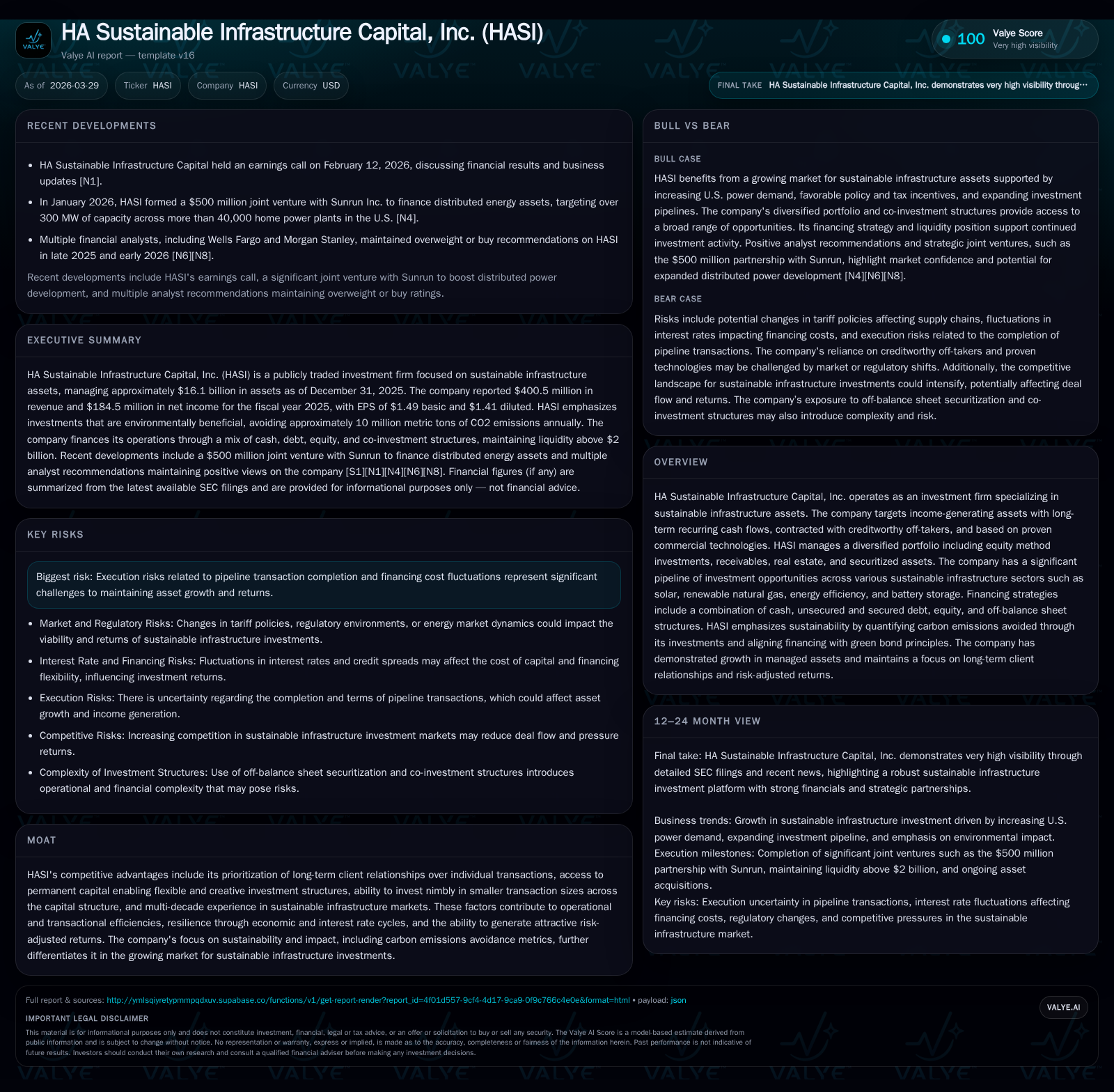
HA Sustainable Infrastructure Capital, Inc. (HASI) specializes in investing in income-generating sustainable infrastructure assets backed by long-term contracted cash flows. The company has demonstrated strong revenue growth from $240 million in 2022 to over $400 million in 2025, driven by expansion in utility-scale solar, residential solar, renewable natural gas, and storage assets. HASI manages over $16 billion in assets through a mix of balance sheet investments, securitized transactions, and co-investment structures. Its capital strategy combines unsecured and secured debt, equity issuance, securitizations, and innovative green bond issues that emphasize sustainability metrics such as carbon emissions avoided. Key risks include execution challenges on pipeline opportunities and fluctuations in funding costs. HASI's multi-decade experience, permanent capital access, and client-focused approach underpin operational resilience and attractive risk-adjusted returns.
Company Overview
HA Sustainable Infrastructure Capital, Inc. (HASI) stands out as a dedicated investment firm targeting sustainable infrastructure assets characterized by reliable income streams contracted with creditworthy off-takers. The company invests across a diversified portfolio including equity method investments, receivables net of allowances, real estate holdings, securitized assets off-balance sheet, and joint ventures tied to climate solutions projects like utility-scale solar, residential distributed energy resources (DER), renewable natural gas (RNG), battery energy storage, energy efficiency initiatives and ecological restoration efforts [S1][S4][S21].
Historical Performance
HASI's trajectory over the recent four-year period reveals rapid top-line growth underscoring increasing market penetration and scale expansion within the U.S. clean infrastructure space. Revenue advanced from approximately $240 million in FY2022 to $400 million by FY2025—a compound annual growth rate (CAGR) near 21%—driven by transaction volume increases coupled with higher asset yields across major climate solution markets [F1][S7].
Net income followed an irregular path: a steep increase from roughly $42 million in 2022 to over $200 million by 2024 before receding modestly to around $185 million in 2025. This fluctuation likely reflects a combination of one-time gains, timing differences in investment returns recognition and varying financing costs amid volatile interest rate conditions [F1].
Operating cash flow shows pronounced improvement especially notable jumping from immaterial positive figures earlier to $167 million CFO by end-2025—highlighting better cash flow conversion from operating earnings despite annual dividend payments exceeding net income indicative of non-cash accounting impacts like depreciation or amortization [F1].
Historical performance (annual)
| FY | Rev ($mm) | Net ($mm) | CFO ($mm) | Rev YoY | Net YoY |
|---|---|---|---|---|---|
| 2025 | 401 | 185 | 167 | +4.4% | -7.7% |
| 2024 | 384 | 200 | 6 | +19.9% | +34.4% |
| 2023 | 320 | 149 | 100 | +33.4% | +258.6% |
| 2022 | 240 | 42 | 0 |
Source: SEC companyfacts cache [F1].
Capital returns and efficiency (annual)
| FY | Div ($mm) |
|---|---|
| 2025 | 210 |
| 2024 | 192 |
| 2023 | 160 |
| 2022 | 132 |
Source: SEC companyfacts cache [F1].
Portfolio Composition and Growth Drivers
As of December 31, 2025, HASI reported over $16 billion of Managed Assets including consolidated portfolio holdings plus assets held through co-investment structures and securitization trusts—the latter representing third-party investors’ ongoing interests not reflected on the balance sheet [S25]. This represents roughly a +17% CAGR since the start of the decade reflecting strategic scaling across three primary markets:
- Behind The Meter (BTM): Residential solar lease/PPA portfolios backed by programmatic partnerships such as the joint venture with Sunrun Inc., financed to support >300 MW serving ~40K home power plants.
- Grid Connected (GC): Utility-scale solar farms like Sunzia offering gigawatt-scale capacity with stable long-term power purchase agreements enabling predictable cash flows.
- Fuels/Transport/Nature (FTN): Renewable natural gas facilities with growing demand driven by regulatory tailwinds aiming at decarbonizing transportation fuels.
A robust pipeline currently exceeds $6.5 billion consisting of prospects likely to close within twelve months spanning new equity deployments, structured debt packages, real estate investments and sustainability-linked finance arrangements [S7].
The macro environment favors continued demand growth fueled by rising electricity consumption projected between +15–40% through the decade due primarily to electrification trends including EVs adoption alongside data center expansion stimulated by artificial intelligence workloads [S11][N1]. Renewable natural gas demand is forecast to more than double between now and the end of the decade strengthening FTN market potential [S11].
Financing Strategy
HASI’s multifaceted financing approach is geared toward optimizing cost of capital while maintaining agility to capitalize on diverse opportunities within variable market environments:
- Utilizes unsecured revolving credit lines totaling approximately $1.8 billion offering liquidity flexibility.
- Employs commercial paper programs supported by strong banking relationships reducing reliance on expensive equity issuance.
- Issued green senior unsecured notes aggregating $400 million at a fixed rate coupon of 6%, maturing in 2036.
- Supplemented capital structure with junior subordinated notes totaling $600 million carrying a coupon near ~7.125%, featuring step-up interest rates post-reset dates designed for longer duration finance needs [S4][S14][S16][S18][S21].
Debt issuance decisions align closely with long-term strategic targets for leverage optimization balancing interest costs versus access breadth while hedging interest rate risk via swaps [S4]. Many offerings carry environmental eligibility certifications under Green Bond Principles aligned with International Capital Market Association standards—substantive credibility enhancers drawing sustainability-focused institutional investors [S4].
Sustainability Focus and Impact Metrics
Central to HASI’s mission is delivering measurable environmental impact through investments rigorously assessed for carbon neutrality or reduction benefits via their proprietary CarbonCount® methodology estimating metric tons CO2 avoided annually per dollar invested based on location-specific emissions factors relative to project output or savings projections [S4]. As of latest reporting frames this cumulative avoidance metric at roughly ten million metric tons annually—a meaningful footprint reduction validating the firm's contribution amidst global emission control efforts.
Other environmental attributes factored include water usage reductions as well as stormwater management and ecological restoration outcomes reinforcing broader ecosystem paybacks beyond pure carbon metrics [S4]. Such multidimensional sustainability performance remains focal when underwriting new deals adding unique client value propositions within an increasingly discerning impact investment landscape.
Risks and Execution Challenges
Despite strengths evident across pipeline breadth and capital sophistication HASI faces notable execution risk primarily tied to:
- Completion uncertainties on pipeline transactions due to regulatory approvals or sponsor engagements.
- Volatility in financing costs arising from macroeconomic interest rate shifts potentially compressing spreads or asset yield attractiveness.
- Potential trade policy changes affecting supply chain costs especially for components linked to RNG production or energy efficiency retrofits though current sourcing tends toward domestic origin mitigation mitigating tariff exposure [S10].
Vigilant monitoring combined with flexible deal structuring leveraging HASI’s permanent capital base aims at mitigating these risks though vigilance remains warranted given large capex commitments unfolding into future uncertain market settings.
Capital Allocation Practice
HASI maintains disciplined capital allocation prioritizing growing recurring income streams while returning meaningful cash flow distributions:
- Paid dividends totaling approximately $210 million during FY2025 reflecting management’s commitment to providing shareholder yield even amid reinvestment efforts.
- Operating cash flows comfortably cover dividends signaling sustainable payout capacity despite operating margin pressures.
- Buyback activity has been minimal historically with last noted repurchases well over ten years ago suggesting current focus remains on external growth capitalization rather than share price support initiatives [F1].
This approach synchronizes with their stated objective of optimizing return on equity via cost-effective debt layering integrated alongside equity issuance sparingly utilized although available if needed for opportunistic deployments or balance sheet strengthening maneuvers
What To Watch: Forward-Looking Considerations
Fundamental indicators affecting HASI’s outlook will center on:
- Pipeline transaction closings magnitude relative to announced >$6 billion opportunity funnel impacting top-line escalation sustainably beyond historical CAGR rates.
- Interest rate macro trajectories influencing debt cost curves affecting net spread compression dynamics central to risk-adjusted return profiles.
- Regulatory environment shifts particularly concerning clean energy tax credits expiration timelines such as Section 25D residential incentives influence downstream volumes for DER portfolios.
- Efficacy of joint venture partnerships securing additional programmatic origination rights that ensure recurring deal flow stability crucial for future earnings consistency.
While no specific forward guidance has been provided publicly recently beyond planned use proceeds from bond issuances aimed at refinancing expensive near-term debt instruments plus funding green projects acquisitions consistent with stated strategies there is keen investor focus on deployment velocity coupled with margin integrity maintaining incremental ROE expansion opportunity insights remain largely analysis-driven currently [N1][N2].
This analysis is based solely on available public disclosures up through March 29, 2026 without speculation or forward-looking statements beyond company-reported facts or publicly referenced industry conditions. It is designed for informational purposes only without investment advice or recommendations.
Disclaimer: This is research-only, informational analysis and not investment advice. It may include AI-generated interpretation and general industry context. Always verify important details using primary sources.

Comments