
EDAP TMS SA Advances Robotic HIFU Innovation Amid Market Expansion
The company leverages regulatory milestones and capital investments to grow its proprietary robotic HIFU platform for prostate cancer and beyond.
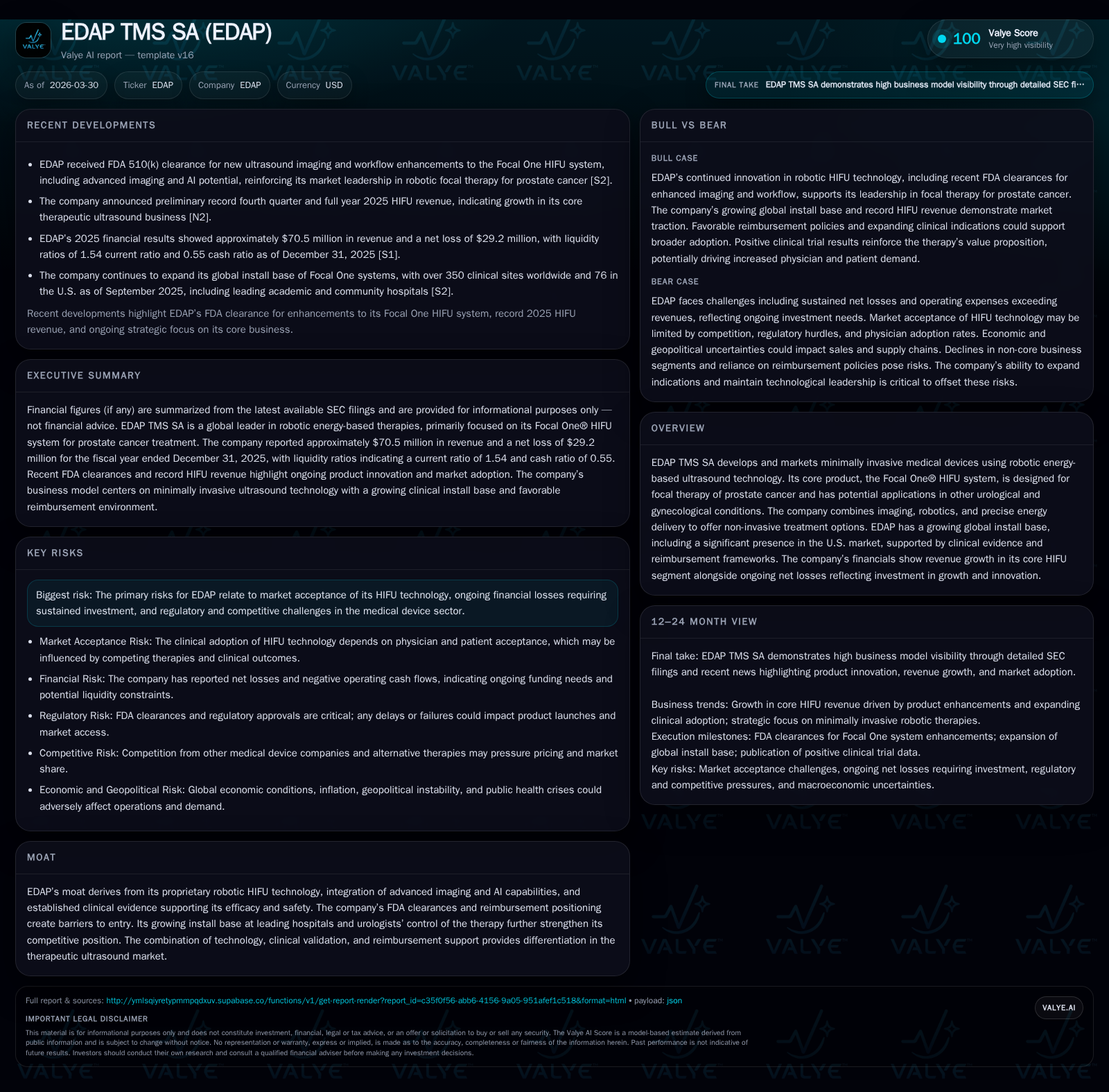
EDAP TMS SA demonstrated notable revenue growth in FY2025, driven by its core High Intensity Focused Ultrasound (HIFU) business and expanding adoption of the Focal One system, particularly in the U.S. market. The FDA's recent 510(k) clearance enhances the system with advanced imaging and workflow improvements, reinforcing EDAP’s competitive position. Despite topline growth and gross margin expansion, the company operated at a loss amid sustained R&D and SG&A investments. Cash reserves support ongoing innovation but reflect constrained free cash flow. Future growth hinges on clinical trial progress, expanded indications, and reimbursement dynamics.
EDAP's Revenue Growth Fueled by Expanding HIFU Adoption
Historical performance (annual)
| FY | Capex ($) |
|---|---|
| 2025 | |
| 2014 | 140000 |
| 2013 | 232000 |
| 2012 | 272000 |
Source: SEC companyfacts cache [F1].
EDAP TMS SA’s FY2025 results show continuing growth driven primarily by its flagship Focal One High Intensity Focused Ultrasound (HIFU) platform. Total revenues were approximately $70.5 million as of December 31, 2025 [F1], maintaining stability despite declines in non-core businesses such as ESWL and distribution.
The core HIFU segment recorded $23.9 million in revenues for the nine months ended September 30, 2025 — a substantial 42% increase from $16.3 million during the same period in 2024 [S14]. This momentum is underpinned by a rapid expansion of the installed base in the U.S., with a compound annual growth rate (CAGR) of 67% for system installations between 2021-2024 [S8]. Procedure volumes also grew significantly, signaling increased acceptance of focal therapy as an effective treatment option for localized prostate cancer.
This strategic shift towards higher-margin HIFU sales has contributed to improved profitability metrics despite ongoing operating losses.
Technological Leadership and Clinical Validation
EDAP’s Focal One system integrates real-time ultrasound imaging with robotic precision energy delivery to enhance surgical accuracy [N1][S8]. The platform’s next-generation ultrasound engine supports real-time visualization of tissue ablation zones during procedures, facilitating targeted interventions with improved safety profiles.
Recent advancements include AI-driven algorithm development aimed at assisting surgeons with tissue characterization and treatment assessment [S2]. Completed randomized controlled trials have demonstrated favorable oncological outcomes compared to traditional treatments [S8], further supported by high rates of continence preservation (96%) and erectile function maintenance (82%), reinforcing clinical confidence in focal therapy [S26].
Regulatory Milestone: FDA Clearance Enhances Market Position
In November 2025, EDAP received FDA 510(k) clearance for enhancements to the Focal One i system that include advanced ultrasound imaging capabilities and optimized user interfaces designed to streamline treatment planning [N1][S2].
These improvements are expected to increase procedural efficiency—a key factor driving hospital adoption—and bolster reimbursement pathways within major markets benefiting from established Medicare APC Level 6 status [S26]. This clearance strengthens EDAP’s competitive moat by raising barriers to entry and enabling future AI-enabled surgical applications.
Profitability Profile: Stable Expenses Amid Revenue Growth
For the nine months ended September 30, 2025, gross profit reached $20.7 million with a margin of approximately 42.5%, up from about 40% the previous year due largely to favorable product mix shifts favoring high-margin HIFU devices [S10][S14]. Operating expenses remained stable at around $39.4 million despite revenue increases, reflecting ongoing investments in R&D and commercial infrastructure.
Operating loss was approximately $18.7 million over this period with net losses near $19.8 million [F1][S14]. These figures indicate persistent negative earnings driven by sustained SG&A spending alongside material R&D outlays estimated near $7.6 million year-to-date [S6][S14]. However, operating losses showed slight improvement compared to prior periods.
Capital Allocation: Cash Position and Financial Metrics
At fiscal year-end December 31, 2025, EDAP held cash and equivalents totaling about $20.5 million [F1], adequate for near-term operations but highlighting pressures on free cash flow given ongoing negative operating cash flows less capital expenditures estimated around -$16.5 million historically [F1][S24].
Shareholders’ equity declined year-over-year due to accumulated losses, resulting in an approximate return on equity (ROE) near -151% based on net income relative to equity at year-end [F1]. This reflects a capital-intensive profile focused on advancing clinical development rather than current profitability.
The company secured a €36 million credit facility from the European Investment Bank to support expansion of its Focal One platform across new clinical indications such as benign prostatic hyperplasia (BPH) and endometriosis while accelerating sales penetration within prostate cancer markets [S17]. Capital deployment prioritizes R&D initiatives critical for sustaining technological differentiation.
Outlook: Clinical Trials and Reimbursement as Growth Drivers
Key upcoming milestones involve clinical trial follow-ups assessing new indications like endometriosis following CE mark approvals earlier this year [S8]. Completion of patient follow-ups in randomized controlled trials will further strengthen clinical evidence supporting broader adoption.
Reimbursement developments remain pivotal; maintaining favorable Medicare APC coding alongside expanded private payer coverage will facilitate volume growth particularly within U.S. tertiary hospitals known for high procedure throughput [S26][S8]. Procedural volume trends and installed base growth will serve as important indicators of market penetration velocity.
Risks: Regulatory Challenges and Financial Sustainability
Challenges include regulatory uncertainties around new market approvals beyond current geographies as well as navigating device clearances required for additional indications [S4][S9][S21]. Continued net losses necessitate careful capital management through debt or equity financing that could affect leverage or shareholder dilution [F1][S20].
Competitive pressures stem from alternative therapies including other focal energy modalities or ablation techniques that could compress EDAP’s market runway absent continued innovation [S11][S29]. Commercial uptake risks related to physician adoption or patient awareness require sustained educational efforts backed by robust health economic data.
This analysis is based exclusively on publicly available information including SEC filings and regulatory announcements without providing investment advice.
Disclaimer: This is research-only, informational analysis and not investment advice. It may include AI-generated interpretation and general industry context. Always verify important details using primary sources.

Comments