
HCM IV Acquisition Corp.'s Quest for Growth Without a Target
As a recently public Cayman Islands SPAC, HCM IV Acquisition Corp. relies on management acumen and capital structure to underpin its future business combination prospects.
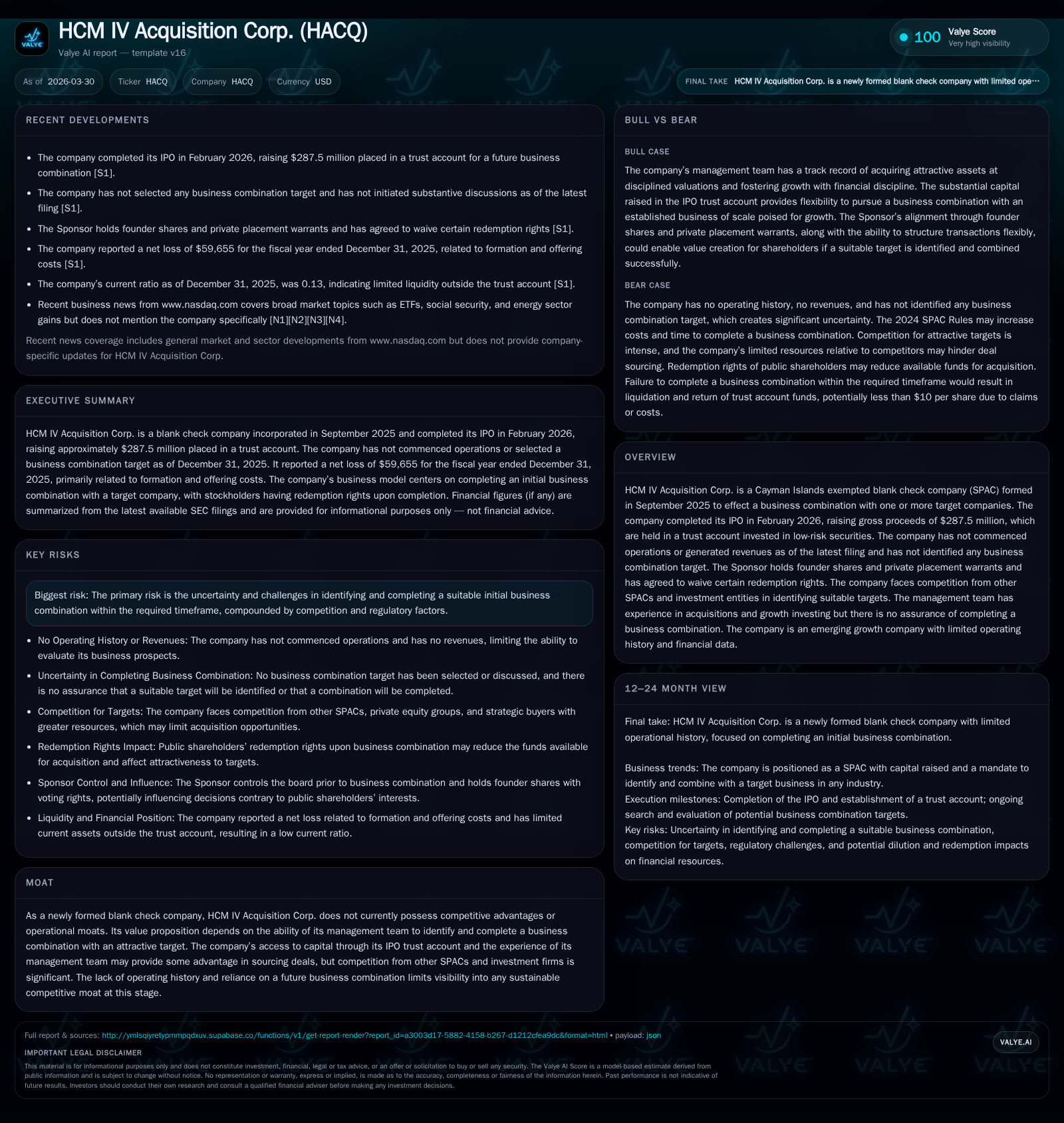
HCM IV Acquisition Corp. launched in late 2025 as a Cayman Islands exempted SPAC and completed a sizable IPO in early 2026, raising $287.5 million held in trust. With no operating history or identified target, the company depends heavily on its seasoned management team’s deal sourcing ability amid intense SPAC competition and evolving regulatory constraints. The capital structure features founder shares with redemption waivers, private placement warrants, and centralized sponsor control. Key risks stem from redemption dynamics and the finite timeframe to consummate an initial business combination. Monitoring target disclosures and shareholder vote outcomes will be critical for gauging progress.
From Formation to IPO: Foundations of the Capital Structure
HCM IV Acquisition Corp., originally incorporated as Mercator I Acquisition Corp. in September 2025 as a Cayman Islands exempted company, rebranded shortly after to its current name. As a blank check company formed explicitly for completing one or more business combinations, HACQ raised gross proceeds of $287.5 million through its initial public offering (IPO) on February 13, 2026 [S1][S3][S4].
The Sponsor initiated the formation with a nominal capital contribution of $25,000 in exchange for approximately 8.43 million founder shares initially priced at roughly $0.003 per share. A subsequent share recapitalization increased the Sponsor's equity to about 8.63 million founder shares, including an issuance of Class B ordinary shares [S1][S4]. Up to 1.125 million founder shares were subject to forfeiture contingent on underwriter overallotment exercise—a condition fully met when the underwriters exercised their full option concurrent with IPO closing, thus eliminating forfeiture risk.
In parallel with the IPO units issuance—each unit comprising one Class A ordinary share and one-fourth warrant—the Sponsor purchased approximately 3.83 million private placement warrants at $1.50 each, alongside Cantor Fitzgerald & Co.’s acquisition of around 0.83 million warrants, aggregating to $7 million in private placement proceeds that augmented HACQ's capitalization [S4].
Founder shares confer significant governance privileges including board appointment control until consummation of a business combination; however, the Sponsor has contractually waived redemption rights for these shares upon closing such combination—a strategic signal intended to align Sponsor incentives with long-term value creation rather than immediate liquidity events [S6].
This capital and governance structure situates HACQ within classic SPAC frameworks but also potentially heightens sponsor influence particularly given concentrated founder share ownership (roughly equivalent to around 23% of post-IPO outstanding Class A shares by number), which may affect public shareholder dynamics during deal negotiations.
Financial Snapshot: Historical Metrics and Capital Position
By year-end December 31, 2025—the last full reporting period encompassing formation and pre-IPO phases—the company had not recognized any revenues nor engaged operational activity beyond administrative startup costs [F1][S16]. The net loss recorded was modest at about $59,655 USD attributed mainly to organizational expenses prior to IPO [F1].
Current assets stood at only $25 thousand juxtaposed against current liabilities exceeding $195 thousand, leading to a current ratio of just 0.13—indicative primarily of accrued payable balances related to formation activities [F1]. The extremely low level of tangible assets beyond cash equivalents earmarked in trust emphasizes limited liquidity outside guarded IPO proceeds.
The derived return on equity (ROE) metric reported at an outsized 172.1% illustrates statistical distortion given that net losses combined with minimal equity base distort conventional profitability measures; this figure has no operational implication presently but highlights necessity for caution interpreting standard financial ratios for nascent SPAC entities [F1].
Historical performance (annual)
| FY |
|---|
| 2025 |
Source: SEC companyfacts cache [F1].
Table: HCM IV Acquisition Corp. Key Financial Metrics Summary from fiscal year ending Dec-2025.
Management Expertise and Strategic Focus on Future Targets
HACQ's management team comprises executives with established credentials in acquisitions and growth investing across company evolution stages—ranging from startups to multi-billion-dollar enterprises [S1][S5]. Their investment philosophy favors engaging attractive targets demonstrating operational scale teamed with proven leadership—aiming for stability paired with growth potential.
While no specific sector mandates constrain HACQ’s targeting framework—consistent with SPAC norms—the emphasis lies on disciplined valuations and hands-on partnership ethos designed to unlock value through operational improvements post-merger [S1][S5]. This approach leverages domain expertise supplemented by an extensive network that frequently channels proprietary investment opportunities absent from broad market auctions [S10].
The flexibility inherent in pursuing businesses “at any stage” but favoring those poised for expansion likely reflects adaptive readiness amid competitive deal landscapes where timing orthodoxy faces headwinds due to compressed Completion Window durations [S1].
Navigating Regulatory Shifts and Market Competition
Recent regulatory amendments governing SPAC transactions introduce complicating factors into HACQ’s acquisition timetable and cost structure [S1]. The "2024 SPAC Rules" entail stringent tender offer requirements mandating extended disclosure periods around redemption rights that encumber transaction closure velocity.
These rules require public shareholders seeking redemption in conjunction with business combination votes either conduct tender offers or participate in proxy solicitations encompassing extensive documentation filings ahead of consummation—increasing administrative burdens relative to prior frameworks [S1][S12].
Furthermore, provisions restrict sponsor trading activities during tender offer windows preventing market purchases aimed at influencing voting outcomes until legal milestone expirations potentially reducing flexibility for maneuvers mitigating dilution via repurchases [S8][S13].
Alongside these regulatory pressures exists crowded competition for quality targets amid an ecosystem saturated by other active SPACs and private equity vehicles vying aggressively within finite pools of mid-cap or growth-stage companies amenable to merger transactions—a dynamic necessitating tactical nimbleness despite constrained information advantages [S10].
Capital Allocation Framework and Sponsor Roles
HACQ’s capital deployment governance adheres closely to typical SPAC norms but reveals notable sponsorship arrangements affecting control and risk allocation [S4][S6][S7][S8]. Sponsor waivers of redemption rights relating both to founder shares and any Public Shares they may acquire align incentives toward successful deal completion rather than opportunistic liquidation ahead of merger closures.
Simultaneously, Sponsor-appointed board director slate retains complete control over corporate decision-making prior to initial business combination approval—introducing concentrated influence capable of overriding dissenting public shareholder voting blocs especially given Sponsor commitments to vote favorably irrespective of public sentiment [S1][S11][S14].
Capital returned before combinations is restricted by locked-down trust accounts managed conservatively predominantly in short-duration U.S. government securities or money market funds ensuring principal preservation until either deal consummation or mandatory dissolution deadlines [S4][S16]. Neither dividends nor buybacks are authorized prior to consummation preserving pooled resources solely for acquisition financing.
Private placement warrants acquired by Sponsors and underwriters further enhance capitalization flexibility while embedding potential dilution mechanics once exercisable post-combination though warrant rights afford no current redemption instruments distinct from underlying shares [S4]. This layering exemplifies carefully balanced incentives fostering alignment yet signaling complex ownership stakes post-initial transaction.
Key Risks: Redemption Dynamics and Deal Completion Pressures
A salient risk vector facing HACQ involves shareholder redemption rights exercised when announced deals prompt public stockholders’ decisions whether to redeem holdings for cash withdrawn from trust accounts—actions which can deplete available merger financing beyond anticipated thresholds ultimately thwarting deals structured assuming lower redemption rates [S1].
Compounding this vulnerability is the Sponsor’s capacity via founder share voting dominance including any privately negotiated class acquisitions post-IPO to endorse combinations notwithstanding public opposition—a scenario possibly antagonistic toward minority investor interests yet consistent legally under Cayman jurisdiction articles governing quorum sufficiency ex officio voting blocks [S1][S14].
Additionally, completion must occur within predefined "Completion Window" parameters delineated in charter documents, bounded typically within two years from IPO close barring extensions requiring approvals [S1]. This temporal pressure grants prospective targets leverage negotiating terms knowing urgency constraints tighten as expiry nears thereby limiting exhaustive diligence or structuring sophistication.
Market uncertainties also introduce inherent risks where incomplete deals precipitate dissolutions returning cash close but potentially below invested values especially if claims drive down trust account totals exposing investors indirectly tied through indemnity arrangements involving Sponsors who lack explicit reserve funds beyond company stock holdings posing systemic uncertainty safeguards reliability of recapitalization remedies [S6][S26].
Outlook: What Investors Should Watch Next
Given HACQ’s nascent status without disclosed acquisition targets or firm milestones beyond IPO closing events, prospective observers should monitor key developments diligently including:
- Initial announcement(s) identifying target(s) along with disclosed transaction terms,
- Commencement of shareholder votes or tender offers detailing redemption procedures,
- Actual redemption volumes reported post-disclosure impacting aggregate deal financing,
- Any amendments to charter or governance documents potentially altering voting protocols or extension conditions,
- Progress updates on partnership integrations once combinations consummate,
- Regulatory filings indicating compliance status particularly surrounding transaction disclosures.
Such indicators will materially influence stakeholder value trajectories by elucidating HACQ’s capability to navigate competitive markets within prescribed regulatory guardrails while balancing sponsor-public interests pragmatically.
This analysis relies exclusively on direct information from HCM IV Acquisition Corp.’s SEC filings as of March 30, 2026 ([F1], [S1]–[S29]) supplemented by standard SPAC transaction protocol insights common in capital markets practice. It does not predict investment outcomes nor offer recommendations but seeks comprehensive understanding rooted strictly in verifiable disclosures without speculation beyond documented data points.
Disclaimer: This is research-only, informational analysis and not investment advice. It may include AI-generated interpretation and general industry context. Always verify important details using primary sources.

Comments