
Gulf Coast Ultra Deep Royalty Trust Faces Uncertain Horizons After Well Abandonment
GULTU’s passive royalty income hinges critically on third-party drilling outcomes amid no current production and constrained liquidity support.
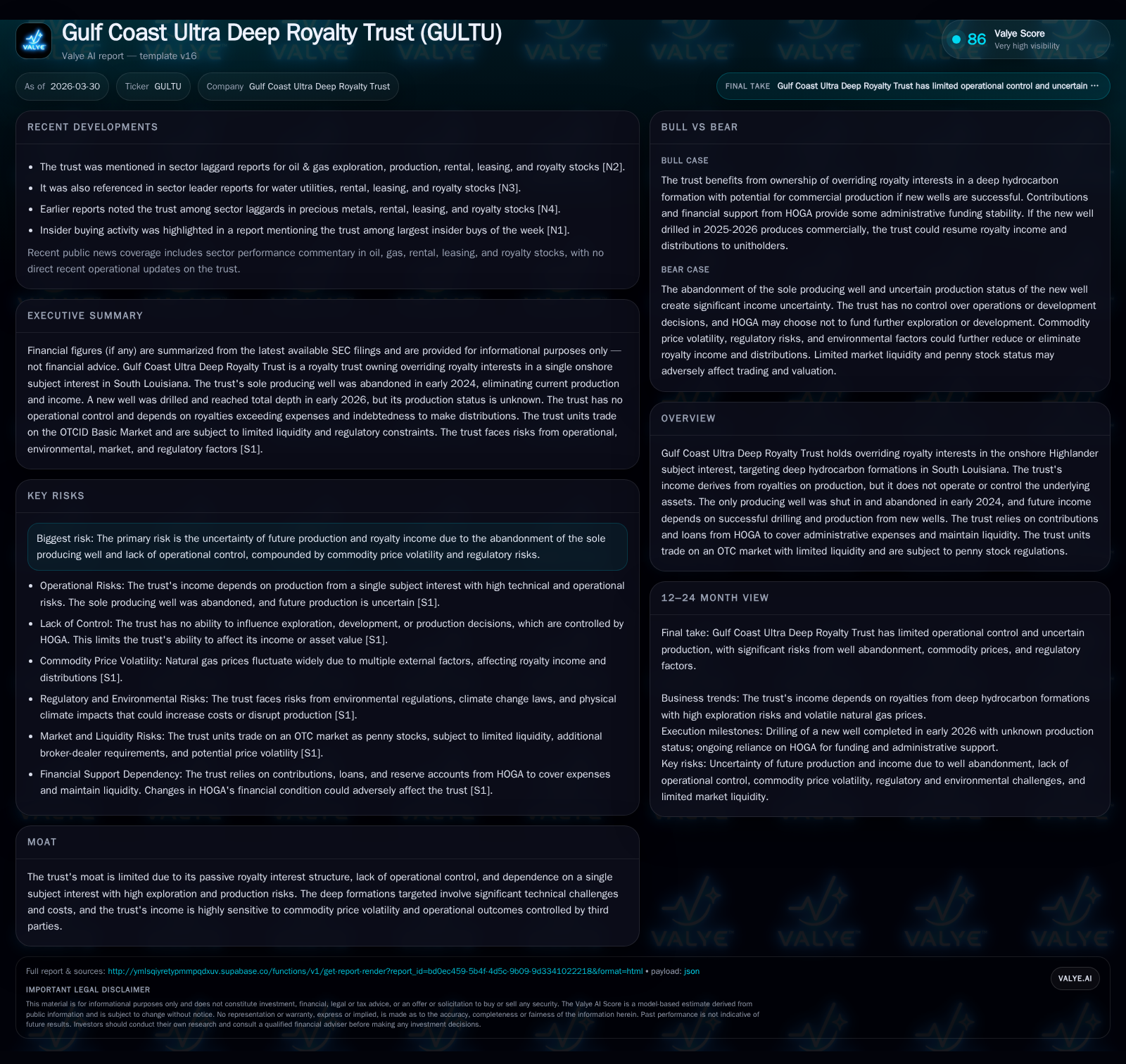
The Gulf Coast Ultra Deep Royalty Trust (GULTU) derives all its revenues from overriding royalty interests in the Highlander subject interest in South Louisiana. Its sole producing well was permanently shut in and abandoned during early 2024, removing any ongoing cash flow. Future distributions depend entirely on successful exploration and production by HOGA, which lacks any obligation to develop the reserves. Administrative costs are currently funded by capped contributions and unsecured loans from HOGA, emphasizing a precarious liquidity position amid zero operational control. The trust units trade OTC with limited liquidity and face regulatory hurdles typical for penny stocks, further complicating investor access and valuation. Investors must monitor new drilling results and commodity prices closely to gauge any recovery in income streams.
Overview of Gulf Coast Ultra Deep Royalty Trust’s Revenue Formation Model
Gulf Coast Ultra Deep Royalty Trust (GULTU) is structured as a passive entity holding overriding royalty interests—entitling it to a portion of proceeds from hydrocarbon sales but conferring no direct control or responsibility for operations. The entire trust income stems from these interests burdening the onshore Highlander subject interest located in South Louisiana, which targets ultra-deep hydrocarbon reservoirs within Inboard Lower Tertiary/Cretaceous formations known for high-pressure high-temperature (HPHT) conditions [S1]. The trust itself neither operates wells nor makes capital expenditure decisions; instead, it depends wholly on third-party operators—in this case, HOGA—to drill and produce hydrocarbons.
Royalty income is contingent on successful commercial production on these premises. Given the technical challenges of penetrating ultra-deep reservoirs — such as attaining total vertical depths exceeding 30,000 feet under extreme downhole stress — drilling success is far from guaranteed [S9].
Historical Performance: Impact of the Sole Producing Well Shutdown
Until early 2023, GULTU's revenue hinged entirely on one producing well within the Highlander subject interest. On January 19, 2023, this well encountered a critical operational issue involving excessive water ingress that drastically reduced production quality and led to a shut-in by March 31, 2023 [S1][S13]. Intermittent flows ensued briefly thereafter, but attempts to remediate failed. By October 2023, the operator declared the well irreparable due to underground fluid intrusion necessitating permanent plugging and abandonment commencing March 2024.
This single-well dependency highlights the acute concentration risk inherent in GULTU’s business model. With that sole revenue contributor offline and formally abandoned, the trust ceased receiving any royalty proceeds related to production post-first quarter 2023 [S1]. This cessation effectively terminated distributions to unitholders given that no alternate producing assets exist within its subject interests.
| Fiscal Year | Notes |
|---|---|
| 2022 | No detailed financials disclosed; revenue dependent on sole well production |
| 2023 | Sharp decline in revenue after Q1 due to well shutdown; ceased thereafter |
Specific numeric financial data not provided; narrative confirms revenue collapse post-well failure [S1]
Technical and Operational Hurdles in Ultra-Deep Hydrocarbon Exploration
Exploration within the Inboard Lower Tertiary/Cretaceous horizons involves substantial geological complexity characterized by elevated reservoir depths beyond conventional plays (~30,000 feet TVD reported for newest well), HPHT environments exceeding standard equipment ratings, and poorly established reservoir properties due to scant historical analogs [S9]. These factors multiply costs via specialized drill bits, corrosion-resistant tubulars, longer rig durations, and intricate completion techniques.
Completion risk is especially pronounced given weak diagnostic tools in these harsh downhole environments. Successfully achieving sustained commercial flow-back is nontrivial.
Such parameters heighten financial exposure while dampening predictability for consistent royalty streams underpinning GULTU's returns.
Liquidity Support and Capital Structure Dependence on HOGA
Post-production cessation, GULTU's operational financing relies entirely on administrative expense coverage primarily sourced from HOGA-related entities. Under terms fixed in its agreement, annual administrative costs up to $350,000 are funded by non-repayable contributions from HOGA [S4]. During 2025, two contributions totaling this cap were made ($200,750 then $149,250). Beyond these caps, HOGA provides unsecured interest-free loans — cumulative outstanding stood at approximately $416,489 as of December 31, 2025 [S4].
These loans must be repaid before any distributions can flow to unitholders; thus all capital allocation presently prioritizes essential administration rather than cash returns.
Absent active production generating royalties sufficient even to cover basic expenses plus minimum cash reserves (~$302,500), liquidity remains fragile.
Market Dynamics and Penny Stock Implications for Unit Trading
The royalty trust units trade on an OTC market platform subject to penny stock rules pursuant to SEC Regulation Rule 15g-9 due to their low trading price below $5 per unit [S5][S10]. These rules impose broker-dealer obligations including comprehensive risk disclosures and approval procedures prior to facilitating transactions involving these securities.
Consequently, limited broker participation restricts liquidity severely while increasing transaction friction for retail investors seeking entry or exit. Concentrated holdings by entities such as HOGA or FCX could materially affect market pricing through their trading activities [S18].
This illiquid environment with limited institutional coverage typical of microcap penny stocks focused on energy royalties under exploration risk umbrellas results in inherently volatile valuations.
Outlook: New Drilling Activity Offers Conditional Recovery Potential
Following the abandonment of the original producing well:
- A new well was spudded on January 30, 2025;
- Total depth of approximately 30,862 feet was reached by February 17, 2026;
- No public disclosure yet confirms commercial viability or timing of production commencement [S22].
Given GULTU’s lack of control over operations or development decisions by HOGA [S1], future distributions depend entirely on successful testing results and subsequent commercial production.
Investors should monitor operator announcements regarding initial production rates and ongoing well performance metrics closely.
Risks Amplified: Commodity Price Volatility and Regulatory Environment
Natural gas prices fluctuated widely during calendar year 2025—from lows near $2.65/MMBtu up toward nearly $9.86/MMBtu before softening again near $2.99/MMBtu as of early March 2026—directly impacting royalty proceeds due to price-linked revenue calculation [S9].
In addition:
- Environmental regulations targeting methane emissions under EPA Clean Air Act authority introduce compliance costs potentially reducing operating margins [S7][S8];
- Legislative uncertainties regarding climate change disclosure rules may increase reporting burdens and operational costs.
These factors collectively influence operators’ incentive structures for costly ultra-deep drilling projects underpinning GULTU’s income potential.
Capital Returns Profile: No Current Distributions Amid Expense Funding Priority
Distributions were paid only when the sole producing well was active (up until early 2023). Post-abandonment there have been no distributions due to lack of incoming royalties [S1][S27]. Administrative costs are funded exclusively via:
- Annual non-repayable contributions capped at $350k,
- Unsecured interest-free loans totaling approximately $416k outstanding at end FY25, with a minimum cash reserve (~$302k) maintained before any distributions can be made.
Consequently, current capital allocation prioritizes expense coverage with no capacity for dividends or share buybacks until sustainable royalties resume.
This analysis presents factual information drawn solely from publicly available SEC filings without offering investment advice. The outlook is inherently uncertain given operational dependencies outside the trust's control.
Disclaimer: This is research-only, informational analysis and not investment advice. It may include AI-generated interpretation and general industry context. Always verify important details using primary sources.

Comments