
Equillium’s Clinical Progress and Capital Constraints Define Its Growth Challenge
Equillium, Inc. remains a clinical-stage biotech relying heavily on EQ504 and EQ302 development amid operating losses and funding needs.
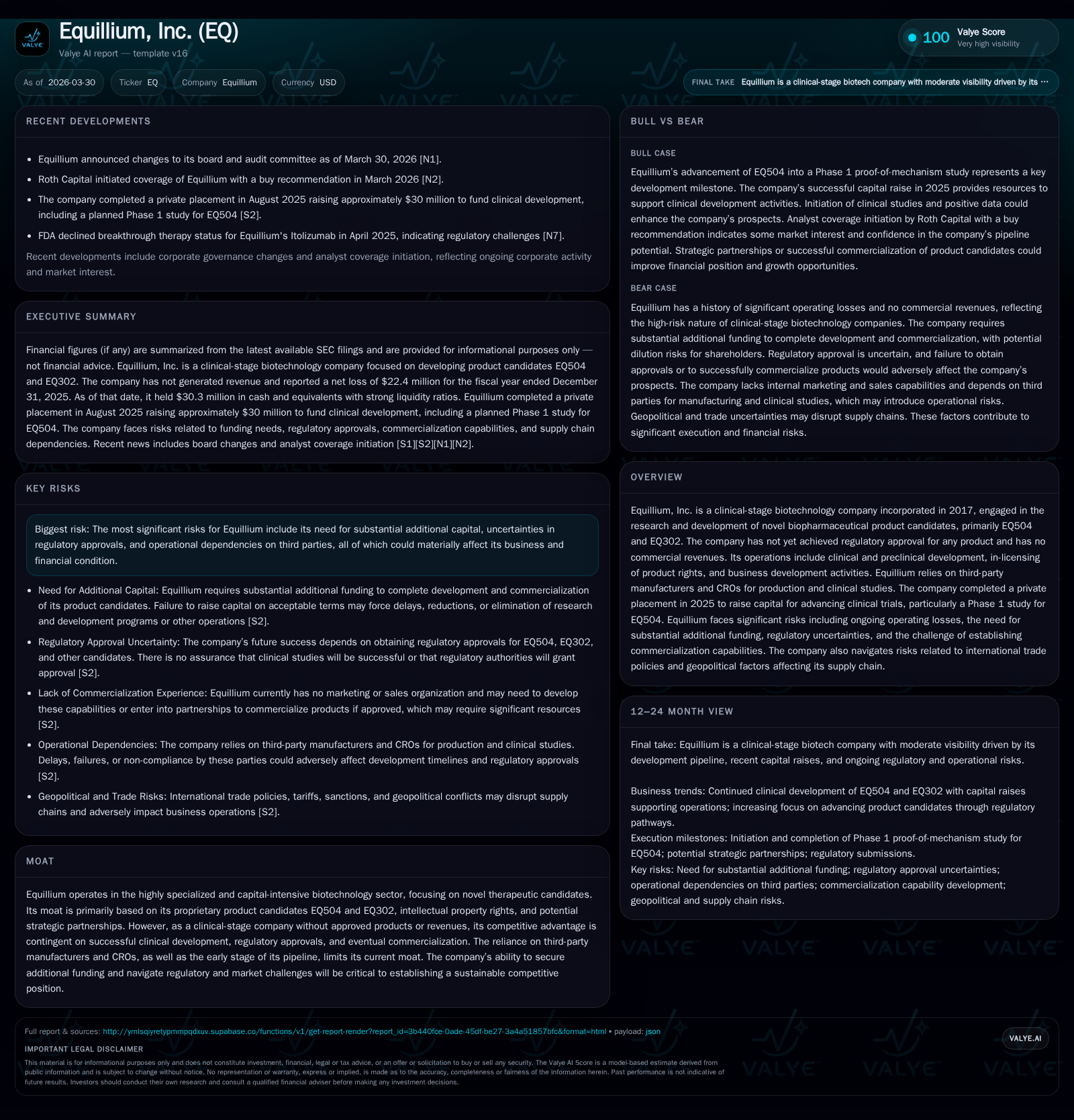
Equillium, Inc., founded in 2017, has yet to bring any products to market, focusing primarily on the clinical development of two novel candidates, EQ504 and EQ302. Despite sustained operating losses that deepened in 2025, the company successfully raised capital via a 2025 private placement to propel its pivotal Phase 1 trial for EQ504. The company’s near-term growth hinges on clinical milestones and regulatory approvals, with significant risks tied to funding availability, regulatory hurdles, and operational dependencies on third-party contractors. Equillium’s capital position remains sufficient for now but limited operating cash flows and continued losses underscore ongoing financial constraints.
Company Overview
Established in 2017, Equillium, Inc. is a clinical-stage biotechnology firm dedicated to advancing innovative biopharmaceutical therapies. Its current pipeline centers on two main product candidates—EQ504 and EQ302—both at various stages of clinical and preclinical development [S1]. As of late March 2026 filings, the company has not yet obtained regulatory approval for any therapy nor generated commercial sales [S1].
Equillium’s strategic focus lies heavily in progressing EQ504 through an initial Phase 1 clinical study funded by capital raised from a private placement completed in 2025 [N2][S1]. The company outsources manufacturing and clinical study operations extensively to third-party contract manufacturing organizations (CMOs) and contract research organizations (CROs), reflecting a common model among early-stage biotech firms lacking internal production infrastructure [S2][S23].
Historical Financial Performance
The company has historically operated at a loss as it invests in R&D necessary for clinical advancement. Net losses have fluctuated but showed an alarming uptick in magnitude during FY2025. Specifically, net income declined from -$8.07 million in FY2024 to -$22.40 million FY2025, reflecting nearly triple the prior year’s loss [F1]. Operating income similarly deteriorated sharply from -$8.27 million to -$23.63 million over the same period [F1].
Operating cash flow remained negative throughout this period, worsening somewhat from -$19.03 million (FY2024) to -$22.75 million (FY2025), signifying elevated expenditures associated with clinical trial progression [F1]. Capital expenditures stayed minimal relative to operating costs (about $48K in FY2025), underscoring the outsourcing model and absence of significant physical assets [F1].
Notably, the company’s balance sheet strength improved slightly thanks to capital injection via equity financing. Cash and equivalents stood at $30.28 million at the end of FY2025 against current liabilities of only $2.93 million yielding a high current ratio exceeding 10x—indicating ample short-term liquidity [F1]. Equity rose modestly from $19.06 million in FY2024 to roughly $28.60 million in FY2025 [F1].
Historical performance (annual)
| FY | Net ($mm) | CFO ($mm) | OpInc ($mm) | Capex ($) | Net YoY |
|---|---|---|---|---|---|
| 2025 | -22 | -23 | -24 | 48000 | -177.6% |
| 2024 | -8 | -19 | -8 | 85000 | +39.5% |
| 2023 | -13 | -22 | -15 | 50000 | +78.6% |
| 2022 | -62 | -9 | -62 | 279000 |
Source: SEC companyfacts cache [F1].
Capital returns and efficiency (annual)
| FY | Buybacks ($) | FCF ($mm) | ROE% |
|---|---|---|---|
| 2025 | -23 | -78.3 | |
| 2024 | 260000 | -19 | -42.3 |
| 2023 | 260000 | -22 | -59.1 |
| 2022 | -9 | -195.4 |
Source: SEC companyfacts cache [F1].
All figures USD; YoY net income decline shown where calculable from available data [F1]
Growth Drivers and Future Outlook
Equillium’s prospects hinge principally on the successful execution of clinical development phases for EQ504 and EQ302 and consequential regulatory approvals [N2][S1]. The announcement of Roth Capital initiating coverage with a positive outlook underscores commercial interest tied to near-term value inflection points around trial results [N2].
The company faces long lead times typical of biopharma development paths—with outcomes influenced by study enrollment rates, data maturity timing for interim readouts or topline results publications [S2]. Regulatory agencies’ decisions post-Phase 1 will determine feasibility of larger-scale efficacy trials.
Additionally critical is the securing of further funding beyond existing cash resources to finance extensive R&D activities projected over upcoming years [S2]. Failure to raise sufficient new capital may necessitate program delays or reductions.
External dependencies remain significant: reliable performance by CRO partners conducting studies and CMOs fulfilling manufacturing supply requirements are vital risk factors capable of delaying or halting progress [S23]. Intellectual property protection also remains an essential competitive moat but carries inherent legal uncertainties given frequent litigation among biotechnology entities surrounding patent validity or infringement [S6][S9][S29].
Milestones and Guidance
While explicit forward guidance is not outlined beyond the public disclosures describing active Phase 1 trials for EQ504 funded by recent capital raises [N2], industry-standard checkpoints include:
- Completion of Phase 1 study enrollment,
- Interim safety/tolerability data releases,
- Regulatory inputs on next phase trial design.
Investors should monitor announcements regarding study progress timelines or unexpected regulatory feedback challenges as these represent key catalysts.
Returns and Capital Allocation
Return metrics are currently deeply negative owing to substantial operational investment without revenue streams: approximated return on equity for FY2025 stands near -78% calculated from reported net loss relative to shareholder equity balances [F1]. This reflects the high-risk profile inherent in early-stage biotech ventures prioritizing pipeline advancement over profitability.
Cash flow analysis shows persistent negative operating cash flows outpacing minimal capital expenditures leading to annual free cash flow deficits around $22.79 million in FY2025 [F1]. No dividends were declared consistent with focus on reinvestment into drug development programs.
Buyback activity ceased after minor repurchases totaling $260K reported in previous years through FY2024; this likely reflects prudent capital conservation amidst heightened financing needs [F1]. Future allocation priorities will almost certainly emphasize funding clinical operations until product approval generates sustainable revenues.
Industry Context (Analysis)
The biotechnology sector demands rigorous commitment of resources toward lengthy R&D cycles where few candidates reach market authorization. Equillium fits within small-cap biotech firms whose primary value derives from intellectual property portfolios covering promising candidates like EQ504/302 currently under study. Success or failure hinges largely on navigating complex regulatory environments (FDA/EMA approval pathways), securing adequate recurring capital infusions during development lulls between milestones, managing multi-vendor partnerships effectively for manufacturing and trials operations while mitigating patent infringement risks that can complicate commercialization plans.
Such companies typically face prolonged periods of negative earnings before crossing crucial approval thresholds enabling product launches that can pivot financial trajectories positively.
Risks Summary (Reconciled)
Significant risks outlined comprehensively within SEC filings emphasize:
- Ongoing funding requirements with uncertain access impacting continuity of development activities if capital markets become constrained or valuations erode [S2][S4][S11].
- Regulatory uncertainties including potential delays or non-approvals impacting time-to-market estimates profoundly affecting valuation assumptions [S27][S28].
- Operational dependencies on third-party CROs/CMOs introducing execution risks related to trial conduct/compliance/manufacturing scale-up challenges possibly delaying milestones substantially or increasing costs unexpectedly [S23].
- Intellectual property suits risk costly litigation diverting management attention while possibly curtailing exclusivity advantages critical to competitive positioning [S29].
- No historic revenue stream accentuates financial vulnerability should trial efforts falter;
- Non-compliance or perceived lapses related to rapidly evolving data privacy/security obligations may invite governmental sanctions or reputational harms damaging investor confidence [S10][S20][S26].
Closing Remarks
Equillium encapsulates the quintessential developmental-stage biotechnology enterprise balancing promising proprietary immunoregulatory candidates against considerable execution risks intrinsic to high-cost drug discovery platforms. Its recent capital raise provided vital runway but sustained losses heighten urgency around achieving accelerating clinical evidence demonstrating safety/efficacy.
Market participants should watch for updates stemming from ongoing Phase 1 trial progress alongside broader healthcare policy shifts impacting drug pricing/reimbursement environments influencing ultimate commercial viability post-approval.
This report is prepared solely for informational purposes regarding Equillium Inc.'s business fundamentals and industry context as sourced from publicly available filings and news as of March 30th, 2026 without offering investment opinions.
Disclaimer: This is research-only, informational analysis and not investment advice. It may include AI-generated interpretation and general industry context. Always verify important details using primary sources.

Comments