
REED'S, INC. Confronts Profitability Challenges and Debt Refinancing Risks Despite Portfolio Expansion
Natural and functional beverage maker REED'S faces operational losses and refinancing hurdles amid competitive pressures and growth ambitions.
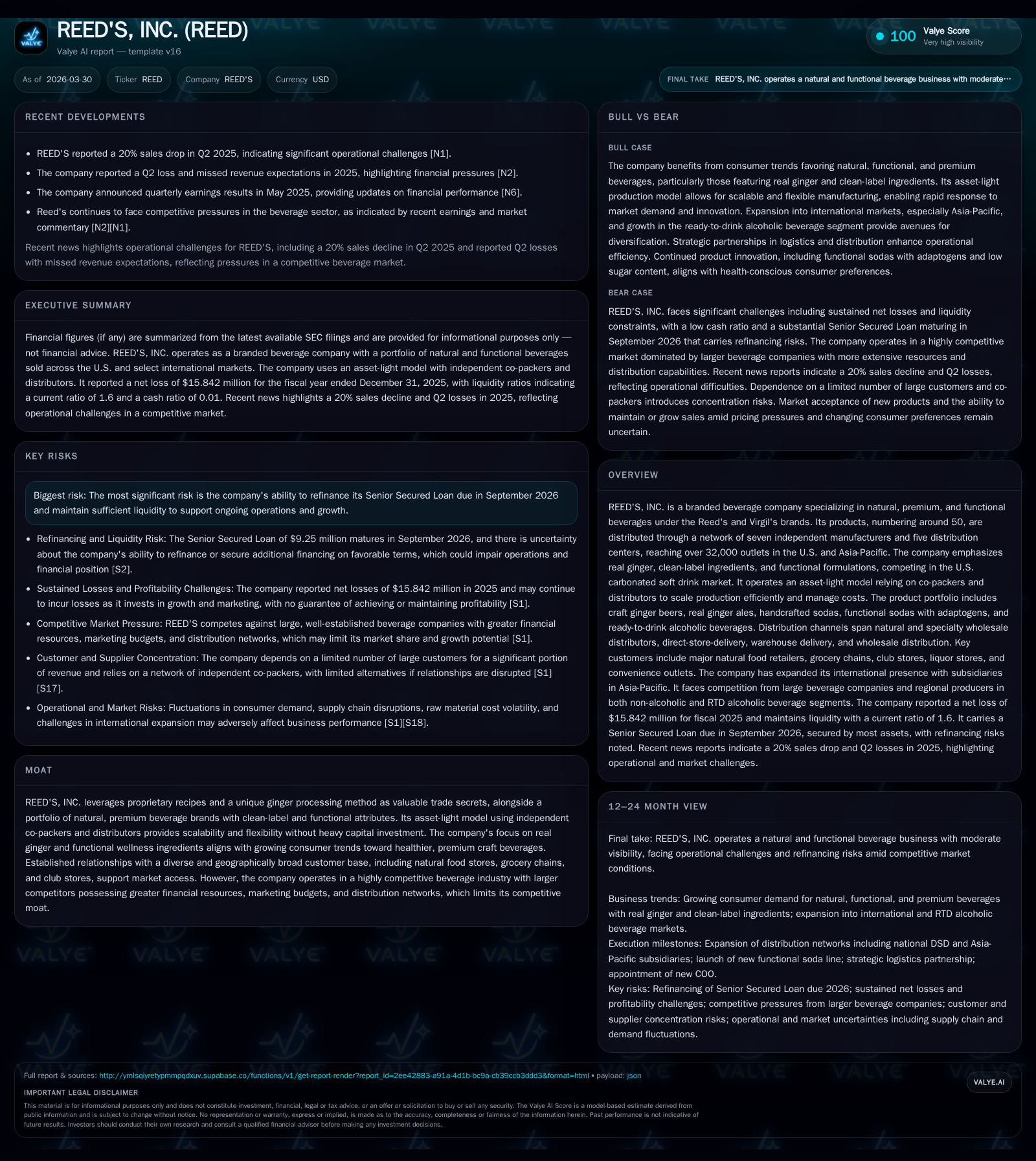
REED'S, INC. specializes in natural and functional premium beverages with a focus on real ginger ingredients, serving over 32,000 outlets across the U.S. and Asia-Pacific through an asset-light model. The company has experienced consistent net losses in recent years, with operating income deteriorating to a negative $15.1 million in 2025 [F1]. Despite growth efforts including geographic expansion and an expanded product line, profitability remains elusive. A major near-term risk is refinancing the $9.25 million Senior Secured Loan maturing in September 2026 under tight liquidity conditions [S6][S14]. REED’S strategic priorities emphasize expanding distribution channels, driving innovation in modern soda, and reducing costs through packaging shifts and freight consolidation, but its competitive environment features larger players with more resources [S15].
Company Overview
REED'S, INC. is a branded beverage company targeting the premium natural and functional carbonated soft drink segment under its Reed's and Virgil's brands [S1][S15]. It emphasizes clean-label ingredients and proprietary use of real ginger root processed via unique methods considered valuable trade secrets [S18]. The company maintains about 50 products encompassing craft ginger beers, real ginger ales (including zero sugar variants), functional modern sodas enriched with adaptogens launched recently in 2025, and ready-to-drink alcoholic beverages introduced starting in 2020 [S1][S15].
Business Model & Distribution
The core operational model is asset-light: production is outsourced through seven independent co-packers rather than owned facilities, while distribution is conducted via five independent centers complemented by direct-to-store delivery (DSD) networks across multiple retail channels [S1][S4][S5]. This facilitates scalability without significant capital expenditure.
Retail presence spans over 32,000 outlets covering natural food stores (Whole Foods Market, Sprouts), gourmet/specialty retailers (Trader Joe’s), grocery chains (Kroger banners), mass merchandisers including Costco club stores, convenience chains (Duane Reade), drug stores, liquor outlets (BevMo!, Total Wine), as well as on-premise bars and restaurants nationally [S9]. Recent strategic partnerships with national logistics providers aim to optimize freight and warehousing efficiency which management expects will reduce unit costs further over time [S4].
Internationally, REED’S pursues growth principally within Asia-Pacific markets where ginger-related products align culturally; it operates local legal entities in Hong Kong, Japan, China and Singapore using co-packing or concentrate models to keep freight costs manageable while scaling market penetration [S5].
Historical Financial Performance
The company has faced chronic unprofitability despite its niche positioning. Net losses expanded from approximately $13.2 million in FY2024 to $15.8 million in FY2025 while operating income declined sharply from -$8.1 million to -$15.1 million during the same period, representing an operating income deterioration exceeding 80% year-over-year [F1].
Revenue data is sparse beyond historical points showing a declining trend post-2015 when revenue stood near $45.9 million but had fallen to about $37.7 million by end-2017 [F1]. Management stresses fluctuations driven by consumer demand variability across channels.
Cash flows from operations were negative at about -$17 million in FY2025 compared to -$6.1 million prior year; limited capital spend (capex ~$272k) means free cash flow remains deeply negative (-$17.3 million), reflecting structural challenges converting sales into sustainable earnings or cash generation [F1].
The equity base improved slightly from negative territory ($-19.2M) into positive book equity around $9.15 million by end-2025 due to capital raises or accounting adjustments but ROE remains sharply negative at approximately -173% given persistent heavy losses relative to net assets [F1].
Historical performance (annual)
| FY | Net ($mm) | CFO ($mm) | OpInc ($mm) | Capex ($) | Net YoY |
|---|---|---|---|---|---|
| 2025 | -16 | -17 | -15 | 272000 | -20.5% |
| 2024 | -13 | -6 | -8 | 152000 | +15.3% |
| 2023 | -16 | -4 | -9 | 85000 | +22.6% |
| 2022 | -20 | -16 | -15 | 326000 |
Source: SEC companyfacts cache [F1].
Capital returns and efficiency (annual)
| FY | Buybacks ($) | FCF ($mm) | ROE% |
|---|---|---|---|
| 2025 | -17 | -173.1 | |
| 2024 | 1000 | -6 | -197.8 |
| 2023 | 1000 | -4 | 80.9 |
| 2022 | 2000 | -16 | 236.8 |
Source: SEC companyfacts cache [F1].
Growth Prospects & Strategic Initiatives
REED’S aims to grow by expanding its retail footprint across key U.S channels including mass merchants like Walmart and Costco clubs as well as convenience outlets where DSD proves essential for visibility and merchandising impact [S7][S9][S15]. Ongoing investment targets enlarging the internal sales force geographically as well as partnerships with brokers specialized in niche accounts.
International expansion into Asia-Pacific represents a long-term growth priority leveraging localized supply chains for cost containment [S5][S7]. The introduction of new healthy soda SKUs utilizing organic ingredients aligns with accelerating trends toward functional beverages that combine wellness benefits such as reduced sugar content alongside botanicals like adaptogens [S15].
Operational efficiencies are pursued via packaging migration from glass bottles toward aluminum cans—which reduces both freight expenses and breakage risks—and consolidation of freight logistics under a national provider contract implemented recently to address cost volatility experiencing supply chain disruptions through past years [S4][S25].
Competitive Environment & Risks
The carbonated soft drink market within which REED’S competes valued roughly at $46 billion grew moderately (~2%) while the niche ginger ale segment grew faster at ~6%, reflecting consumer trends favoring premium craft soda alternatives with cleaner labels and functional claims [S15]. However competition remains intense requiring significant marketing budgets that REED’S cannot match versus larger global beverage firms wielding economies of scale across advertising spend and distribution networks which put pricing pressures on smaller players like REED’S [S8][S21].
Significant customer concentration risks exist as the top three customers contributed around half of net sales recently; losing any could cause disproportionate revenue decline unless offset by new gains or broader customer diversification efforts underway but not yet materialized at scale [S16]. Supply chain challenges persist due to dependency on limited co-packers; disruptions delay shipments impacting order fulfillment capabilities along with heightened raw material inflation notably for core ingredients like organic ginger or packaging materials such as aluminum cans during volatile market conditions for commodities present risks to margin stability going forward [S25][S26].
Debt Profile & Liquidity Concerns
A prominent short-term financial constraint is the $9.25 million Senior Secured Loan due September 30, 2026 involving monthly interest payments at an annualized rate near 8%, secured by substantially all assets including intellectual property—the company holds zero capacity left on revolving credit lines indicating tight liquidity conditions coming into fiscal year-end [S6][S14]. Restrictions under loan covenants potentially limit strategic flexibility regarding mergers/acquisitions or dividends until refinance or repayment occurs which creates uncertainty around continued capital access particularly if operational losses persist or macroeconomic headwinds worsen availability remains limited potentially risking business continuity if refinancing terms cannot be obtained favorably or repayment fails without alternate sources secured promptly.
What To Watch / Analysis Outlook
Absent explicit guidance disclosed publicly for future periods within referenced documentation there is considerable uncertainty around timing for achieving profitability given steady losses compounded by working capital consumption evidenced by negative operational cash flows persisting into FY2025 [F1][S1]. Market acceptance of newer functional soda SKUs along with progress expanding DSD reach nationwide could be pivotal influencers driving sales trajectory.
Monitoring developments surrounding loan refinancing ahead of September 2026 maturity will be critical given its immediate impact on financial flexibility; failure here may restrict funding for vital growth investments or day-to-day operations potentially necessitating restructuring discussions or asset sales though none currently disclosed would suggest imminent distress yet this remains pivotal risk per disclosed risk sections highlighting concentration among largest customers coupled with competitive intensity from better-capitalized rivals constraining price-setting ability even amidst growing consumer preference for healthier soda alternatives[S11] [S22] .
Margins may improve gradually if freight consolidation benefits materialize fully alongside packaging innovations lowering per-unit costs but volume retention amid efforts raising average sale prices may moderate gains if sensitive consumer elasticity surfaces negatively impacting wholesale orders from tightly margin-focused large retail accounts[S24] . International expansion success depends heavily on execution given challenges establishing brand presence far from home base requiring ongoing capital allocation despite current net loss posture.
Capital Allocation Review
The company's capital expenditures remain minimal relative to operational scale approximating just $272k in FY2025 focusing largely on transitional investments like packaging changes rather than capacity expansion indicative of the asset-light model relying on third-party co-packers extensively[F1] . Share repurchases are negligible historically reflecting conservative shareholder return policies appropriate under current financial constraints[F1] . With negative free cash flow near -$17 million coupled with constrained liquidity headroom due primarily to debt servicing obligations refinancing becomes central priority likely superseding dividend consideration until stable profitability returns[S6],[F1] . Equity position moved positive after extended deficit years but return on equity depicts elevated losses underscoring performance challenges[F1] .
Conclusion
REED’S stands as a niche premium beverage player strategically aligned with evolving consumer preferences towards natural ingredients and functional wellness benefits centered on ginger formulations combined with emerging functional soda formats promising growth avenues domestically and abroad.[S1],[S15] However operational realities show persistent losses deepening alongside tightening liquidity signals intensifying refinancing risk related to near-term loan maturity which heavily influences future strategic flexibility.[F1], [S6],[S14]
While management's efforts towards broadening distribution especially DSD coverage nationwide together with supply chain optimizations provide visible levers aimed at cost reduction plus product innovation aimed at premiumization dovetail well with market trends,[S4],[S7], competitive headwinds impose undeniable pressure constraining margin recovery potential contributing towards sustained losses recorded deeper into FY2025.[F1],[S21]
Investor scrutiny should prioritize monitoring refinancing developments ahead of September 2026 maturity alongside tracking sales performance of new product launches and international market traction particularly Asia-Pacific outcomes due to cultural relevance of key ingredient ginger.[S5],[S16]
Overall REED'S navigates a complex intersection of promising market alignment challenged by structural financial deficits necessitating decisive capital strategy execution combined with operational discipline to transition towards profitability sustainably.
This report synthesizes reported SEC filings up to March 30, 2026 ([F1],[S1]-[S29]) without extending beyond publicly available facts; it does not constitute investment advice or a recommendation.
Disclaimer: This is research-only, informational analysis and not investment advice. It may include AI-generated interpretation and general industry context. Always verify important details using primary sources.

Comments