
Pioneer Acquisition I Corp's Strategic Play for Healthcare Merger Success
A special purpose acquisition company harnessing a seasoned healthcare-focused management team and robust capital base to pursue transformative business combinations.
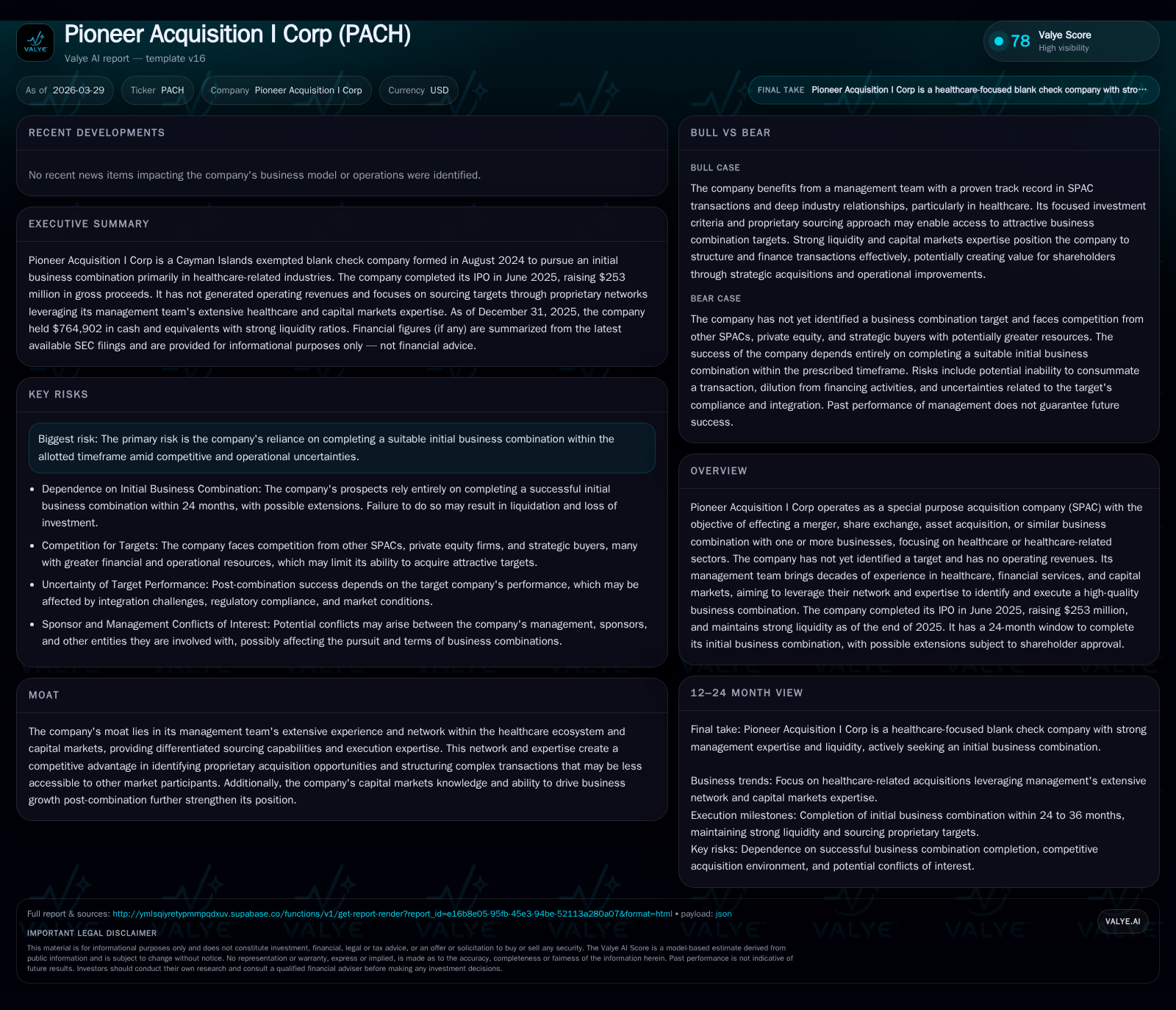
Pioneer Acquisition I Corp (PACH), a healthcare-focused SPAC launched in mid-2025, maintains strong liquidity and is actively searching for an initial business combination. The company’s management brings extensive cross-sector expertise, providing a competitive advantage in proprietary deal sourcing and transaction execution within the healthcare ecosystem. Operating within a 24-month window to consummate a merger or face liquidation, Pioneer’s capital allocation strategy emphasizes preserving trust account assets while preparing to deploy financing flexibly post-combination. Upcoming milestones include target announcement, shareholder voting, and redemption processes that will mark its transition from IPO vehicle to operating public entity.
Early Performance and IPO Proceeds Deployment
Pioneer Acquisition I Corp operates as a blank check company focused on healthcare-related industries. The company completed its initial public offering in June 2025, raising approximately $253 million intended for future business combinations [S1]. For the fiscal year ended December 31, 2025, Pioneer reported no operating revenues—as expected given its SPAC status—and recorded an operating loss of roughly $560,000 primarily due to administrative expenses during its search phase [F1]. Net income of about $4.78 million is attributable mainly to earnings on financial instruments held in the trust account rather than operational activities.
The balance sheet reflects substantial liquidity: cash and equivalents stand at approximately $765,000 with current assets totaling around $850,000 against current liabilities near $186,000. This yields a current ratio of about 4.57, underscoring prudent capital preservation during this early stage [F1]. Such liquidity is essential as Pioneer pursues its acquisition target amid the time constraints imposed by its corporate charter.
Historical performance (annual)
| FY |
|---|
| 2025 |
Source: SEC companyfacts cache [F1].
Management Team’s Competitive Edge in Sourcing Healthcare Targets
Pioneer’s management team offers a significant competitive advantage through decades of cumulative experience spanning life sciences, medical devices, diagnostics, population health management, digital health technologies, behavioral health services, and leadership roles at publicly traded companies [S1][S7][S15]. This depth enables access to proprietary deal flow often unavailable through broadly marketed processes and allows structuring complex transactions tailored to unique financing needs.
Their extensive network includes founders of private companies, venture capitalists, private equity funds, and industry executives—facilitating identification of targets positioned for scalable growth post-combination [S15]. Additionally, their capital markets expertise aids potential targets in leveraging public listing benefits while optimizing capital structures—an increasingly important factor for growth-stage healthcare businesses.
This sourcing advantage is critical given intense competition within the SPAC space targeting similar healthcare verticals [S16], positioning Pioneer as a preferred partner capable of delivering both capital and strategic value.
Navigating the Search: Timeline and Strategic Constraints
Pioneer must complete an initial business combination within 24 months from its IPO closing date—by June 2027—although shareholder-approved extensions may be pursued [S1][S3][S4]. Failure to close within this timeframe triggers dissolution protocols including returning invested capital from the trust account less expenses.
The process incorporates mandatory redemption rights allowing public shareholders to redeem shares prior to closing if they disapprove of the proposed transaction or seek liquidity [S3][S6]. Nasdaq listing rules require shareholder votes when transactions exceed thresholds such as issuing more than 20% new shares or effecting change-of-control transactions needing ordinary resolutions passed by simple majority with quorum requirements [S3][S4].
These factors create tension between pursuing highly attractive but potentially time-consuming deals versus quicker transactions that might compromise target quality. Management must balance valuation considerations, structural complexity, timing risks, and shareholder interests carefully.
Capital Allocation Approach Before and After Business Combination
Until completing a business combination, Pioneer holds all IPO proceeds—including deferred underwriting commissions—in a trust account established under U.S. regulations designed to preserve investor capital at approximately $10 per share [S3][S8]. Funds are accessible only upon successful merger completion or liquidation following the search period.
Shareholders exercising redemption rights must deliver physical share certificates or transact electronically via The Depository Trust Company's DWAC system ahead of votes on proposed combinations to enable timely processing [S6]. Founders and insiders waive redemption rights on founder shares and any sponsor shares purchased publicly post-IPO—aligning incentives toward deal closure while preserving voting power [S9].
No dividends or share buybacks are planned during the search phase; capital allocation focuses on fund preservation with flexibility for deployment upon deal announcement [S3][S9]. Post-combination policies will depend on the operating cash flows and strategic needs of the combined entity.
Financial Snapshot: Liquidity, Capital Structure, and Returns Indicators
As of December 31, 2025, Pioneer holds nearly $0.76 million in cash equivalents against current liabilities around $186 thousand indicating conservative leverage and essentially no debt obligations typical for SPACs at this stage [F1][S5][S11][S16]. Operating cash flow remains negligible due to lack of operations but liquidity ensures readiness for transactional activities or unforeseen expenses during the ongoing search.
Return metrics like ROE show negative results (approximately -42%) reflecting no-revenue status rather than operational inefficiency—consistent with industry norms where meaningful returns emerge post-business combination [F1].
What Investors Should Watch: Key Milestones and Potential Catalysts
Investors should monitor:
- Announcement of identified target(s) specializing in healthcare or related sectors.
- Filing of proxy materials detailing transaction terms enabling informed shareholder decisions.
- Shareholder voting outcomes authorizing or rejecting proposed combinations.
- Redemption activity levels signaling investor support or dissent.
Successful execution with attractive pricing aligned with growth prospects could mark an inflection point transforming Pioneer into an operating entity with clearer earnings visibility. Conversely, delays or failure increase risk premiums capped by deadlines embedded in corporate charter provisions.
Risks Surrounding Initial Combination and Market Environment
Key risks include uncertainty in completing transactions meeting strategic criteria within timeline constraints amid crowded SPAC competition targeting healthcare verticals [S1][S2][S16]. Failure results in liquidation returning only trust funds less costs with sponsor interests expiring worthless except residual upside from founder shares if applicable.
Additional risks involve adverse vote outcomes due to misaligned expectations or skepticism over deal terms [S23], macroeconomic volatility impacting healthcare valuations affecting negotiating leverage, and potential conflicts if management incentives encourage closing deals regardless of long-term dilution effects [S11]. Regulatory risks appear limited based on disclosures and absence of material litigation.
Despite risks, Pioneer’s experienced leadership is positioned to navigate complex healthcare M&A landscapes while balancing timing imperatives.
This analysis synthesizes Pioneer Acquisition I Corp's position based on official filings and data points without speculative projections. It clarifies foundational elements relevant for stakeholders tracking this SPAC’s evolution toward transformative healthcare merger activity.
Disclaimer: This document is for informational purposes only and does not constitute investment advice or recommendations regarding any securities discussed herein.
Disclaimer: This is research-only, informational analysis and not investment advice. It may include AI-generated interpretation and general industry context. Always verify important details using primary sources.

Comments