
Kraig Biocraft Laboratories Advances Spider Silk Production Amid Financial Headwinds
Kraig Biocraft Laboratories pushes the frontier of biotech materials with genetically engineered spider silk amid persistent financial challenges and liquidity constraints.
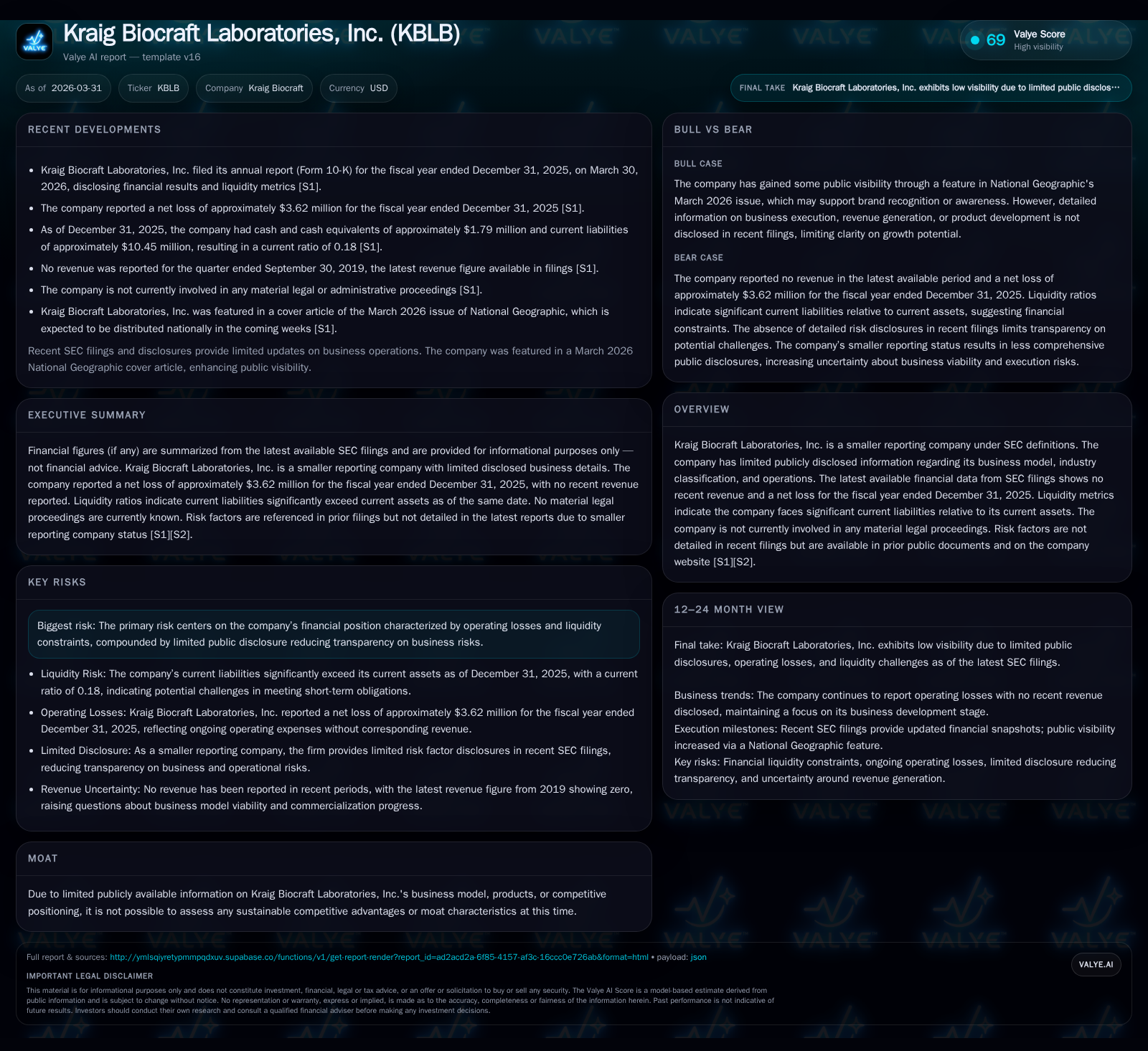
Kraig Biocraft Laboratories, a pioneer in producing recombinant spider silk through specially engineered silkworms, is achieving notable production milestones including deploying over 700,000 BAM-1 Alpha hybrids. Despite technological strides recognized by features like National Geographic’s cover story, the company continues to grapple with significant losses and a strained balance sheet, reflected in a current ratio of just 0.18 as of fiscal year-end 2025. Growth ambitions hinge on expanding R&D efforts linked to projects such as Project Atlas and increasing production scale, while near-term sustainability depends on navigating capital and liquidity pressures.
Financial Trajectory and Operating Performance: Losses during R&D Investment
Kraig Biocraft Laboratories has exhibited a pattern of increasing operating losses over recent years consistent with its focus on developing recombinant spider silk technologies without corresponding revenue growth since fiscal 2018 [F1]. Operating income declined from approximately -$2.1 million in 2022 to -$3.4 million by the end of 2025, representing a nearly 60% increase in losses over three years. Net income followed a similar trajectory, with a net loss of about -$3.6 million in fiscal 2025 [F1].
Operating cash flow has remained negative, around -$1.8 million annually between 2022 and 2025, reflecting ongoing cash burn inherent in Kraig's research-driven business model [F1]. Capital expenditures have been modest, ranging roughly from $4,200 to $6,400 annually during this period—consistent with a biotech firm emphasizing lab-scale development over heavy fixed asset investments [F1]. The last recorded revenue was approximately $0.4 million in fiscal 2018 [F1], confirming that Kraig remains in an extended pre-commercial phase.
Liquidity metrics reveal significant pressure: as of the end of fiscal 2025, current assets stood at about $1.87 million against current liabilities exceeding $10.4 million, yielding a very low current ratio near 0.18 [F1]. This disparity indicates substantial short-term funding constraints that could impact operational flexibility absent new financing sources [S10][S11]. The company has not paid dividends or conducted share buybacks during this period, focusing capital allocation primarily on R&D initiatives.
Historical performance (annual)
| FY | Net ($mm) | CFO ($) | OpInc ($mm) | Capex ($) | Net YoY |
|---|---|---|---|---|---|
| 2025 | -4 | -1788970 | -3 | 5395 | -6.6% |
| 2024 | -3 | -1839086 | -3 | 4240 | -12.2% |
| 2023 | -3 | -1244483 | -3 | 6399 | +21.1% |
| 2022 | -4 | -1887187 | -2 | 5021 |
Source: SEC companyfacts cache [F1].
Capital returns and efficiency (annual)
| FY | FCF ($) | ROE% |
|---|---|---|
| 2025 | -1794365 | 45.3 |
| 2024 | -1843326 | 41.7 |
| 2023 | -1250882 | 53.1 |
| 2022 | -1892208 | 109.1 |
Source: SEC companyfacts cache [F1].
Data sourced from Kraig Biocraft Laboratories’ SEC filings through FY2025 [F1].
Innovative Breakthroughs and Production Milestones in Recombinant Spider Silk
Central to Kraig's value proposition is its pioneering technology engineering transgenic silkworms to produce spider silk—a biomaterial noted for exceptional tensile strength and elasticity surpassing synthetic alternatives [S5]. In early 2026 alone, Kraig deployed over 700,000 BAM-1 Alpha transgenic silkworm hybrids as part of an aggressive scale-up strategy signaling transition toward commercial manufacturing [N3][N11].
These engineered silkworms utilize advanced biotechnological methods inserting synthetic spider silk genes into Bombyx mori species to produce fibers mimicking natural spider silk properties but at scalable volumes [N5][S5]. The resulting recombinant fibers have potential applications across industrial sectors requiring lightweight yet ultra-strong materials such as aerospace composites and defense textiles.
The March 2026 cover feature by National Geographic further validates Kraig’s scientific advances and enhances its industry profile amidst emerging market opportunities [N9][N8].
Strategic Outlook: Expanding R&D Capacity and Commercialization Ambitions
Kraig is currently focused on expanding its research infrastructure while advancing commercialization efforts through initiatives like Project Atlas—a program aimed at developing new spider silk transgenics for specialized industrial uses including defense materials [N4][N7][S5]. Early 2026 quarterly disclosures highlight incremental production waves designed to increase output and optimize fiber performance via refined genetic constructs [N11].
These growth initiatives face typical biotech sector challenges including limited product diversity and lengthy timelines required for regulatory approval and scaling living organism-based fiber manufacturing.
Capital Structure and Liquidity: Navigating a Challenging Balance Sheet
Kraig operates without dividend distributions or stock repurchases—a common stance for development-stage biotech firms prioritizing reinvestment into core technologies [F1][S10]. The stark imbalance between approximately $1.87 million in current assets versus more than $10 million in current liabilities underscores acute liquidity risks necessitating strategic financing or capital injections for operational continuity [F1][S11].
Operating cash flows remain substantially negative with free cash flow near negative $1.79 million as ongoing R&D spending outpaces minimal capital expenditure needs [F1]. The balance sheet reflects deeply negative equity close to -$8 million at year-end 2025—a consequence of cumulative net losses exceeding invested capital rather than asset growth [F1].
Key Developments to Monitor
While explicit management guidance is limited, attention should be given to successive production waves throughout fiscal 2026 which may indicate progress toward commercial viability [N11]. Additionally, monitoring patent filings related to novel recombinant sequences or applications may provide insight into competitive positioning amid the described 'biotech patent blitz' [N1]. Strategic partnerships or off-take agreements disclosed publicly would represent important validation points for market adoption.
Further reputational momentum is expected from media exposure beyond National Geographic’s feature that could broaden awareness of practical applications transitioning from research milestones toward revenue generation potential [N8][N9]. Updates on Project Atlas outcomes will also be critical to assess scalability beyond proof-of-concept stages.
Risk Considerations: Transparency and Market Adoption Challenges
As a smaller reporting company exempt from detailed risk factor disclosure requirements in recent SEC filings ([S1][S2][S4]), transparency regarding operational risks is limited aside from references to prior Form S-1 risk disclosures available online.
Risks include significant ongoing losses coupled with liquidity constraints detailed above. Moreover, acceptance hurdles remain for spider silk materials competing against established synthetic fiber markets where cost-performance tradeoffs and manufacturing scalability challenges persist.
Management reports no material litigation or regulatory proceedings at this time but continued vigilance is warranted given biotechnology sector complexities [S4].
Kraig Biocraft Laboratories illustrates a blend of ambitious scientific innovation with pronounced financial headwinds typical of early-stage disruptive biotech ventures focused on novel biomaterial platforms rather than immediate profitability. Its success will depend heavily on managing liquidity pressures while steadily advancing production scale and diversifying product offerings tailored for industrial end-markets.
This report is for informational purposes only and does not constitute investment advice or recommendations.
Disclaimer: This is research-only, informational analysis and not investment advice. It may include AI-generated interpretation and general industry context. Always verify important details using primary sources.

Comments