
Wright Investors Service Holdings: From Shell Status to Strategic Horizons
Wright Investors Service Holdings operates as a cash-rich shell company facing persistent losses while exploring strategic capital deployment options.
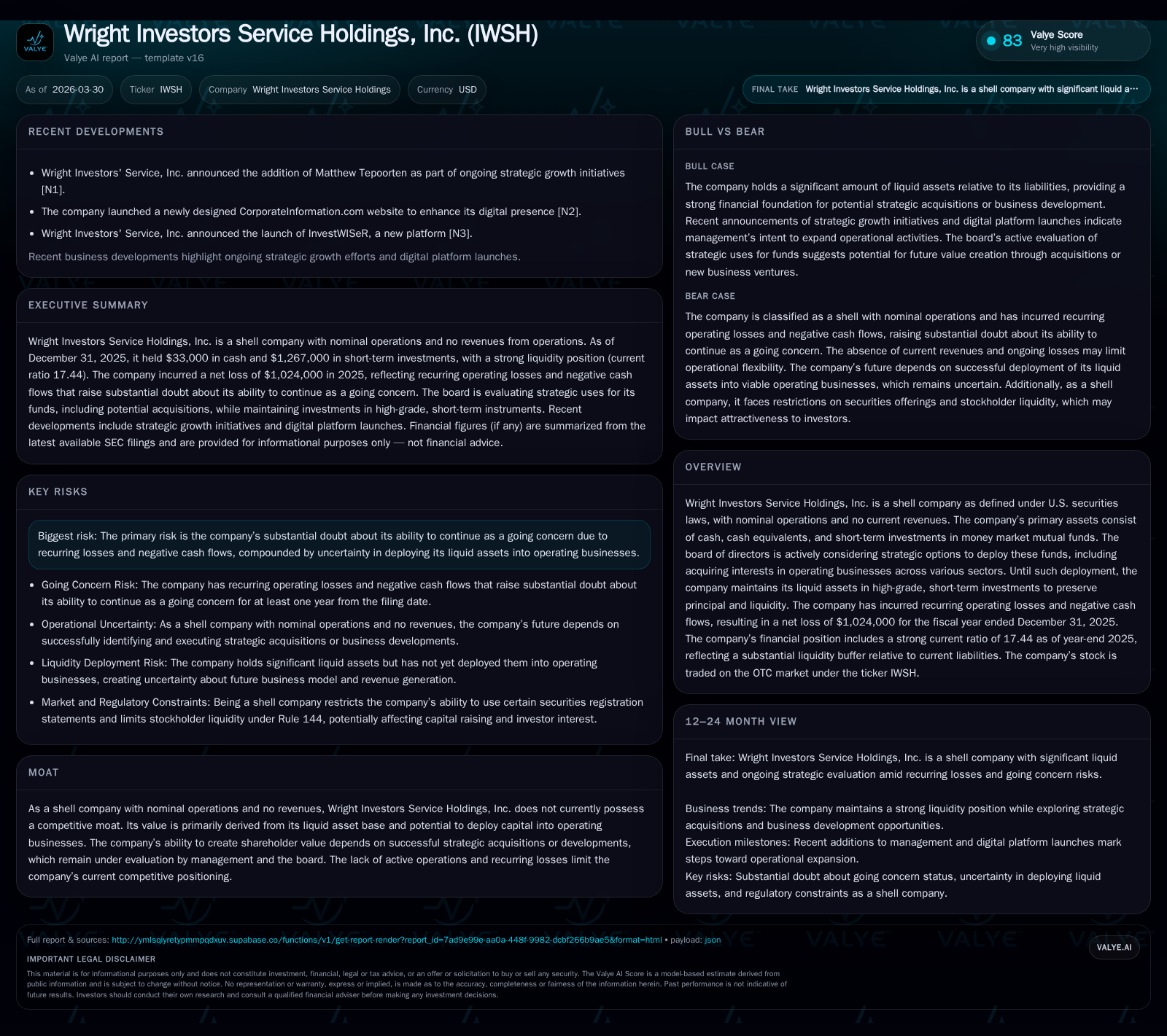
Wright Investors Service Holdings, Inc. is currently a shell company with nominal operations, holding primarily cash and money market mutual funds. The company has incurred recurring operating losses and negative cash flows, resulting in a net loss of $1.024 million in 2025, yet it maintains strong liquidity with a current ratio of 17.44. Management is actively considering strategic acquisitions or returning capital to shareholders, but substantial going concern doubts persist. Future growth hinges on successful deployment of capital into operating businesses or alternative value-enhancing initiatives.
From Operations to Shell Status: Tracing Wright Investors’ Historical Trajectory
Wright Investors Service Holdings, Inc.’s history depicts a clear operational transition from an active entity generating modest revenues to a recognized shell company by SEC standards. The most recent top-line revenue was recorded in fiscal year 2017 at approximately $5.41 million [F1]. Since then, the company has reported no revenues, underscoring an operational cessation that culminated in its classification as a shell company per Rule 12b-2 of the Exchange Act [S2]. This shift represents a fundamental contraction in business activity, whereby nominal operations remain confined to managing liquid assets rather than engaging in core business lines.
The transition has rendered the company's value principally driven by its asset base — cash equivalents and money market mutual funds — rather than operating performance.
Financial Performance and Structural Trends: Revenue, Losses, and Cash Flow Dynamics
Absent any recent revenue streams, Wright Investors' financials are dominated by persistent operating losses and negative cash flows. Annual net losses increased from $920,000 in 2024 to $1.024 million in 2025 (an increase of approximately 11.3% year-over-year) [F1]. Operating income similarly remains negative, declining slightly from -$1.079 million in 2024 to -$1.096 million in 2025.
Operating cash flow (CFO) deficits align with these trends, increasing from -$938,000 in 2024 to -$1.054 million in 2025, indicating continued expenditures without corresponding inflows sufficient to support ongoing operations [F1]. Capital expenditures have decreased significantly over time, consistent with the company's shift away from active investment toward liquidity preservation.
This structural trend highlights an increasingly cash-draining status quo absent revenue support, emphasizing the necessity for strategic capital redeployment.
Liquidity Fortitude Amidst Operating Challenges: Exploring Current Assets and Capital Structure
Wright Investors retains notable liquidity despite operating losses. At December 31, 2025, the company held $33,000 in cash and cash equivalents alongside approximately $1.267 million invested in money market mutual funds [F1], together comprising nearly all of its $1.378 million current assets [S9]. With current liabilities at approximately $79,000, this yields an exceptional current ratio of roughly 17.44 — signaling a robust short-term liquidity cushion capable of sustaining operating obligations temporarily.
Importantly, the balance sheet reflects an equity position of about $1.307 million that includes accumulated deficits exceeding $31 million as of December 31, 2025 [F1][S18]. The absence of debt further supports financial stability but also underscores the challenge of deploying capital profitably given sizeable accumulated losses.
These factors reveal a conservative financial posture focused on principal preservation within high-grade short-term securities pending decision on strategic deployment or shareholder distributions [S1][S19].
Evaluating the Board’s Strategic Options: Potential Acquisitions and Shareholder Returns
Management and the board are actively evaluating multiple pathways to enhance shareholder value via capital deployment strategies [S1][S5]. Explicitly considered alternatives include acquiring interests in operating businesses—particularly within financial advisory services—or pursuing joint ventures and partnerships leveraging management expertise across diverse sectors [S6].
Concurrently, the board retains discretion to return capital by distributing cash or liquid investments back to shareholders. Although authorized to repurchase up to five million common shares, no buybacks occurred during fiscal year 2025; around 2.7 million shares remain available for repurchase authorization as of September 30, 2025 [S5][S6]. No dividends have been paid historically nor declared imminently.
This blended approach of strategic growth versus capital return reflects cautious navigation of resource allocation under conditions of uncertainty and going concern risks.
Risks Undermining Continuity: Going Concern Doubts and Market Realities
The company’s filings explicitly acknowledge "substantial doubt" about its ability to continue as a going concern due to recurring net losses and sustained negative cash flows [S3][S4][S19]. Operating expenditures consistently outpace cash inflows; working capital may not suffice through early 2027 unless corrective measures or strategic transactions materialize promptly.
Further challenges arise from intangible value limitations inherent to shell companies—the absence of active business operations restricts access to certain investor relief mechanisms such as Rule 144 for resales. This constrains liquidity event options and may depress valuation until operational scale or distribution alternatives are realized [S26].
Should efforts to acquire operating businesses falter or fail to generate sustainable earnings, there is elevated risk that accumulated deficits will continue expanding without offsetting asset appreciation or cash generation.
Capital Allocation Review: Buybacks, Dividends, and Cash Management Policies
Capital allocation over recent periods aligns with a preservation-first strategy rather than value extraction or reinvestment [F1][S5][S6]. The company reported zero dividend distributions while maintaining buyback authorizations unexecuted during fiscal year 2025.
Cash used for investing activities primarily involved purchases and redemptions of mutual fund investments with no meaningful capex given the dormant operational status—capex totaled just $33,000 as recently as fiscal year 2017 before declining significantly thereafter [F1]. Operating cash flow deficits have absorbed free cash flow consistently; approximate free cash flow (CFO minus capex) for FY2025 stands near negative $1.087 million.
The equity base contracted roughly by over one-half between FY2022 and FY2025 alongside mounting accumulated deficits [F1], evidencing erosion likely tied to ongoing net losses.
Overall capital policies reflect caution with dry powder held ready for opportunistic restructuring or acquisition plays rather than shareholder yield enhancement at this time.
Historical Financial Summary (USD thousands)
Historical performance (annual)
| FY | Net ($) | CFO ($) | OpInc ($) | Net YoY |
|---|---|---|---|---|
| 2025 | -1024000 | -1054000 | -1096000 | -11.3% |
| 2024 | -920000 | -938000 | -1079000 | +8.5% |
| 2023 | -1006000 | -965000 | -1172000 | +16.7% |
| 2022 | -1207000 | -1160000 | -1228000 |
Source: SEC companyfacts cache [F1].
Capital returns and efficiency (annual)
| FY | ROE% |
|---|---|
| 2025 | -78.3 |
| 2024 | -39.5 |
| 2023 | -30.6 |
| 2022 | -28.1 |
Source: SEC companyfacts cache [F1].
Watchpoints for Growth Catalysts: Milestones and Decision Triggers Ahead
Absent explicit forward guidance or forecasted milestones from management reports or filings [N#], key watchpoints hinge on strategic initiative execution:
- Announcements of acquisition targets or closed transactions integrating operating assets,
- Formalized plans for share repurchases or dividend distributions,
- Shifts in liquidity positioning following investment deployments,
- Changes in risk disclosures pertaining to going concern status,
- Potential alterations in capital structure through equity issuance or debt financing should acquisitions demand additional funding.
Close attention should also focus on public disclosures regarding transaction timing and rationale as these will materially impact valuation frameworks applied by investors evaluating shell companies transitioning toward operational entities.
DISCLAIMER: This document is an analytical summary compiled from publicly available SEC filings and company data as of March 30, 2026. It is intended solely for informational purposes without providing investment recommendations or valuations. Financial figures are strictly sourced per cited evidence; projections are presented only where explicitly available from company disclosures.
Disclaimer: This is research-only, informational analysis and not investment advice. It may include AI-generated interpretation and general industry context. Always verify important details using primary sources.

Comments