
TIM S.A. Advances 5G and Fiber Networks While Managing Regulatory and Capital Intensity Risks
Brazilian telecom leader TIM S.A. leverages infrastructure scale and technology partnerships amidst evolving market and regulatory pressures.
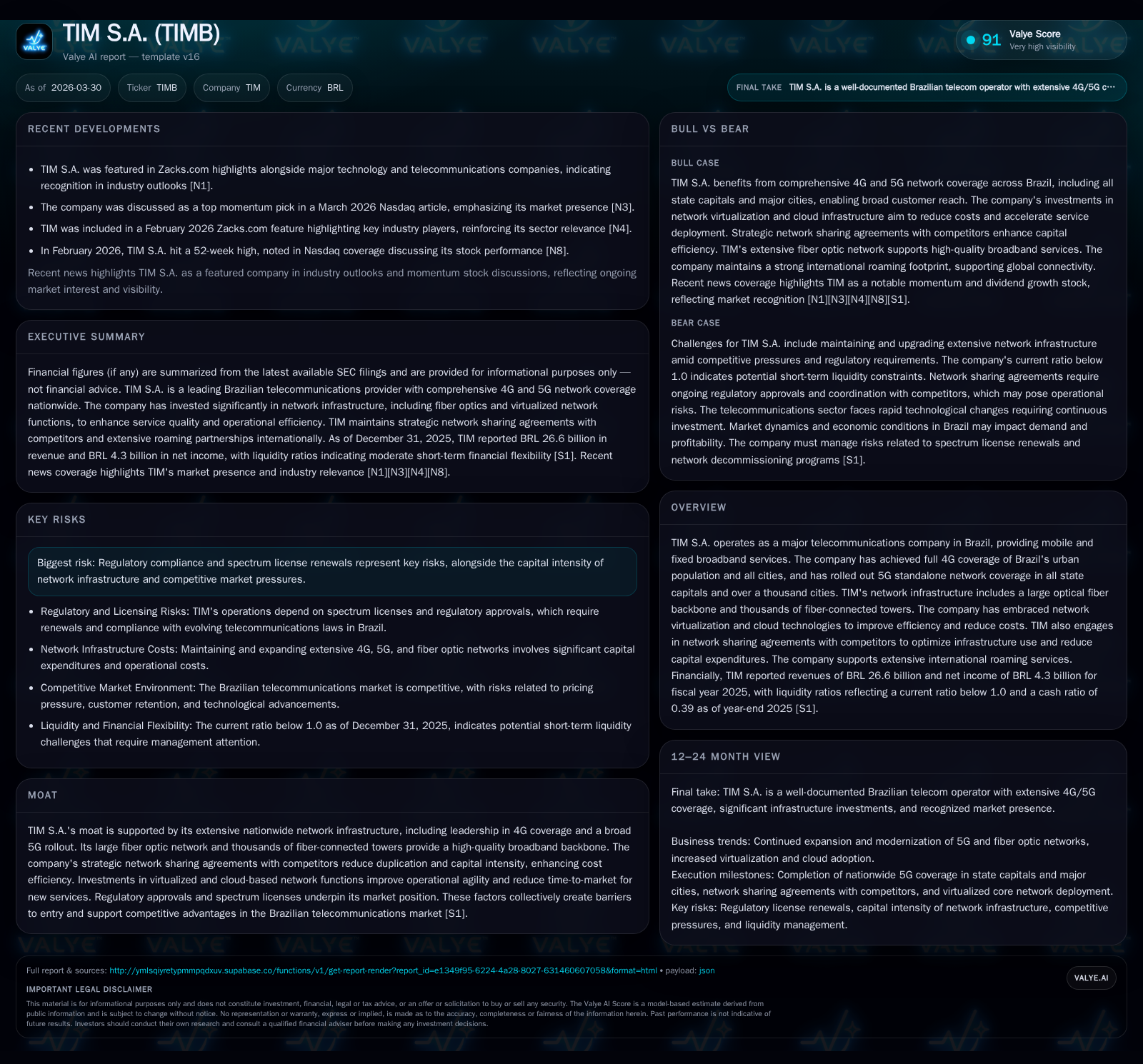
TIM S.A. stands as a major player in Brazil’s telecommunications landscape, having achieved full urban 4G coverage and extensive 5G standalone network deployment in state capitals and over a thousand cities. The company’s substantial optical fiber backbone and strategic network-sharing agreements underpin its cost efficiency and service quality advantages. Despite strong top-line growth of 4.6% and a 36.7% net income increase in fiscal 2025, TIM faces regulatory challenges, capital intensity constraints, and liquidity considerations reflected in a current ratio below 1.0. Capital allocation prioritizes dividends with significant distributions, balanced against heavy investments to support the nationwide rollout of next-gen networks.
Company Overview
TIM S.A., branded as TIM Brasil, operates as a leading telecommunications provider across Brazil, delivering mobile voice and data services alongside fixed broadband offerings. By the end of 2025, the company had attained full coverage of Brazil's urban population with its 4G network across all cities nationwide, an achievement underscoring its leadership in wireless infrastructure deployment [S1]. The firm also rolled out commercial standalone (SA) 5G networks in all state capitals plus over one thousand additional municipalities, reaching significant urban centers such as São Paulo, Rio de Janeiro, Brasília, Salvador, Curitiba, Recife, and Fortaleza with comprehensive neighborhood-level coverage [S1].
The company’s backbone is anchored by an extensive optical fiber network complemented by thousands of towers connected via fiber optics—critical for resilient high-capacity broadband delivery needed for both mobile backhaul and fixed broadband services [S1]. To enhance efficiency, TIM has increasingly virtualized its network core operations adopting cloud native functions (CNF) compliant with global standards (3GPP), which reduces time to roll out new offerings while slashing operational costs [S23]. Further capital discipline is achieved through network sharing arrangements with competitors such as Vivo that reduce duplicative capital expenditures for legacy technologies (2G/3G/4G) while facilitating spectrum consolidation [S1].
Past Growth and Historical Performance
Over the past four fiscal years through end-2025, TIM S.A.'s reported revenues exhibited steady growth supported by expanding consumer demand for mobile data and broadband connectivity amid Brazil’s digitalization push. Revenue rose from BRL 21.5 billion in FY22 to BRL 26.6 billion in FY25 representing a compound annual growth rate above 7%. This top-line momentum was largely driven by increased user penetration of mobile broadband services complemented by the firm’s comprehensive fiber network expansion initiatives.
Net income demonstrated notable acceleration outpacing revenue growth due to scale efficiencies and operating leverage on fixed costs associated with network infrastructure. Net income rose from BRL 1.67 billion in FY22 to BRL 4.31 billion in FY25 (a near threefold increase), translating into a nearly 18% return on equity based on FY25 closing equity levels of roughly BRL 24 billion [F1]. This robust profitability reflects not only operational improvements but also financial management including derivative hedging to mitigate currency exposure given portions of debt denominated in foreign currencies [S1][S7].
Historical performance (annual)
| FY | Rev ($bn) | Net ($bn) | Rev YoY | Net YoY |
|---|---|---|---|---|
| 2025 | 26.6 | 4.3 | +4.6% | +36.7% |
| 2024 | 25.4 | 3.2 | +6.8% | +11.2% |
| 2023 | 23.8 | 2.8 | +10.7% | +69.8% |
| 2022 | 21.5 | 1.7 |
Source: SEC companyfacts cache [F1].
Capital returns and efficiency (annual)
| FY | Div ($bn) | ROE% |
|---|---|---|
| 2025 | 3.1 | 18.0 |
| 2024 | 1.4 | 11.9 |
| 2023 | 1.6 | 10.9 |
| 2022 | 1.4 | 6.6 |
Source: SEC companyfacts cache [F1].
Source: [F1]
The dividend increases starting FY23 reflect higher profitability coupled with substantial free cash flows allowing TIM to reward shareholders while funding ongoing capex intensity required for next-generation networks [S8][S11].
Future Growth Prospects
TIM’s expansion roadmap hinges critically on broadening the footprint and capacity of its standalone (SA) 5G network, now deployed broadly in Brazil's major urban locales but still in progress across smaller cities where demand drivers vary [S1]. Alongside this wireless upgrade, aggressive fiber-to-the-home/business rollouts underpin growing fixed broadband penetration that complements mobile revenue streams through bundled offers.
The company also plans to continue leveraging virtualized network functions built on cloud architectures enabling flexible scaling to meet IoT growth demands and ultra-reliable low-latency applications which are anticipated growth vectors as Latin America's digital transformation intensifies [S23]. Strategic infrastructure sharing agreements - particularly involving decommissioning redundant equipment from legacy technologies - will control capital intensity in this capital expenditure-heavy sector [S23].
However, these growth drives face natural limits including:
- Regulatory uncertainty on license renewals and spectrum rights which are vital to uninterrupted wireless service delivery [S1][S6]
- Competitive dynamics in Brazil’s saturated urban markets intensifying price pressures
- High capital intensity constraining free cash flow generation despite improving margin trends
- Macroeconomic factors impacting currency volatility which affects cost structures given foreign debt mix [S1][S6]
Careful monitoring of regulatory developments around spectrum renewals is crucial given their potentially material impact on operational continuity.
Forecasts / Milestones / Expectations
TIM has not provided explicit forward-looking financial guidance within recent filings but key upcoming milestones include:
- Completion of full nationwide standalone 5G coverage beyond state capitals into secondary cities throughout Brazil
- Continued execution of network virtualization projects enhancing OSS/BSS integration with cloud platforms for innovative customer offerings
- Ongoing extension of cooperation agreements with parent Telecom Italia reflecting knowledge transfer to adapt mature European telecom practices efficiently into local Brazilian market conditions [S18]
- Execution pace of legacy network decommissioning aligned with shared infrastructure agreements notably involving competitor Vivo [S23]
Quarterly earnings releases will provide directional visibility on service revenue growth trajectories amid increasingly competitive pricing environments.
Returns / Capital Allocation
TIM S.A.’s ROE approximates an attractive ~18% based on net income relative to shareholders’ equity as of fiscal year-end December 2025 [F1], demonstrating effective capital utilization given the industry’s asset-heavy nature.
Free cash flow generation supports a dividend payout policy consistent with Brazilian corporate law mandates requiring minimum distribution equal to at least 25% of adjusted net income [S12][S19]. In fiscal year ending December 2025, dividends paid totaled approximately BRL 3.1 billion marking significant increase relative to prior years driven by elevated profits [F1].
Balance sheet liquidity poses some cautionary signals with the current ratio at just below one (0.89), indicating near parity between current assets (BRL13.4 billion) and current liabilities (BRL15.2 billion), necessitating proactive liquidity management [F1][S7]. Nonetheless TIM holds cash & equivalents totaling around BRL3.6 billion alongside other highly liquid financial instruments providing buffer against short-term obligations [F1][S7].
Leverage remains moderate to high reflective of ongoing funding requirements for capex-intensive network deployment projects; net debt exceeds BRL10 billion after accounting for derivative instruments designed for hedging interest rate and currency risk exposures [S13]. The financial leverage index remains stable near ~0.83 reflecting disciplined debt servicing capacity supported by EBITDA exceeding BRL13 billion last twelve months [F1][S13].
Capital allocation strategy balances sustained dividend payments against necessary reinvestment into capacity upgrades while preserving capital structure health via refinancing strategies when advantageous [S18][S27].
Regulatory and Legal Environment
TIM confronts multifaceted risks embedded in Brazil’s regulatory framework including license renewal uncertainties for spectrum vital to its operations per revised telecom laws enacted since 2021 that foster longer authorization periods but impose strict renewal conditions [S1][S6]. Numerous judicial proceedings exist spanning consumer complaints regarding billing disputes or service quality (total reserves R$133 million), tax lawsuits contesting ICMS tax base calculations (possible contingencies totaling billions of reals), labor claims linked mainly to contractors’ former employees (R$161 million reserved), social security litigations, environmental licensing disputes, plus antitrust investigations on alleged anti-competitive practices associated with value-added service providers like BASE (ongoing administrative inquiries by ANATEL and CADE) [S6][S15][S16][S17][S22].
While management estimates no material adverse effect on financial stability from these contingent litigations given prudent provisioning policies calibrated against probable losses as advised by external counsel, these exposures require ongoing vigilance among stakeholders given potential implications especially if matters escalate or new legislation arises.
Sector Context Analysis
Brazil’s telecom sector continues rapid digital service adoption aligned with governmental pushes toward wider broadband accessibility under social inclusion programs—a double-edged sword pressuring pricing yet unlocking volume upside particularly for data-centric plans suited for emerging consumption patterns facilitated by affordable smartphone penetration. Coalitions around multi-operator site sharing increasingly become norms not only due to capex savings but also environmental licensing complexities evidenced by tighter ANATEL approvals fostering rationalization demanded by ESG criteria dominating investor emphasis globally. Cloudification of networks holding promise extends beyond mere cost cuts; it underpins differentiated service creation capability required for sectors such as smart cities or industrial IoT deployments that could constitute future growth spheres once widespread adoption crosses tipping points. These thematic trends frame TIM's strategic moves embedding European expertise from Telecom Italia aimed at elevating maturity levels sustainably within local idiosyncrasies present across diversified Brazilian regions.
Conclusion
TIM S.A.’s status as an incumbent telecom operator endowed with extensive rural-urban footprint across Brazil confers strong competitive moats supported by advanced infrastructure enabled primarily through large-scale fiber backbones combined with pioneering standalone fifth-generation networks rollout achieved within a reasonable timeframe compared to regional peers. The company’s performance through fiscal year-end demonstrates sound top-line revenue growth underpinned by robust net income advances reflective of operating leverage alongside disciplined capital returns marked by increasing dividends orchestrated amidst cautious liquidity profiles. Meticulous balancing acts are warranted going forward due to ongoing regulatory scrutiny including spectrum licensing renewals coupled with litigation exposures scattered across consumer protection realms and tax disputes—all endemic challenges faced by telcos operating within emerging market frameworks. Technological innovation via cloud-native virtualization allied with cooperative infrastructure sharing cements pathways aimed at containing capital burdens sustaining long-term viability while addressing evolving customer expectations challenged by intensifying competition. Monitoring progress against execution milestones tied to complete nationwide SA-5G coverage rollout plus continuous transformation roadmaps will shed greater light on trajectory sustainability as TIM navigates structural shifts defining Brazil's telecommunications ecosystem during this pivotal stage.
This report is intended solely for informational purposes reflecting public filings and reported data without expressing investment recommendations.
Disclaimer: This is research-only, informational analysis and not investment advice. It may include AI-generated interpretation and general industry context. Always verify important details using primary sources.

Comments