
Vroom Shifts from Ecommerce to Non-Prime Auto Finance and AI Analytics Amid Financial Restructuring
Following a strategic wind-down of its ecommerce used vehicle business and chapter 11 restructuring, Vroom now centers on UACC’s non-prime auto lending and CarStory’s AI-driven automotive analytics.
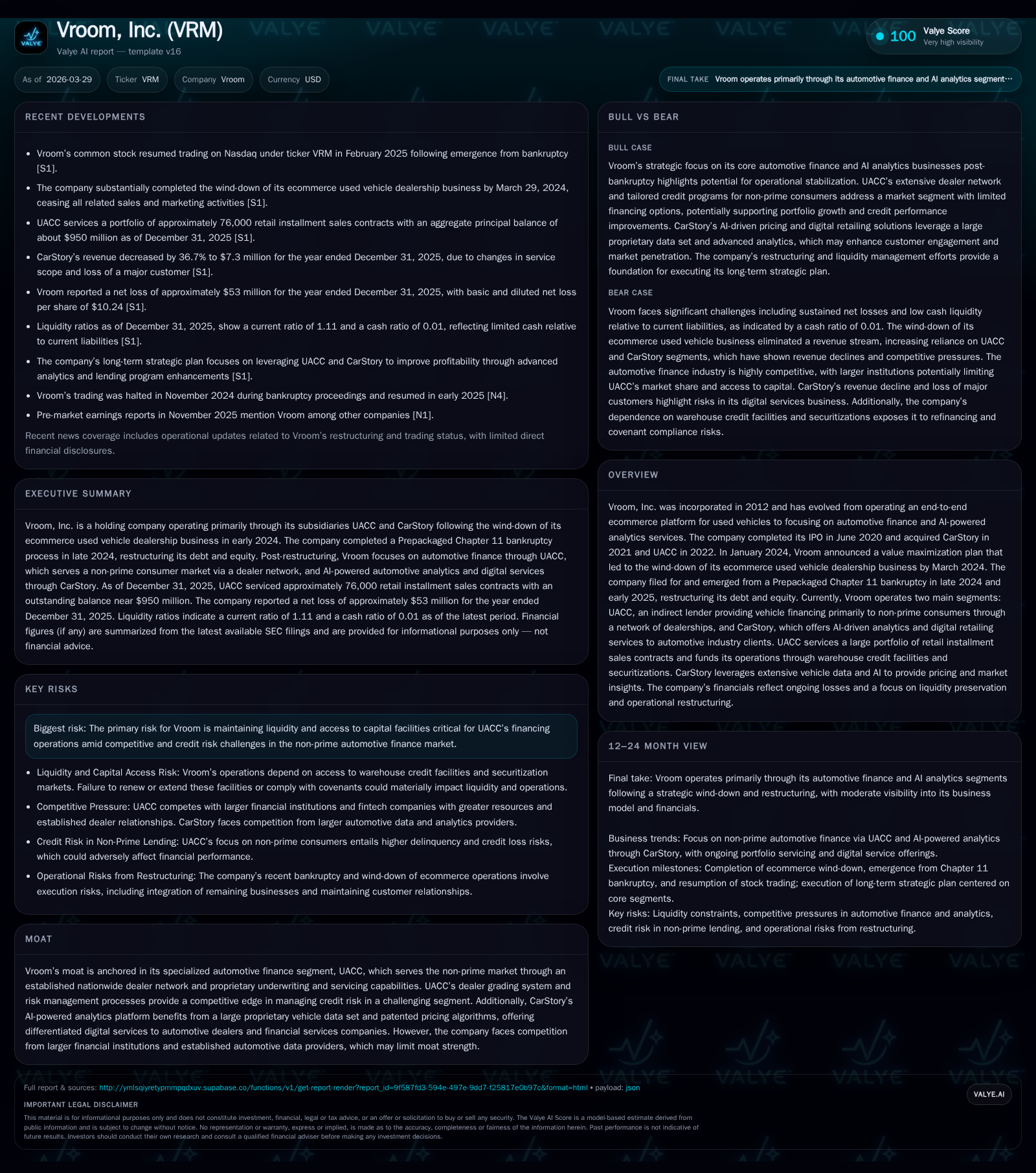
Vroom, Inc. has fundamentally transformed since its 2020 IPO, exiting ecommerce vehicle sales by early 2024 to focus on its automotive finance arm, United Auto Credit Corporation (UACC), and AI-powered digital services provider CarStory. The company navigated a prepackaged Chapter 11 bankruptcy in late 2024, emerging with restructured debt and equity in early 2025. UACC operates as an indirect lender specializing in non-prime consumers through a nationwide dealer network, while CarStory leverages a vast proprietary dataset and patented neural-net pricing algorithms to assist automotive dealers in digital retailing. Despite maintaining operations post-bankruptcy as a going concern, Vroom faces ongoing liquidity constraints linked to warehouse credit facilities essential for financing receivables in the credit-challenged subprime auto market.
Company Background
Incorporated in 2012, Vroom, Inc. initially operated an end-to-end e-commerce platform for buying and selling used vehicles through its subsidiary Vroom Automotive, LLC. After completing its IPO in June 2020, the company expanded into automotive finance and AI-driven analytics via acquisitions: Vast Holdings (d/b/a CarStory) in January 2021 and Unitas Holdings Corp. (parent of United Auto Credit Corporation - UACC) in February 2022. The latter positioned Vroom firmly within the indirect auto finance market.
Historical Performance Trends
Vroom encountered significant operating losses stemming from its capital-intensive ecommerce model. Operating income losses widened to approximately -$572 million in FY2022 before improving to -$270 million by FY2023 [F1]. Net income losses followed a similar path, narrowing from -$452 million to -$366 million over the same period.
A pivotal strategic shift occurred early 2024 when Vroom announced a Value Maximization Plan leading to a full wind-down of its ecommerce dealership business by March 29, 2024 [S1]. This enabled focus consolidation on UACC's finance operations alongside CarStory's AI services.
Financial Summary Table
Historical performance (annual)
| FY | Net ($mm) | CFO ($mm) | OpInc ($mm) | Capex ($mm) | Net YoY |
|---|---|---|---|---|---|
| 2025 | -53 | 75 | 7 | +67.9% | |
| 2024 | -165 | -97 | 3 | +54.8% | |
| 2023 | -366 | -534 | -270 | 15 | +19.1% |
| 2022 | -452 | -109 | -572 | 24 |
Source: SEC companyfacts cache [F1].
Capital returns and efficiency (annual)
| FY | FCF ($mm) | ROE% |
|---|---|---|
| 2025 | 68 | -45.5 |
| 2024 | -101 | 533.6 |
| 2023 | -548 | -299.3 |
| 2022 | -133 | -95.1 |
Source: SEC companyfacts cache [F1].
- Reflects accounting changes post-Chapter 11 restructuring.
Operating income improved over 50% YoY between FY2022-23 but remained negative; net losses narrowed substantially post-winddown signaling cost containment [F1]. Operating cash flow turned positive at $75 million in FY2025 after years of outflows.
Business Model Post-Restructuring
Post-ecommerce cessation, Vroom streamlined into two reportable segments [S10][S11]:
- United Auto Credit Corporation (UACC): An established indirect lender offering retail installment contracts through thousands of independent motor vehicle dealers in 49 states, focusing on non-prime borrowers underserved by traditional lenders [S1]. As of December 31, 2025, UACC serviced approximately 76,000 contracts with nearly $950 million principal outstanding [S1].
- CarStory: Provides AI-powered analytics and digital retail services for automotive retailers and financial firms using extensive data including over 256 million VINs and billions of related photos/sales cycles [S10]. Its patented neural-net pricing algorithm incorporates local market factors beyond standard averages.
Growth Prospects
Growth depends on UACC's proprietary underwriting technology launched mid-2025 that enhances application processing and portfolio quality [S21], optimizing dealer networks critical for accessing non-prime consumers, plus expanding CarStory’s digital product adoption amid competition from major valuation providers.
Challenges include elevated credit losses inherent in subprime lending and intense competition limiting pricing power across both segments.
Capital Structure & Liquidity
Vroom's return profile remains negative with an approximate return on equity near negative 45% based on FY2025 net loss (-$53 million) against equity ($116 million) [F1]. Operating cash flow rebounded strongly with low capex (~$7 million), yielding free cash flow close to $68 million [F1].
Liquidity is supported by three senior secured Warehouse Credit Facilities totaling $600 million borrowing capacity collateralized by eligible finance receivables; borrowings stood at approximately $319 million with $11 million excess capacity as of December 31, 2025 [S5][S6][S8][S9]. Facilities mature between June 2026 and April 2027; renewal negotiations are ongoing without assurance of success [S8].
Debt restructuring introduced significant common equity dilution alongside warrants exercisable at ~$61 per share expiring five years post issuance [S1]. Related party debt arrangements also exist with Mudrick Capital Management holding majority shares post-restructuring [S22]. No dividends or buybacks have been reported post-transition; earlier repurchases were minimal [F1].
Regulatory Environment & Risks
Legacy ecommerce operations resulted in regulatory scrutiny including fines totaling $3 million settled by September 2025; ongoing compliance investigations into UACC remain unresolved but have not materially affected financial results so far [S17][S18].
Key risks include dependency on short-term warehouse facilities critical for financing loan originations—failure to renew could materially impair liquidity and operations [S16][S19]. Competition from larger banks with stable funding sources and established automotive data providers constrains growth potential despite Vroom's niche underwriting and AI capabilities.
Conclusion
Vroom has transitioned from a capital-intensive ecommerce platform into a focused provider of non-prime auto financing paired with AI-driven automotive analytics. Financial stabilization is evident post-bankruptcy emergence but significant refinancing risks tied to warehouse facility maturities remain alongside regulatory vigilance inherited from prior businesses. Monitoring credit facility renewals supporting UACC’s lending alongside commercial traction at CarStory will be key for sustained revenue growth while managing credit risks inherent in non-prime auto lending.
This analysis is based solely on disclosed SEC filings and internal financial data snapshots without investment advice or recommendations concerning Vroom securities.
Disclaimer: This is research-only, informational analysis and not investment advice. It may include AI-generated interpretation and general industry context. Always verify important details using primary sources.

Comments