
Toppoint Holdings Turns Waste Logistics Challenges Into Growth Opportunities
Toppoint leverages its specialized recycling export trucking network and geographic expansion to pursue revenue growth despite operating losses and liquidity pressures.
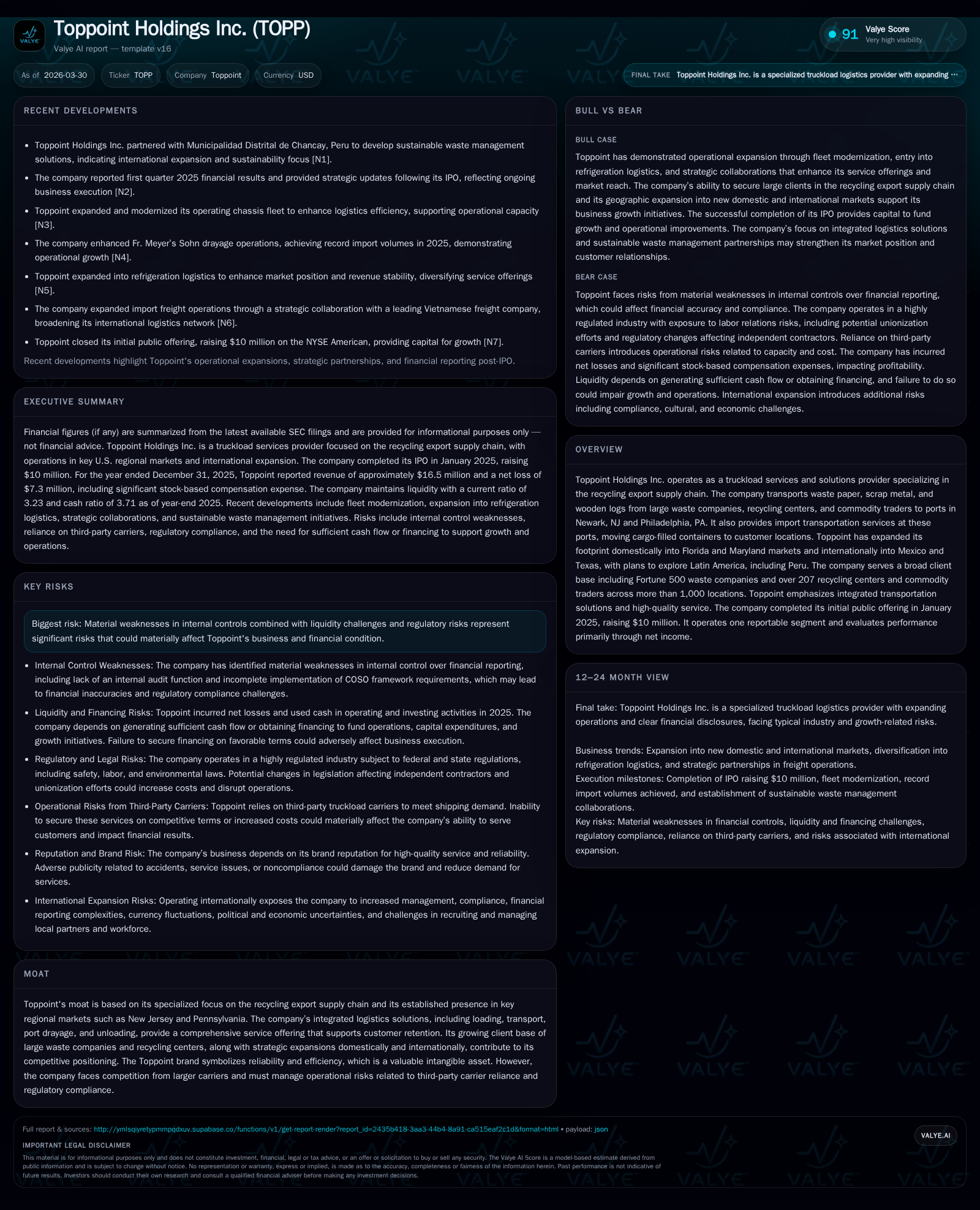
Toppoint Holdings operates a niche truckload services business focused on the recycling export supply chain, transporting waste paper, scrap metal, and logs to key Northeastern ports while expanding into new U.S. and international markets. Revenues grew modestly by 3.2% in 2025 driven by integrated transportation solutions and expanded client relationships. However, escalating costs—particularly an 18% rise in cost of revenue—and significant stock-based compensation expenses contributed to a net loss exceeding $7 million and negative operating cash flow. The company’s liquidity benefits from a strong current ratio and proceeds from its recent IPO but faces ongoing risks from regulatory challenges, reliance on third-party carriers, and operational controls. Future revenue growth hinges on successful execution of geographic expansion plans into Florida, Maryland, Texas, Mexico, and Latin America, alongside improved cost control measures.
Specialized Focus and Client Base Power Revenue Growth
Toppoint Holdings Inc. has established itself as a truckload services provider focused on the recycling export supply chain. It transports bulk commodities such as waste paper, scrap metal, wooden logs—as well as containerized imports—from major Fortune 500 waste companies and over 207 recycling centers and commodity traders operating at more than 1,000 locations[S1 , S7]. This broad client network requires reliable 'white glove service' encompassing loading through port drayage to final delivery.
The company’s reported revenues for fiscal year 2025 increased by approximately 3.2% year-over-year to $16.55 million [F1], driven by geographic expansion beyond New Jersey and Pennsylvania into new U.S. regions like Florida and Maryland since 2023, entry into Mexico’s Ensenada port (2024), Houston Texas (2025), and plans to explore Latin American markets including Peru [S1][S7]. The company offers integrated transportation solutions covering loading, transport, port drayage, and unloading that align with industry expectations for comprehensive logistics services.
Toppoint benefits from its presence at key Northeast ports like Newark and Philadelphia that handle substantial volumes of recycled materials bound for export—a niche requiring expertise in regulatory compliance and time-sensitive freight management.
Historical performance (annual)
| FY | Rev ($mm) | Net ($mm) | CFO ($) | OpInc ($mm) | Rev YoY | Net YoY |
|---|---|---|---|---|---|---|
| 2025 | 17 | -7 | -1781512 | -7 | +3.2% | -4300.0% |
| 2024 | 16 | 0 | -593734 | -1 |
Source: SEC companyfacts cache [F1].
Capital returns and efficiency (annual)
| FY | FCF ($mm) | ROE% |
|---|---|---|
| 2025 | -2 | -85.2 |
| 2024 | -2 | 6.9 |
Source: SEC companyfacts cache [F1]. Source: [F1]
Rising Costs and Operating Losses Underline Profitability Challenges
Despite top-line growth focused on niche cargo flows commanding premium pricing, Toppoint's operating results deteriorated significantly in 2025 [F1][S1]. Cost of revenue increased about 18%, reaching approximately $14.62 million versus $12.39 million the prior year[F1], outpacing revenue growth substantially.
Expenses rose due to independent contractor driver fees, insurance premiums affected by self-insurance retention strategies common in transportation sectors [S1], maintenance costs for leased equipment essential for specialized hauling requirements, and rent expenses including related party leases[S6][S12]. These factors pushed operating income down from a small loss of $645k in FY24 to a negative $7.38 million in FY25 [F1]. Non-cash stock-based compensation charges amounted to $5.36 million heavily impacting GAAP earnings though management expects this expense not to recur materially [S6].
Operating cash flows were negative about $-1.78 million reflecting net loss effects and working capital challenges linked to increased receivables partly tied to deferred revenue recognition schedules [F1][S9]. Cost control remains critical given fixed and semi-variable costs inherent in trucking capacity assets.
Expanding Geographies: From Northeast Hubs to Latin America Prospects
Toppoint’s strategic expansion beyond its core Northeastern U.S. footprint aims to harness cross-border logistics opportunities aligned with North-South trade corridors [S1][S7]. The company expanded into Florida cities—Tampa, Jacksonville, Miami—and Baltimore during 2023 before moving into Mexico's Ensenada port operations in 2024 followed by Houston Texas in 2025 [S7]. The creation of Topp Metals Inc., a wholly-owned subsidiary without operations as of reporting date, indicates preparatory steps toward diversification or targeted commodity logistics plays [S7].
Plans to explore Chancay port in Peru signal intent to enter Latin America's growing recycling export infrastructure where demand for integrated transportation solutions is rising due to environmental regulations driving exports from emerging markets [S1].
These expansions introduce operational complexity including labor market heterogeneity with ongoing litigation over driver classification since early 2024, customs compliance variability across borders, insurance premium volatility heightened internationally due to geopolitical risk assessments within freight insurance pools, plus reliance on third-party carriers which increases exposure if not tightly managed [S25][S29].
Capital Structure, Liquidity, and Cash Flow Dynamics
Toppoint’s capital structure reflects proceeds from its January 2025 IPO raising gross proceeds near $10 million supporting geographic expansions and working capital needs [S4][S8]. As of December 31, 2025, cash balances were approximately $1.2 million with current assets at $5.22 million against current liabilities of about $1.62 million yielding a current ratio around 3.23—a favorable short-term liquidity position [F1].
The balance sheet includes loan receivable assets exceeding $5 million split between current ($2M) and non-current ($3M) tranches related to a loan made to Golden Bridge Capital Management with amended repayment terms extending through early 2028 at interest rates between 5%-7% plus penalties for defaults[S4][S11]. This receivable inflates asset base but does not directly improve operating cash flows.
Free cash flow was negative roughly -$2.14 million due to investing outlays associated with loan advances plus reduced property capex reflecting cautious investment amid scaling uncertainties: capex fell over seventy percent year-over-year from $1.20 million to $355k[F1][S21].
Debt obligations consist mainly of scheduled principal repayments under $1 million extending through 2030 supported by short-term loans plus related party financing documented alongside operating lease liabilities mainly tied to equipment vehicles [S16][S17].
Allocation of Capital: Investments, Stock Compensation, and Dividend Policy
Capital allocation shows restrained asset investments consistent with management’s conservative approach during loss-making phases[F1]. Resources have prioritized geographic footprint expansion and human capital incentives via stock-based compensation critical for talent acquisition during rapid scaling.[S6] The dilutive impact is reflected in an approximate negative ROE near -85%, indicating losses relative to shareholders’ equity[F1].
Consistent with high-growth service firms reinvesting earnings into network development rather than returning cash externally,[S1] Toppoint does not expect dividend payments in the foreseeable future.
Risks from Regulatory Environment and Operational Controls
Key risks include labor classification disputes exemplified by active class action lawsuits filed January 2024 alleging misclassification of drivers as independent contractors under New Jersey wage laws[S25]. Although some claims were dismissed temporarily for lack of prosecution then reinstated early 2025,[S25] management considers them without merit but litigation outcomes could materially affect costs.
Cross-border regulatory scrutiny encompasses customs protocols and tariffs affecting Mexico/U.S./Latin America shipments.[S25] Insurance cost fluctuations driven by self-insurance retention expose Toppoint further amid industry-wide premium inflation post-pandemic.
Material weaknesses in internal controls present governance risks potentially undermining reliable financial reporting during this post-IPO phase.[S25] Reliance on third-party carriers heightens operational risk requiring strong oversight uncommon yet increasingly vital amid tightening freight sector regulations.
What Investors Should Watch Next: Milestones and Market Signals
Key areas include:
- Profitability inflection through cost containment addressing contractor fees & insurance while balancing growth;
- Resolution progress on driver classification litigation impacting labor models;
- Execution success on geographic rollouts beyond Northeast U.S., especially initial traction in Mexican/Latin American markets;
- Liquidity trends including collection on loan receivables maintaining positive working capital;
- Customer contract renewals or new wins amid competition;
- Operational leverage gains via technology adoption improving efficiency enhancing margins.
Navigating these factors will determine if Toppoint can convert its logistics niche positioning into sustainable profitability while managing sector-specific legal/regulatory complexities.
Disclaimer: This analysis is based solely on publicly available filings through March 30, 2026 including SEC reports cited herein; it does not constitute investment advice or endorsement.
Disclaimer: This is research-only, informational analysis and not investment advice. It may include AI-generated interpretation and general industry context. Always verify important details using primary sources.

Comments