
BioRestorative Therapies’ Stem Cell Breakthroughs and Financial Crossroads
Innovations in autologous mesenchymal stem cell therapies contrast sharply with BioRestorative’s urgent liquidity challenges.
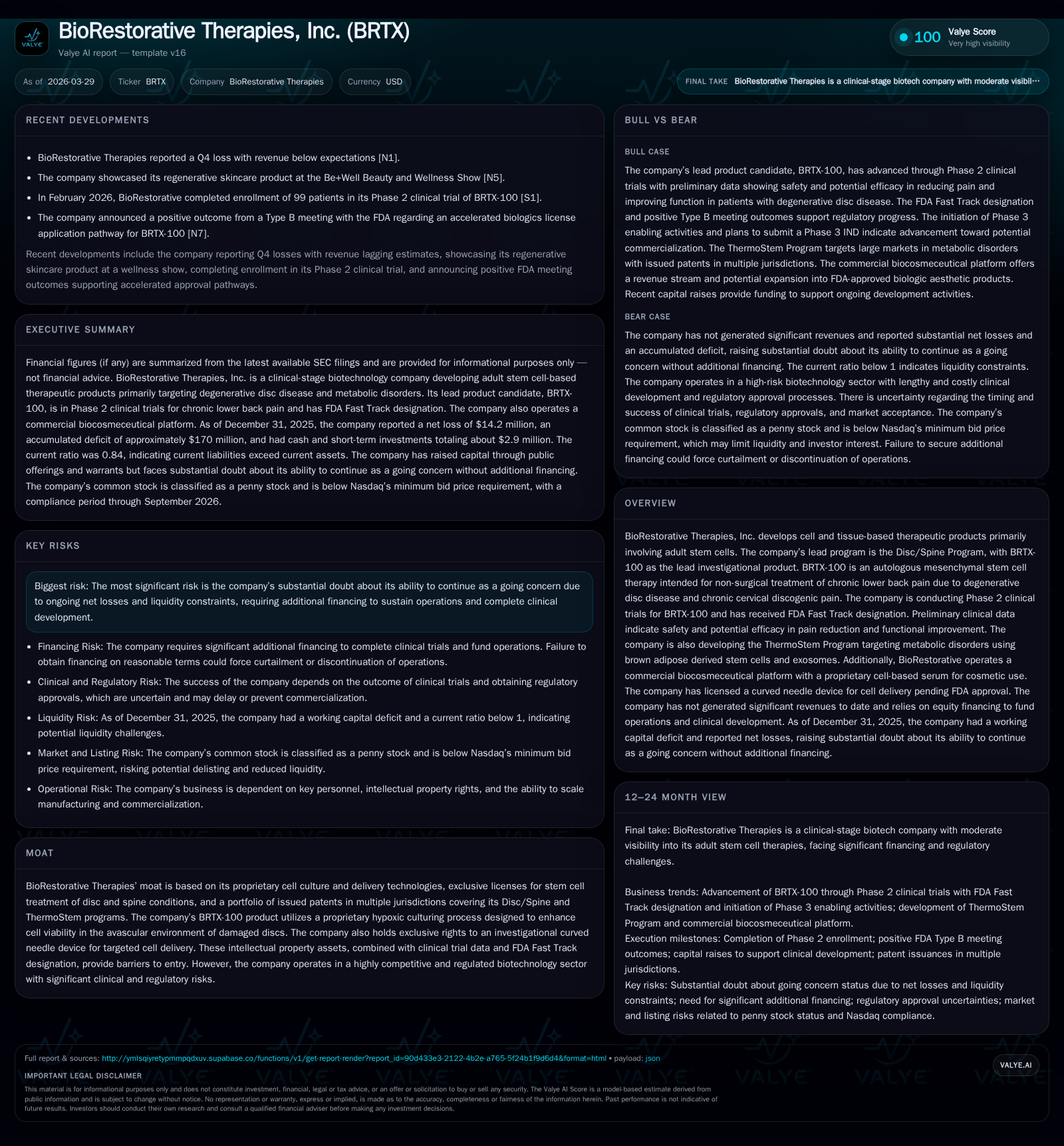
BioRestorative Therapies, Inc. is advancing its lead investigational product BRTX-100, an autologous mesenchymal stem cell therapy targeting chronic discogenic pain. The company holds FDA Fast Track designation and proprietary hypoxic culturing technology underpinning potential clinical differentiation. However, its financial performance exhibits sustained and deepening net losses alongside minimal revenue generation, casting substantial doubt on its near-term viability without additional capital. Upcoming Phase 2 trial readouts and regulatory milestones will be pivotal for de-risking, yet the firm's modest cash balance and ongoing burn rate highlight a pressing need for funding to sustain operations and scale toward commercialization.
Evolution of Biorestorative’s Pipeline and Revenue Trajectory
BioRestorative Therapies has exhibited a historical pattern of very limited revenue generation coupled with escalating operating losses. Annual top-line peaked modestly at approximately $629K in FY2015 but declined sharply thereafter to just $81K in FY2017 [F1]. Since then, reported revenues have trended immaterially, primarily deriving from a commercial biocosmeceutical serum platform leveraging proprietary secretome technology for aesthetic applications [S1]. This negligible revenue base starkly contrasts with the steep increase in operating expenses driven by research and development efforts targeting regenerative medicine indications.
Operating income has followed a deteriorating trajectory with losses ballooning to -$15.6 million in FY2025 from -$11.6 million in FY2024 [F1]. Net losses widened similarly to -$14.2 million in FY2025 [F1]. The company's cash flow from operations has been negative consistently for several years, reaching nearly -$10.8 million in FY2025 [F1], underscoring an unsustainable burn rate absent fresh capital injection.
Historical performance (annual)
| FY | Net ($mm) | CFO ($mm) | OpInc ($mm) | Capex ($) | Net YoY |
|---|---|---|---|---|---|
| 2025 | -14 | -11 | -16 | 116069 | -58.6% |
| 2024 | -9 | -8 | -12 | 106189 | +13.8% |
| 2023 | -10 | -6 | -15 | 171043 | +43.7% |
| 2022 | -18 | -6 | -19 | 265223 |
Source: SEC companyfacts cache [F1].
Capital returns and efficiency (annual)
| FY | FCF ($mm) | ROE% |
|---|---|---|
| 2025 | -11 | -3992.2 |
| 2024 | -8 | -105.3 |
| 2023 | -7 | -104.1 |
| 2022 | -6 | -116.8 |
Source: SEC companyfacts cache [F1].
The growth pattern underscores that commercial traction is nascent outside early-stage cosmetic products while the core pipeline advances through costly clinical stages.
Clinical Advancements in the Disc/Spine and ThermoStem Programs
BioRestorative’s flagship program is BRTX-100, an autologous mesenchymal stem cell (MSC) therapy intended as a non-surgical treatment for chronic lower back pain linked to degenerative disc disease (DDD). This product candidate utilizes a proprietary hypoxic culturing process which enhances MSC viability in the inherently avascular environment of intervertebral discs—an innovation aimed at overcoming a critical biological delivery barrier common to regenerative therapies targeting disc repair [S1].
The company is currently conducting Phase 2 clinical trials for BRTX-100 with enrollment completion reported at 99 patients as of February 2026 [S22]. Preliminary blinded analyses covering up to 52 weeks demonstrate no serious adverse events or dose-limiting toxicities among initial cohorts [N1][S1]. Early efficacy signals encompass reductions in patient-reported pain scores alongside functional improvement metrics, though these remain preliminary pending full dataset publication.
Complementing the Disc/Spine Program is the ThermoStem initiative focused on metabolic disorders such as type II diabetes and obesity via brown adipose-derived MSCs and exosomes [S1]. This preclinical program explores thermogenesis modulation pathways to affect energy homeostasis [S19]. While ThermoStem holds issued patents internationally, it remains significantly earlier stage relative to BRTX-100 with no clinical data available yet.
Regulatory Milestones Bolstering Commercial Prospects
The FDA granted Fast Track designation to BRTX-100 in February 2025 for chronic lumbar disc disease treatment, recognizing its potential to address an area of unmet medical need with substantial clinical burden [S1][N1]. This status enables more frequent interactions with regulators and may accelerate review timelines contingent on positive trial outcomes.
Additionally, the FDA cleared an Investigational New Drug (IND) application for BRTX-100 targeting chronic cervical discogenic pain in February 2025 expanding potential indications under evaluation [S1]. These regulatory achievements represent meaningful de-risking steps translating years of preclinical innovation into formal clinical development channels.
However, distinct regulatory complexities remain inherent given the biologic nature of autologous MSC therapies regulated under Public Health Service Act provisions. Post-approval compliance demands—including manufacturing oversight, pharmacovigilance mandates such as Risk Evaluation and Mitigation Strategies (REMS), labeling controls, and potential post-market studies—are anticipated [S8][S11]. Such layers add execution risk beyond initial approval hurdles.
Financial Health Check: Operating Losses and Liquidity Pressures
Despite clinical progress, BioRestorative’s financial footing portrays significant fragility. As of December 31, 2025, cash & equivalents stood at approximately $1.5 million against current liabilities nearing $3.7 million, yielding a current ratio of roughly 0.84—below conventional thresholds for short-term solvency [F1][S16].
Operating cash flows have been persistently negative with FY2025 recording nearly -$10.8 million while free cash flow (operating cash flow minus capex) also remained deeply negative at over -$10.9 million reflecting high operational burn without offsetting capital expenditures or asset sales [F1].
Equity shrank precipitously from over $15.8 million in FY2022 to just about $0.36 million by FY2025 amidst mounting losses eroding shareholder value [F1]. Calculated ROE is severely negative (~-3992%), corroborating that returns have been deeply unfavorable due primarily to ongoing development stage costs without revenue offsets [F1].
Auditor reports have included going concern qualifications emphasizing substantial doubt about the firm’s ability to continue operations without securing additional financing imminently [S1][S16]. The company acknowledges this liquidity shortfall explicitly as a principal risk factor.
Capital Strategies: Financing the Path to Commercialization
To offset cash depletion risks, BioRestorative has undertaken multiple capital raises recently. In February 2026, the company closed a public offering issuing over 12 million units including shares and warrants netting approximately $5 million gross proceeds [N3][S22][F1]. Pre-funded warrants were exercised shortly thereafter providing incremental liquidity.
Previous financings comprise warrant exercises aggregating over $8 million during early 2024 plus about $2 million via at-the-market offerings during that year—the latter now fully exhausted [S16]. Operating history reveals no dividend payments or share repurchase activities as resource allocation concentrates exclusively on extending development runway rather than capital returns [F1].[N3]
This capital strategy indicates reliance on dilutive equity issuances given lack of operational cash flow or partnering revenues thus far. Persistent fundraising necessity raises concerns about shareholder dilution but appears essential given cash burn dynamics.
IP Positioning and Delivery Technologies Creating Competitive Barriers
BioRestorative’s moat hinges on its intellectual property portfolio centered around unique cell culture processes and delivery mechanisms tailored for disc regeneration applications [S12]. The hypoxic culturing methodology enhances survival of transplanted autologous MSCs within harsh avascular disc microenvironments—addressing a substantial translational challenge not broadly solved by competitors.
Exclusive licensing rights cover an investigational curved needle device designed explicitly for targeted stem cell delivery into spinal discs under image guidance conferring controlled administration advantages potentially improving therapeutic efficacy and safety profiles [S23].
Such IP assets spanning issued patents across multiple jurisdictions create high barriers against replication by new entrants or generic competitors post-approval. The robustness of these protections remains subject to patent law evolution risks especially internationally but forms a critical competitive advantage feature if commercialized successfully.
Evaluation of Market Access Risks and Reimbursement Challenges
Beyond FDA approval hurdles lies the formidable landscape of market access shaped by payer reimbursement policies that remain uncertain for novel cell-based therapies such as BRTX-100 [S5][S6][S9]. Medicare and Medicaid coverage levels fluctuate amid federal healthcare program budget pressures potentially constraining reimbursement ceilings.
Regulatory compliance extends into healthcare fraud statutes including Anti-Kickback Statute enforcement plus false claims laws affecting pricing practices; any violations could trigger material penalties potentially impeding commercialization efforts or leading to exclusion from public health programs [S4][S14][S17].
Managed care trends favor bundled payment models which might limit use frequency or reduce unit pricing relative to traditional fee-for-service paradigms presenting additional commercialization challenges requiring navigation through complex contracting environments.
Competition further includes unregulated stem cell clinics offering unapproved treatments circumventing costly FDA pathways—though these players operate with higher safety risks undermining comparability—and legitimate rivals advancing alternative regenerative approaches.
What to Watch: Upcoming Clinical Data, Regulatory Decisions, and Fundraising
Key near-term milestones include:
- Completion and topline results from the Phase 2 BRTX-100 clinical trial assessing efficacy/safety endpoints cited as imminent following enrollment completion at nearly 100 subjects as of Q1/2026 [N1][S22];
- Potential feedback engagements with FDA possibly guiding Phase 3 trial design or confirmatory data requirements contingent on Phase 2 outcomes;
- Further financing initiatives are likely necessary given low current liquidity juxtaposed against expenditure forecasts; successful execution will be vital to maintaining clinical momentum;
- Updates on ThermoStem preclinical progression could broaden pipeline optionality though remain subordinate near-term;
- Strategic partnership discussions may emerge as alternative commercialization vehicles relieving capital burden but no public agreements have been disclosed yet;
These catalysts collectively embody crucial inflection points determining whether BioRestorative can realize transformative value creation or face protracted funding dilemmas threatening ongoing viability.
Disclaimer: This analysis is based on publicly available information as of March 29, 2026. It does not constitute investment advice or recommendations. Readers should conduct their own due diligence before making financial decisions related to BioRestorative Therapies, Inc.
Disclaimer: This is research-only, informational analysis and not investment advice. It may include AI-generated interpretation and general industry context. Always verify important details using primary sources.

Comments