
Insight Molecular Diagnostics Advances Organ Rejection Testing While Facing Regulatory and Capital Challenges
Insight Molecular Diagnostics pioneers decentralized molecular diagnostics for transplant rejection amid ongoing operating losses and regulatory uncertainty.
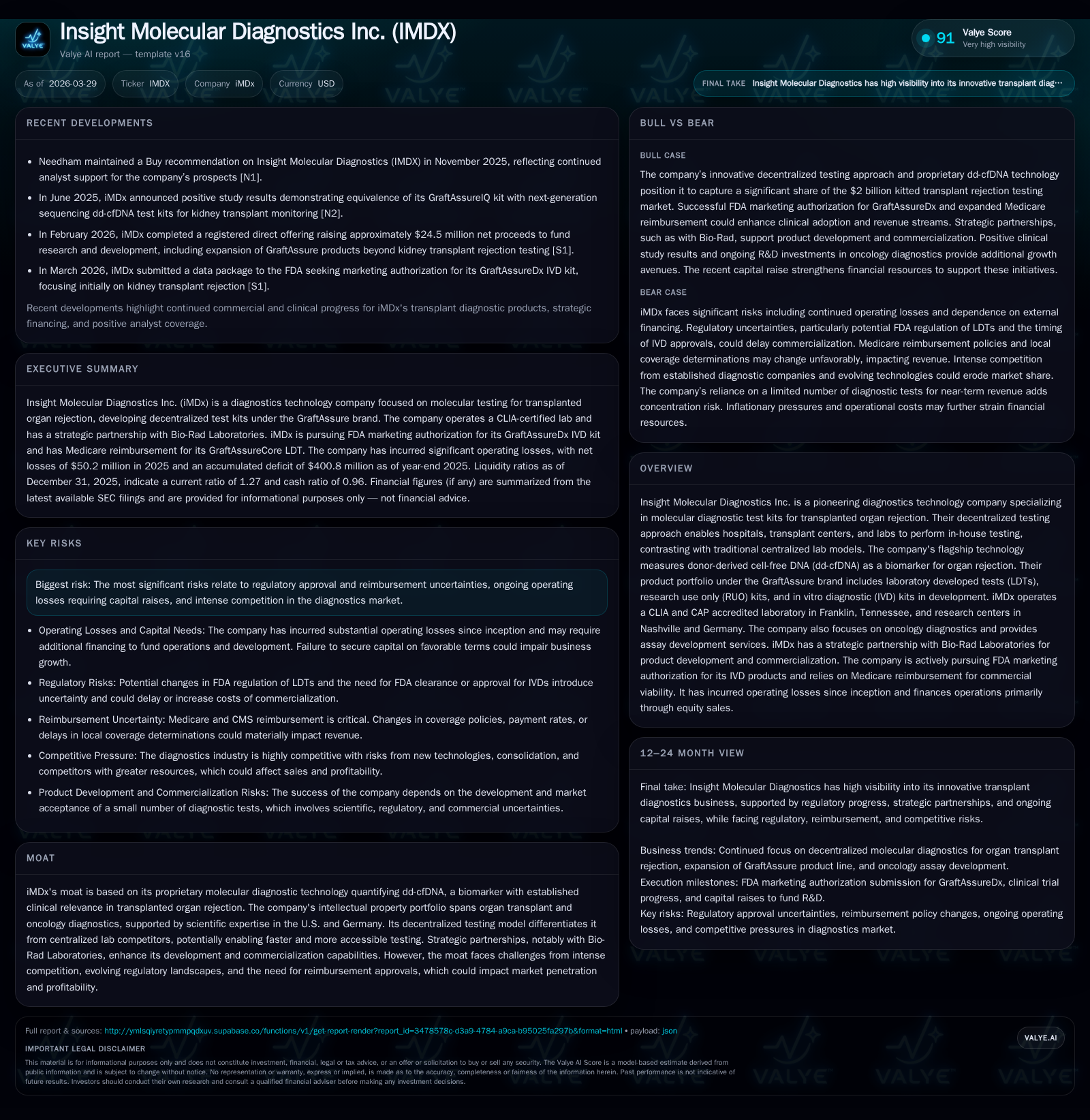
Insight Molecular Diagnostics Inc. (IMDX) focuses on decentralizing molecular diagnostic testing for transplanted organ rejection, leveraging proprietary donor-derived cell-free DNA (dd-cfDNA) assays under the GraftAssure brand. The company offers LDT, RUO, and IVD products targeting hospitals and labs to enable in-house testing. Despite progress in product development and reimbursement coverage for certain tests, IMDX continues to operate at substantial net losses driven by investments in R&D and commercialization. Growth depends on FDA approval of IVD kits, expanded payer reimbursement, and navigating evolving regulatory frameworks around LDTs. The company maintains limited liquidity and negative equity, underscoring ongoing capital needs [F1][S1][S2][S19].
Business Overview
Insight Molecular Diagnostics Inc. ("iMDx") operates at the forefront of molecular diagnostics specializing in test kits detecting transplanted organ rejection via donor-derived cell-free DNA (dd-cfDNA). This biomarker has become a trusted clinical indicator of graft health over the past decade. iMDx’s strategy centers on decentralizing access by enabling hospitals, transplant centers, and labs to perform these advanced tests onsite rather than relying on centralized laboratories.
The GraftAssure™ product family includes:
- GraftAssureCore: A laboratory developed test (LDT) performed at iMDx’s CLIA-certified Tennessee lab with Centers for Medicare & Medicaid Services (CMS) reimbursement.
- GraftAssureIQ: A research use only (RUO) kit intended for non-clinical applications.
- GraftAssureDx: An in vitro diagnostic (IVD) kit under development aimed at clinical decision-making in decentralized settings.
Scientific contributions from iMDx’s U.S. and German teams underpin proprietary intellectual property protecting dd-cfDNA quantification technology relevant across transplant and oncology indications. Partnership with Bio-Rad Laboratories supports manufacturing of digital PCR instruments integral to executing GraftAssure assays alongside joint commercialization efforts.
Historical Financial Performance
Since its founding in 2009, iMDx remains pre-revenue from commercial molecular diagnostic sales with financials reflecting a development-stage profile characterized by significant operating losses funding R&D and commercialization infrastructure.
Historical performance (annual)
| FY | Net ($mm) | CFO ($mm) | OpInc ($mm) | Capex ($mm) | Net YoY |
|---|---|---|---|---|---|
| 2025 | -50 | -22 | -51 | 3 | +17.2% |
| 2024 | -61 | -21 | -61 | 1 | -118.4% |
| 2023 | -28 | -23 | -25 | 0 | +61.9% |
| 2022 | -73 | -46 | -18 | 4 |
Source: SEC companyfacts cache [F1].
Capital returns and efficiency (annual)
| FY | FCF ($mm) | ROE% |
|---|---|---|
| 2025 | -25 | 159.6 |
| 2024 | -21 | 494.2 |
| 2023 | -24 | -135.7 |
| 2022 | -50 | -212.6 |
Source: SEC companyfacts cache [F1].
Operating cash flows have consistently been negative due to outlays supporting platform development and market entry; capex increased substantially in FY2025 aligned with scaling manufacturing and lab capabilities [F1].
Equity declined into negative territory by fiscal year-end 2025 ($-31.5 million), reflecting cumulative losses outweighing capital infusions—a condition highlighting reliance on external financing [F1].
Growth Prospects
The approximately $2 billion addressable market for kitted transplant rejection testing presents substantial revenue potential if iMDx achieves widespread adoption [S19]. Decentralized testing promises faster clinical turnaround and operational efficiencies for hospitals.
Growth drivers include:
- FDA clearance of the GraftAssureDx IVD kit enabling broader decentralized lab use;
- Expansion of Medicare and private payer reimbursement coverage enhancing physician adoption;
- Extension of dd-cfDNA applications into oncology diagnostics;
- Leveraging Bio-Rad’s distribution channel to increase market penetration.
Constraints include:
- Regulatory uncertainty around FDA oversight of LDTs that may impose pre-market clearance requirements [S2][S10];
- Lengthy IVD approval timelines requiring costly clinical trials;
- Dependence on third-party payer reimbursement decisions affecting demand [S26];
- Competitive pressure from established diagnostics companies offering alternative assays or centralized services.
Outlook & Milestones
Key upcoming milestones include submission and review of De Novo FDA authorization requests for GraftAssureDx kits [S20]. Approval would facilitate marketing directly to decentralized labs beyond iMDx’s CLIA lab.
Other indicators:
- Expansion of specimen collection partnerships increasing potential test volumes;
- Progress on reimbursement acceptance beyond Medicare critical for scale;
- Development of oncology-related assays diversifying pipeline.
Absent explicit revenue guidance due to early commercial stage, investors should monitor quarterly updates on kit shipments, FDA communications, clinical validation data, and payer contracts .
Returns & Capital Allocation
No dividends or share repurchases have been declared; focus remains on reinvestment during development stage.
Operating income improved approximately 16% YoY between FY2024–2025; net losses decreased by about 17%, indicating some cost control improvement despite large absolute deficits [F1].
Capital expenditures rose over 500% YoY to $3.2 million in FY2025 supporting manufacturing scale-up and lab infrastructure expansion [F1]. Negative operating cash flow combined with capex results in free cash flow deficits exceeding $25 million annually necessitating continued financing.
Liquidity includes roughly $11.6 million cash against $12 million current liabilities yielding a current ratio near 1.27—adequate but tight runway without further capital raises [F1].
Given accumulated deficit (~$400 million) since inception and negative equity position, dilution risk persists absent profitable scale or alternative financing sources [S1].
Competitive & Regulatory Environment
Competition derives from centralized reference labs as well as decentralized assay providers and pharmaceutical diagnostics units using AI/ML technologies [S6]. Consolidation among competitors may intensify pricing pressures. iMDx differentiates via:
- Proprietary dd-cfDNA quantification technology;
- Decentralized testing model reducing reliance on central labs;
- Strong IP portfolio covering transplant rejection and oncology diagnostics;
- Bio-Rad partnership ensuring integrated instrument-channel solutions;
- Scientific rigor fostering clinician trust.
Risks remain that competitors may offer superior efficacy or pricing or adapt more swiftly to regulatory changes [S6][S7].
Regulatory risks involve:
- Potential FDA reclassification imposing premarket clearance on LDTs after vacated May 2024 enforcement rule [S2][S10];
- Careful RUO labeling required to avoid enforcement actions;
- Compliance with HIPAA/HITECH data privacy/security rules increasing complexity/costs [S21];
- Maintaining CLIA certification critical for lab operations [S11];
- Product liability exposure necessitating insurance coverage [S25].
Ongoing negative cash flows require regular capital access contingent on demonstrating regulatory/commercial progress under favorable market conditions [S1][S18]. Intellectual property litigation risks exist given industry patent complexities potentially delaying commercialization or increasing costs [S9][S15][S17].
Summary & Outlook
Insight Molecular Diagnostics targets a sizeable transplant diagnostics niche through innovative decentralized biomarker assays promising faster patient insights aligned with hospital sustainability goals.
Long gestation periods typical of novel diagnostics are evident given absence of revenues coupled with sustained losses funding validation, regulatory approvals, reimbursement efforts, manufacturing scale-up, marketing build-out, compliance infrastructure expansion, and clinical trials.
Future value hinges on navigating regulatory uncertainties including FDA oversight evolution over LDTs; securing Medicare/private insurer reimbursement; maintaining competitive technological edge; managing capital efficiently to extend operational runway; while mitigating typical biotech sector risks including IP protection challenges and product liability exposure.
Investors should track FDA De Novo approval status for GraftAssureDx kits, new payer contract announcements, quarterly shipment data indicating commercial traction, and evolving LDT regulatory landscape potentially reshaping commercialization dynamics.
This analysis is based solely on publicly available SEC filings as of March 29, 2026 ([F1], [S1]-[S29]) without any forward-looking statements or investment advice.
Disclaimer: This is research-only, informational analysis and not investment advice. It may include AI-generated interpretation and general industry context. Always verify important details using primary sources.

Comments