
Arrow Financial Corp’s Earnings Surge and Strategic Acquisition Redefine Growth Path
Arrow Financial Corporation’s robust net income growth in 2025 and its definitive $89 million acquisition of Adirondack Bancorp mark pivotal steps toward expanded regional banking influence.
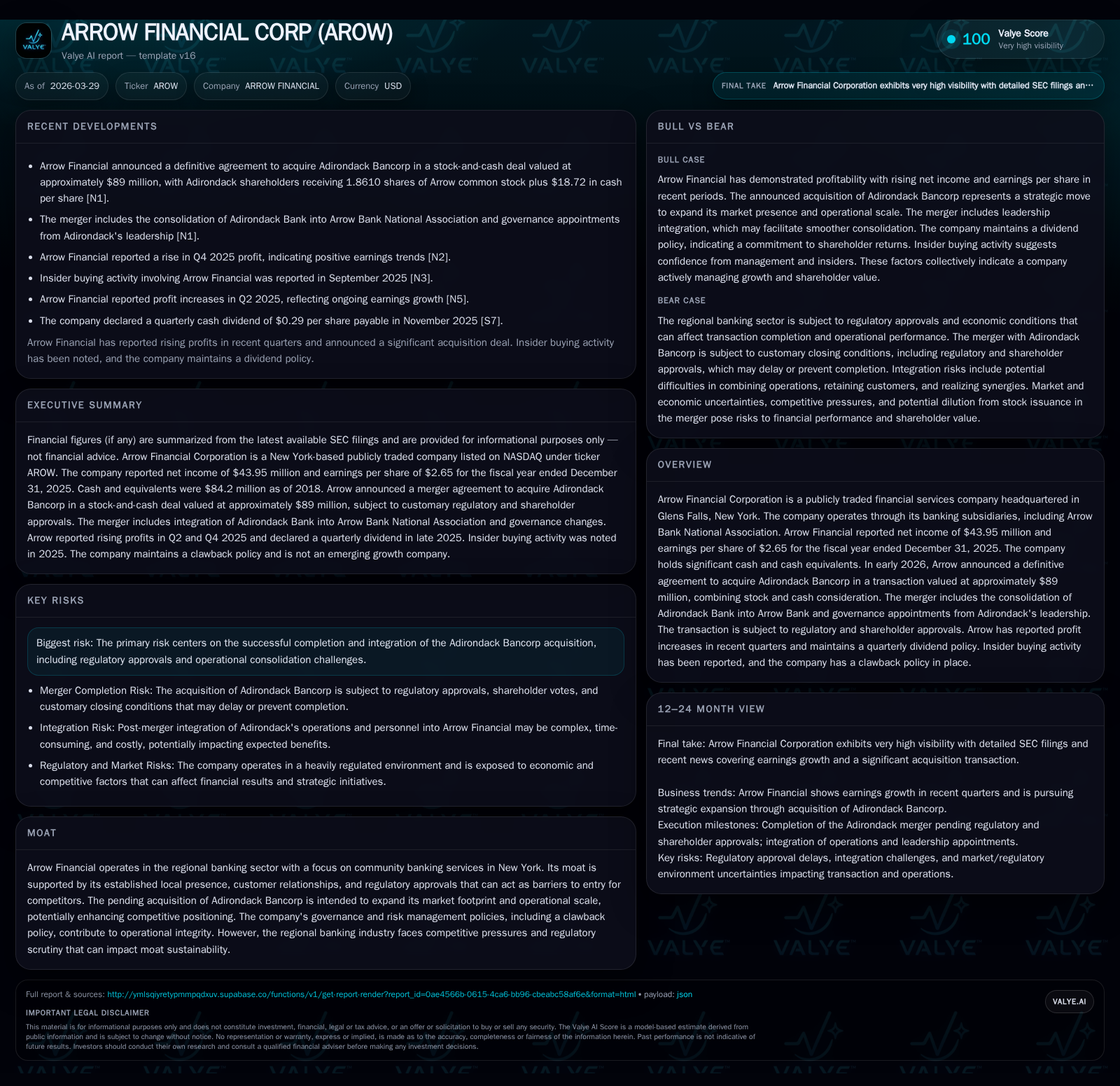
In fiscal year 2025, Arrow Financial Corp significantly ramped its net income by nearly 48%, backed by improved operating cash flow and moderated capital expenditures. The company announced an $89 million stock-and-cash merger with Adirondack Bancorp, aiming to broaden its community banking footprint in New York. Arrow maintains disciplined capital allocation with consistent dividends and increasing share repurchases, poised to balance growth investment with shareholder returns. While the acquisition offers considerable strategic upside, regulatory approvals and integration risks remain key uncertainties to monitor.
Robust Earnings Recovery and Growth Drivers up to 2025
Arrow Financial Corp demonstrated a remarkable rebound in profitability for fiscal year 2025, posting net income of $43.95 million—up nearly 48% compared to the prior year’s $29.71 million [F1]. This surge is corroborated by a corresponding improvement in operating cash flow, which rose close to 20% from $34.47 million to $41.28 million year-over-year. Meanwhile, capital expenditures exhibited a controlled reduction of approximately 9%, contributing to stronger free cash flow generation of roughly $36.2 million (operating cash flow minus capex) [F1]. Arrow’s equity base grew steadily over this period to nearly $432 million at year-end 2025, yielding an approximate return on equity of 10.2% based on net income and equity levels reported [F1]. These metrics indicate solid operational performance and effective capital management.
Historical performance (annual)
| FY | Net ($mm) | CFO ($mm) | Capex ($mm) | Net YoY |
|---|---|---|---|---|
| 2025 | 44 | 41 | 5 | +47.9% |
| 2024 | 30 | 34 | 6 | -1.2% |
| 2023 | 30 | 21 | 7 | -38.4% |
| 2022 | 49 | 60 | 14 |
Source: SEC companyfacts cache [F1].
Capital returns and efficiency (annual)
| FY | Buybacks ($mm) | FCF ($mm) | ROE% |
|---|---|---|---|
| 2025 | 10 | 36 | 10.2 |
| 2024 | 7 | 29 | 7.4 |
| 2023 | 4 | 13 | 7.9 |
| 2022 | 3 | 45 | 13.8 |
Source: SEC companyfacts cache [F1].
Note: Dividend data is available through FY2022; buyback amounts show a progressive increase through FY2025.
Capital Deployment Strategy and Shareholder Returns Analysis
Arrow has maintained a consistent quarterly dividend policy into early 2026, including a declared quarterly cash dividend of $0.30 per share payable February 25, 2026 [S15]. Capital returned via share repurchases accelerated notably from $2.87 million in FY2022 up to over $10 million in FY2025 [F1], signaling strong free cash flow capacity and management confidence amid expansion efforts [S26]. This balanced approach supports steady income returns alongside opportunistic enhancement of shareholder value through buybacks.
Additionally, Arrow implemented a clawback policy in December 2023 reinforcing executive accountability tied to financial reporting integrity [S1], an important governance enhancement.
The Adirondack Bancorp Acquisition: Strategic Rationale and Integration Challenges
On February 25, 2026, Arrow entered into a definitive agreement valued at approximately $89 million combining stock and cash consideration to acquire Adirondack Bancorp [N1][S3]. Each Adirondack share converts into approximately 1.861 shares of Arrow common stock plus $18.72 in cash per share [S17]. The transaction is structured as a tax-free reorganization under Section 368(a) of the Internal Revenue Code.
Governance provisions include appointing Adirondack’s CEO Rocco Arcuri Sr. as Regional President and board member immediately following the closing to support leadership continuity during integration [S17].
The transaction awaits customary regulatory approvals from the Federal Reserve Board, Office of the Comptroller of the Currency, and New York State Department of Financial Services—all required without imposing material adverse conditions for completion [S16][S23].
Risks highlighted include potential customer attrition, challenges retaining key personnel, complexities realizing synergies or cost savings within expected timeframes, possible revenue shortfalls post-merger, and management distraction during integration execution [S5][S6]. Termination fees apply under specified conditions if closing fails [S20]. Voting agreements among Adirondack insiders ensure supportive shareholder approval profiles while lock-up arrangements stabilize shares post-close [S27].
Liquidity Profile and Funding Structure Ahead of Merger Completion
While recent filings do not explicitly detail new debt issuances for the acquisition financing, Arrow's balance sheet as of fiscal year-end shows strong equity exceeding $430 million complemented by historical cash balances noted in prior years [F1][S23]. The company has demonstrated conservative leverage consistent with community bank regulatory expectations and maintains liquidity supported by operating cash flows exceeding capital expenditures [F1][S25].
Operational Outlook: Synergies, Market Expansion, and Risks to Monitor
Key upcoming milestones include shareholder voting on the merger following anticipated regulatory approvals [N1][S16]. The integration plan aims to merge Adirondack Bank into Arrow Bank National Association under a unified charter enhancing scale efficiencies within New York’s regional banking sector [N1][S17].
Potential revenue synergies may derive from cross-selling opportunities across combined customer bases; efficiency gains are targeted via technology platform consolidation and streamlined back-office operations.
SEC disclosures emphasize risks around regulatory timing or conditions affecting deal economics; integration challenges could dampen near-term earnings; cultural alignment and client retention will be critical success factors [S5][S6]. Market participants should monitor regulatory feedback and progress against synergy targets through forthcoming company communications.
Long-Term Competitive Positioning within New York Regional Banking
Arrow Financial operates primarily as a community bank anchored in Glens Falls, NY with established local market relationships providing defensible competitive advantages typical for state-chartered institutions. The acquisition expands geographic reach within New York enhancing branch density—a notable advantage against larger national banks and fintech entrants lacking physical presence.
Competitive pressures persist from national players exerting pricing pressure plus fintech innovation reshaping deposit gathering and lending paradigms. Maintaining disciplined credit controls combined with personalized service remains fundamental for Arrow's differentiation.
Governance improvements including transparent clawback policies enhance credibility amid heightened regulatory scrutiny faced by regional banks post-sector upheavals. This integrated approach supports resilience though macroeconomic uncertainties warrant ongoing vigilance regarding loan demand and asset quality trends.
This analysis synthesizes publicly filed SEC data alongside recent news reports without offering investment advice or recommendations; market participants should consider additional qualitative factors outside this summary when forming views.
Disclaimer: This is research-only, informational analysis and not investment advice. It may include AI-generated interpretation and general industry context. Always verify important details using primary sources.

Comments