
Opera Ltd’s Strategic Transformation and Revenue Surge in 2025
Examining Opera Ltd's growth driven by its fintech investment, evolving valuation challenges, and capital return strategies.
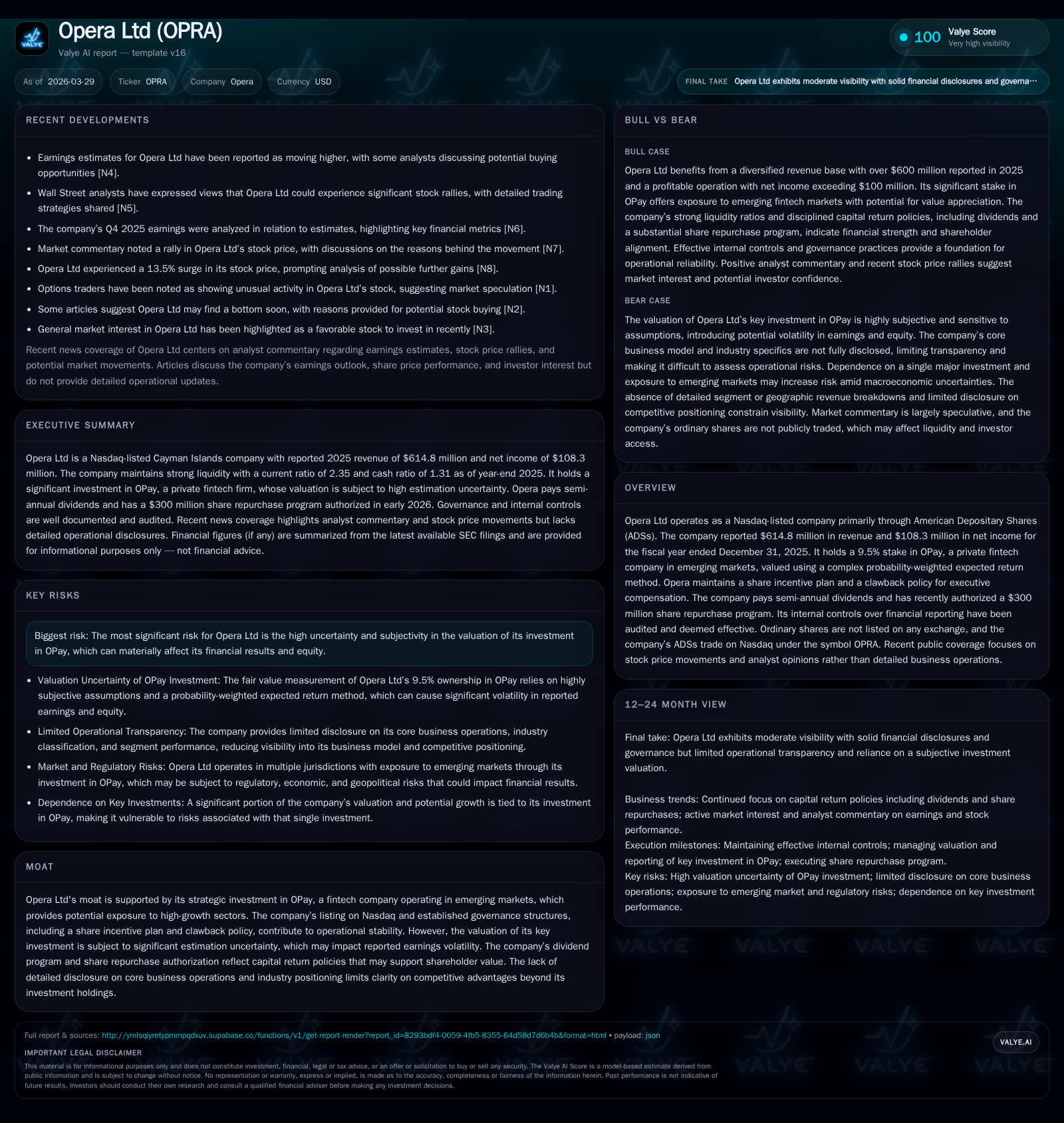
Opera Ltd recorded robust revenue growth of 27.9% in fiscal year 2025 to $614.8 million, propelled primarily by its strategic 9.5% stake in OPay, a fintech operator across emerging markets. The fair value measurement for this investment relies on a highly complex probability-weighted expected return methodology, introducing significant earnings volatility risk. The company maintained disciplined capital allocation with ongoing semi-annual dividends and a newly authorized $300 million share repurchase program. While fiscal 2025 net income rose 34.1% to $108.3 million, the evolving valuation inputs for OPay remain a critical variable shaping future reported performance.
Robust Revenue Expansion Fueled by Emerging Market Fintech Exposure
Opera Ltd's fiscal trajectory from 2022 through 2025 reveals strong top-line momentum anchored predominantly by its investment in OPay, a fintech company operating across African and Asian emerging markets. The reported annual revenues grew from approximately $331 million in FY2022 to $615 million in FY2025 — an impressive compound growth rate underpinned by robust operational assumptions tied to OPay's expected liquidity event outcomes [F1],[S1]. This expansion translates to a solid year-over-year increase of 27.9% between FY2024 and FY2025.
The company's equity base grew moderately alongside revenue at an average pace, registering shareholders' equity around $1.01 billion at the end of FY2025. Correspondingly, net income displayed meaningful improvement to roughly $108.3 million during the same period, lifting the approximate return on equity to around 10.7%, indicative of growing profitability alongside scale [F1].
Historical performance (annual)
| FY | Rev ($mm) | Net ($mm) | Rev YoY | Net YoY |
|---|---|---|---|---|
| 2025 | 615 | 108 | +27.9% | +34.1% |
| 2024 | 481 | 81 | +21.1% | -47.3% |
| 2023 | 397 | 153 | +19.9% | +919.6% |
| 2022 | 331 | 15 |
Source: SEC companyfacts cache [F1].
Capital returns and efficiency (annual)
| FY | Div ($mm) | ROE% |
|---|---|---|
| 2025 | 71 | 10.7 |
| 2024 | 70 | 8.6 |
| 2023 | 107 | 16.7 |
| 2022 | 1.7 |
Source: SEC companyfacts cache [F1].
*Net income and revenue experienced fluctuations due to earlier-stage investments and accounting adjustments [F1].
The magnitude of operational growth parallels rising expectations for OPay's exit scenarios realized through dynamic market deployment across key emerging regions.
Evolving Valuation Methodologies for OPay: Navigating Estimation Complexity
A central driver shaping Opera Ltd’s financial statements is its fair value measurement of the privately-held OPay stake, constituting approximately a quarter or more of Opera’s asset base by valuation metrics [S1],[S11]. Because OPay shares lack active markets, Opera uses a Level 3 valuation approach applying a Probability-Weighted Expected Return Methodology (PWERM).
This framework requires assigning subjective probabilities to potential exit scenarios such as IPOs or private sales with valuations ranging between $200 million and $6 billion—an extreme range highlighting inherent estimation uncertainty [S1]. Several non-observable inputs significantly influence valuation:
- Exit scenario weights: Estimations of likelihood for liquidity events.
- Estimated equity values: Variable scenario valuations.
- Timing: Projected liquidity windows spanning nine months to two years.
- Discount rates: Cost of equity decreased slightly in FY25 to approximately18.5%, reflecting refined risk assumptions.
- Liquidity discount: Typically set around ten percent due to OPay’s private equity illiquidity.
While corroborated through discounted cash flow models incorporating projected revenue growth near39% over subsequent years (through2031) and terminal growth rates around6%, minor changes in these assumptions can induce substantial volatility recognized immediately in profit or loss [S20]. This sensitivity subjects Opera's earnings to fluctuations beyond core business operations.
Analyzing Operating Profitability and Earnings Trends in Fiscal Year 2025
In FY25, Opera posted a net income of approximately $108 million, up34.1% year-over-year from roughly$81 million the prior year—rebounding from uneven profits experienced notably in FY23 where net income spiked before contracting [F1],[N2]. Analysts attribute this rise partly to improving operational contributions from OPay and refined costs structures [N2].
Calculated return on equity approximated10.7%, indicating reasonable capital efficiency within its investment-centric model.
Despite these gains, considerable earnings volatility persists due to recurrent fair value remeasurements tied to the Level3 assets classification under IFRS standards.
Capital Return Initiatives: Dividends and the $300 Million Share Repurchase Program
Opera Ltd formalized its commitment to shareholder returns by adopting a semi-annual dividend policy starting June2023, distributing$0.40 per ADS consistently every six months thereafter [S6],[S24]. The aggregate dividends paid totaled more than$71 million duringFY25 [F1].
Under Cayman Islands law—the company’s domicile—dividends may be disbursed from profits or share premium balances provided solvency is maintained, subject also to subsidiary cash availability constraints within jurisdictions such as Norway [S1],[S6]. Notably, this dividend policy remains discretionary per Board decisions contingent on financial results and capital needs.
In February2026, Opera announced a$$300 million share repurchase authorization over up to two years [S8],[S22]. The program permits buying back ADSs on the Nasdaq as well as pro-rata ordinary shares from major stakeholder Kunlun Tech Holding Limited without disturbing public free float percentages—strategically balancing liquidity management with ownership structure stability.
These coordinated moves reflect sophisticated capital allocation tactics leveraging both direct dividends and equity repurchases as mechanisms enhancing shareholder value amid cyclical fintech sector dynamics.
Governance Enhancements: Clawback Policies and Incentive Structures
Strengthening governance frameworks aligns with industry best practices for Nasdaq-listed firms managing complex investments like Opera Ltd’s holdings [S7],[S15]. In November2023, Opera instituted a clawback policy effectively enabling recovery of erroneously awarded incentive compensation from executives if later financial restatements reveal prior accounting noncompliance materially affecting reported results.
Additionally, Opera administers a tailored share incentive plan providing restricted share units (RSUs) and stock options to align employee interests with long-term company performance while incorporating dividend adjustments preserving award values [S15]. These measures support prudent compensation oversight amid heightened transparency expectations for externally held financial interests.
Prospective Growth Catalysts and Regulatory Risks on the Horizon
Analyst commentary highlights increasing earnings estimate revisions underpinning positive forward sentiment on Opera’s stock potential—with some upward price targets implying near77% appreciation prospects reflective of market optimism around OPay’s eventual monetization timing and performance trajectory [N1],[N4],[N6].
Nonetheless, considerable valuation uncertainty remains an overriding risk given reliance on Level3 inputs vulnerable to macroeconomic shifts impacting emerging market fintech regulatory environments particularly in Africa and Asia [S4],[S21]. Thus, prospective investors should monitor major KPIs such as upgrades to OPay’s operating performance metrics, progress toward exit liquidity events within forecast timelines, and evolving compliance landscapes affecting cross-border fintech activities.
Analyst Sentiment and Market Expectations: What To Watch Next
Recent market narratives underscore dynamic option trading activity that some interpret as anticipating near-term volatility or informative signals regarding stock movers beyond traditional volume patterns [N3],[N7]. Wall Street analysts increasingly view Opera as undervalued relative to underlying asset worth given growing confidence expressed through raised earnings projections—a trend reinforcing watchlists despite intrinsic complexity stemming from opaque private investment valuations [N6].
Key milestones likely influencing upcoming stock trajectories include timing clarity on OPay liquidity events combined with regulatory updates impacting operational jurisdictions plus continued execution discipline reflected through capital returns execution transparency.
This analysis reflects information publicly disclosed up through March29, 2026 without endorsing any particular investment action or forecast beyond stated facts and cited perspectives.
Disclaimer: This is research-only, informational analysis and not investment advice. It may include AI-generated interpretation and general industry context. Always verify important details using primary sources.

Comments