
EQV Ventures Acquisition Corp. II: Unlocking Value Through the SPAC Structure
Evaluating EVAC’s financial foundation, capital deployment strategy, and governance dynamics as it drives toward a critical business combination deadline.
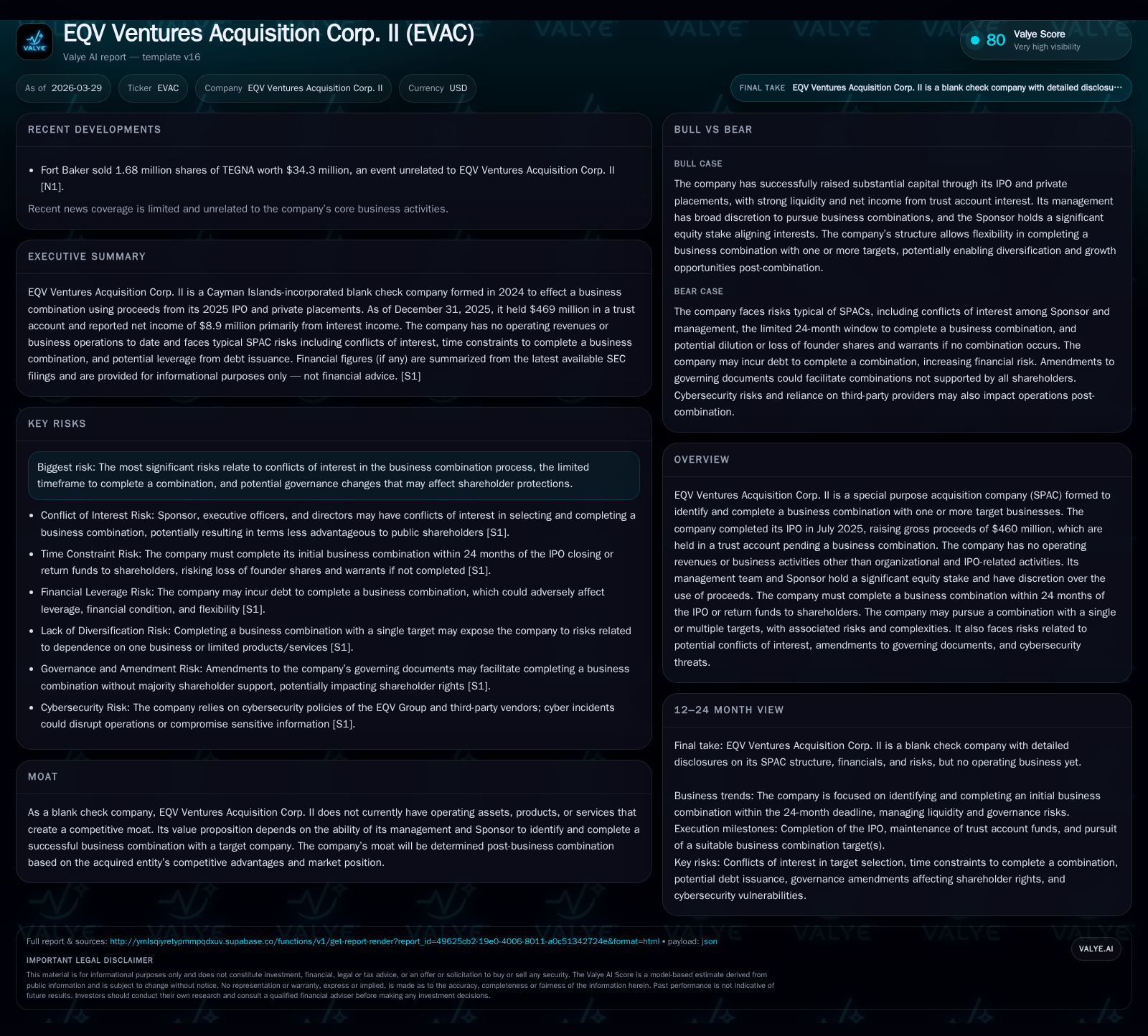
EQV Ventures Acquisition Corp. II (EVAC) launched in late 2024 as a Cayman Islands-incorporated SPAC, successfully raising $460 million gross in its July 2025 IPO with significant additional proceeds from private placements. As a blank-check vehicle, it has generated no operating revenues and maintains its substantial capital predominantly in a trust account invested in short-term U.S. Treasury bills. EVAC faces the imperative of completing a qualifying business combination within 24 months of its IPO or returning funds to shareholders. This report scrutinizes EVAC’s historical financials dominated by interest income, operating costs related to administrative compliance, sponsorship ownership alignment, liquidity readiness, and governance risks including potential conflicts of interest inherent to its sponsor-driven structure.
From Inception to IPO: EVAC’s Formation and Capital Raise
EQV Ventures Acquisition Corp. II was incorporated as a Cayman Islands exempted company on September 9, 2024, purpose-built as a special purpose acquisition company (SPAC) aimed at effecting a merger or similar business combination with one or more target companies [S1]. By July 3, 2025, EVAC completed its Initial Public Offering (IPO), issuing 46 million units at $10 each—including an over-allotment exercise totaling four million Units—raising $460 million in gross proceeds [S1] [F1]. Coinciding with the IPO closure was the completion of private placements consisting of 400,000 units sold to the Sponsor for $4 million and approximately 387,857 units issued to BTIG LLC at just under $3.9 million [S1] [S26]. These units replicate the public Unit structure: each includes one Class A ordinary share (Public Share) plus one-third of a redeemable warrant.
In parallel with the equity issuance, EVAC’s Sponsor obtained significant founder equity via Class B ordinary shares—initially buying in for $25,000 for over 10 million Class B shares—and subsequently receiving share capitalizations increasing this stake to roughly 11.5 million shares or around 20% of total outstanding common shares [S1] [S21]. Founder shares carry heightened risk as they may become worthless if no business combination occurs. Furthermore, founder shares are not subject to redemption rights granted to Public Shares.
The capital raised from both public and private sources was placed into a segregated Trust Account that invests exclusively in short-duration U.S. Treasury bills or equivalent government securities maturing within 185 days or less [S1] [S3]. This dedicated Trust Account preserves investors’ capital until either a suitable business combination is consummated or funds are returned upon liquidation triggered by failing the mandated timeframe.
Historical Financial Snapshot: Costs, Income, and Trust Account Dynamics
EVAC remains a blank-check entity with no operational revenues as it solely pursues identifying suitable acquisition targets [S1]. Operating expenses during its formation and IPO phase reflect administrative costs related to SEC filings, audit fees, underwriting expenses, legal fees, and initial organizational matters.
Accordingly, for the fiscal year ended December 31, 2025 — its first full year post-IPO — EVAC reported operating losses on an exclusive operational basis amounting to approximately $742k [F1]. However, these expenses were offset by interest income earned on the Trust Account investments totaling nearly $9.52 million during the same period [F1]. This net result produced an overall net income of about $8.92 million for FY2025 despite no revenue generation [F1]. Prior to the IPO in late 2024 (covering inception through year-end), EVAC incurred modest operating losses consistent with initial setup costs totaling about $57k without any substantive assets or income generated yet [F1].
Balance sheet snapshots reveal strong liquidity positioning: cash & equivalents stood at roughly $1.09 million supplemented by nearly half a billion dollars held within the Trust Account ($469 million) as of December 31, 2025 [F1] [S3]. Current assets totaled ~$1.2 million versus current liabilities at just $152k yielding an exceptionally strong current ratio close to eight times—a hallmark liquidity profile typical for pre-combination SPACs focused on capital preservation prior to acquisition deployment [F1].
Historical performance (annual)
| FY |
|---|
| 2025 |
Source: SEC companyfacts cache [F1].
Note: CFO denotes Cash Flow from Operations; data sourced from latest audited filings [F1], [S1]
Business Combination Timeline: Opportunities and Constraints Ahead
EVAC is bound by strict regulatory timelines typical for SPACs; it must complete its initial business combination within 24 months following its IPO closing date—here July 3, 2025—translating into a hard deadline around early July 2027 unless extended by shareholder consent or board approval [S1] [N1]. Failure to consummate such transaction triggers mandatory liquidation procedures where funds in the Trust Account would be returned pro rata to Public Shareholders less costs/withholdings.
This ticking clock injects urgency into management’s search processes while imposing constraints on target diligence thoroughness and deal structuring flexibility. Given EVAC's Sponsor exercises broad discretion over target selection and negotiation terms—and may rely heavily on management networks—the capability to source attractive targets before expiration is paramount but fraught with competition from myriad similar entities active in SPAC markets during this cycle.
Moreover, transaction complexity escalates when pursuing multiple simultaneous targets versus single deals due to integration risks and shareholder approval challenges.
Management Discretion and Sponsor Alignment: Potential Conflicts Explored
Sponsor alignment is double-edged in EVAC’s context: holding approximately 20% equity via founder shares plus private placement units aligns incentives towards deal success but concurrently introduces potential self-dealing conflicts during target evaluation or negotiation phases that could disadvantage Public Shareholders materially if transactions prioritize Sponsor interests over value maximization [S1] [S6].
Governance structures include independent directors tasked with oversight responsibilities including obtaining third-party fairness opinions typically used prior to approving combinations involving related parties affiliated with EQV Group—the Sponsor entity—to mitigate perceived conflicts though residual agency risk persists inherently due to incentive asymmetries.
Transparency mechanisms further extend through extensive SEC disclosure requirements concerning material agreements between EVAC and its Sponsor including reimbursement terms for out-of-pocket diligence expenses incurred by officers/directors which are paid outside of the Trust Account ensuring principal protection integrity for public investors [S6] [S20]. Nonetheless vigilance remains warranted especially when nearing timeline endpoints where pressures intensify.
Liquidity Profile and Capital Structure: Readiness for Future Deals
Balance sheet composition displays near pristine liquidity characteristics engineered per SPAC norms: the large majority of EVAC's assets reside within its Trust Account ($469M), invested primarily in ultra-short maturity U.S. Treasury bills designed specifically to preserve principal while generating taxable interest income that offsets operating outflows [S3] [F1].
Importantly deferred underwriting fees totaling $17.1 million are accrued as liabilities payable upon successful combination close or waived if no deal materializes—reflecting industry-standard compensation for underwriters which temporarily reduces deployable capital available immediately post-IPO but protects balance sheet integrity prior to consummation [S4] [S13].
Other payables include accrued offering costs ($288k) and legal fees ($209k), again consistent with primary focus on financing deal sourcing rather than operational expenditures or leverage usage since no debt apart from administrative fee arrangements ($40k/month paid to Sponsor affiliate) currently exists nor is envisioned imminently barring unexpected financing necessity pre-combination execution [S4] [S15] [F1].
Shareholder Returns and Capital Allocation: ROE and Distributions
As expected with blank check companies EVAC does not distribute dividends nor conduct share repurchases given absence of operational cash flow generation or profit harvest capability pre-business combination closing; all capital allocation decisions currently revolve around managing cost efficiency until unlocking value through acquisitions is realized [S14] [S19].
Calculated return on equity (ROE), derived from last reported net income divided by equity base manifests as negative roughly -54%, reflecting expensed organizational burdens surpassing investment yield when netted against shareholders’ deficit notwithstanding nominal positive consolidated net income arising from Trust asset interest uplift that sustains operational runway pre-merger execution ([F1]).
Post-acquisition ROE outlook remains contingent upon nature of acquired business(es), their profitability profiles and strategic execution capabilities rather than inherent pre-combination metrics given EVAC's function solely as an acquisition vehicle at present.
Investors should watch metrics such as announcement timing of binding agreements for initial business combination(s), shareholder vote outcomes relating to deal approvals/extensions impacting timing/capital deployment efficiency alongside any amendments altering redemption rights or warrant structures that could shift effective returns calculus substantially post-transaction closure.
Risks Unique to EVAC’s SPAC Model and Governance Considerations
EVAC enumerates several risks beyond standard business uncertainties emphasizing structural vulnerabilities common among SPACs:
- Conflicts of interest: Prominently those arising from Sponsor’s sizeable equity stakes combined with discretionary control over deal terms can create misalignment detrimental to public shareholders absent rigorous director independence safeguards and procedural fairness measures [S6].
- Regulatory/liability framework: Operating under Cayman Islands law introduces juridical complexities particularly regarding enforceability of judgments tied to U.S. federal securities laws potentially impairing recourse capabilities available domestically; courts there traditionally do not impose penal civil liabilities under U.S. law constraining investor remedies for securities violations assessed outside their local jurisdiction [S18].
- Credit concentration: Funds exceed FDIC insurance limits but remain invested primarily in U.S. Treasury bills mitigating credit risk though liquidity access remains subject to market conditions affecting valuations slightly above par value protections typical for government securities holdings herewith ([S5]).
- Amendments/Governance shifts: Potential shareholder voting on document changes such as extension approvals pose dilution risks linked directly with future timing uncertainties embedded intrinsically within SPAC lifecycle parameters often motivating rushed decision-making under duress scenarios ([N1]).
Key Milestones to Watch: Triggers for Value Realization or Risk Escalation
Looking ahead toward mid-2027 deadline guiding EVAC’s compulsory merger execution horizon investors should track:
- Announcement cadence: Disclosure of targeted acquisition candidates detailing sectors/geography/financial profiles meeting minimum asset valuation thresholds (~80% fair market value relative to Trust Account assets net permitted withdrawals).
- Shareholder votes: Formal approvals requested either via proxy meetings or tender offers impacting redemption rights associated directly with Class A ordinary shares subject to redemption provisions affecting liquidity timing.
- Sponsor activity: Additional fund injections via Working Capital Loans—authorized up to $1.5M convertible into post-deal units—or related party reimbursements possibly signaling pipeline firmness or funding scarcity.
- Extension requests: Board-sought extensions beyond original two-year window requiring shareholder consent typically indicating unresolved negotiation complexity but escalating risks linked with founder share forfeiture coupled with potential warrant expiration.
- Market context: Broader macroeconomic conditions influencing availability/pricing of acquisition financing materially alter final structuring/leverage appetite permissible post-combination.
Failure at any milestone translates into distribution scenarios where funds held plus accrued interests return pro rata without prudent upside capture leaving founder sponsor components worthless coupled possibly with warrant expirations negating ancillary economic participation.
Disclaimer: This analysis is informational only based on publicly filed documents dated through March 27th, 2026 ([F1], [S#], [N#]). It reflects no investment advice or recommendations regarding securities mentioned herein. Investors should conduct personalized due diligence considering evolving circumstances beyond this report's scope.
Disclaimer: This is research-only, informational analysis and not investment advice. It may include AI-generated interpretation and general industry context. Always verify important details using primary sources.

Comments