
Upstream Bio Advances Verekitug with Distinct TSLP Receptor Targeting Amid Escalating Losses
Upstream Bio develops a novel monoclonal antibody for severe respiratory diseases, progressing through pivotal trials while navigating clinical and financial challenges.
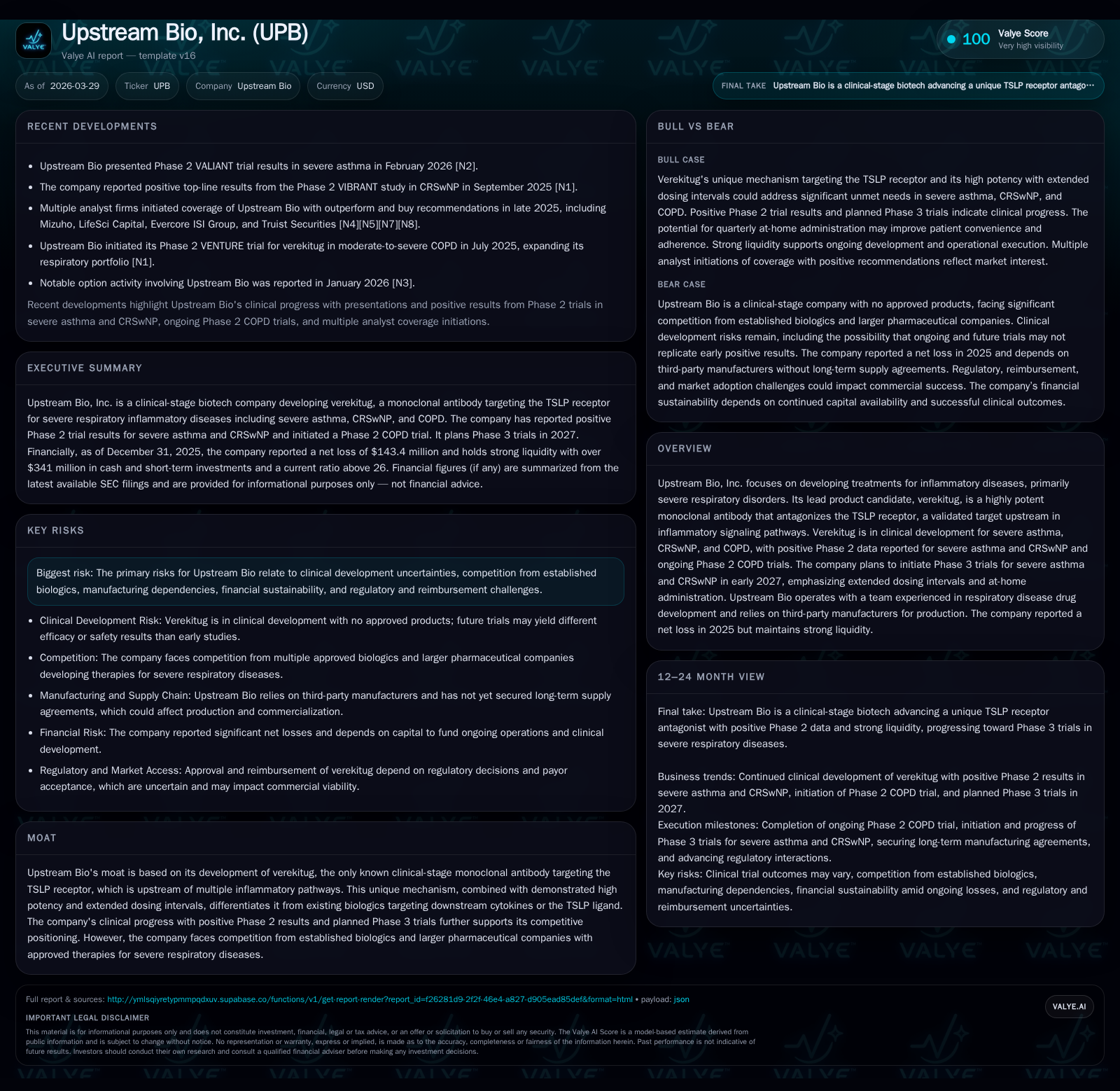
Upstream Bio, Inc. is a clinical-stage biotech firm pioneering verekitug, a highly potent monoclonal antibody antagonizing the TSLP receptor, targeting upstream inflammatory pathways in severe respiratory diseases including asthma, CRSwNP, and COPD. The company reported positive Phase 2 results for severe asthma and CRSwNP and plans Phase 3 initiation in early 2027 focused on extended dosing intervals and at-home administration. Despite these clinical advances, Upstream Bio’s financials reflect deepening net losses and negative operating cash flows in 2025, highlighting funding pressures as it invests heavily in R&D and clinical development. Dependence on third-party manufacturing and the competitive biologics landscape remain notable operational risks.
Company Overview
Upstream Bio, Inc., incorporated in Delaware in April 2021, is a biotechnology company focused on discovering and developing treatments for inflammatory diseases with an initial concentration on severe respiratory disorders such as asthma, chronic rhinosinusitis with nasal polyps (CRSwNP), and chronic obstructive pulmonary disease (COPD) [S1]. Its flagship product candidate, verekitug, is an innovative monoclonal antibody that antagonizes the Thymic Stromal Lymphopoietin (TSLP) receptor—a validated upstream target in inflammatory signaling cascades.
Unlike Amgen/AstraZeneca's FDA-approved tezepelumab—which targets the TSLP ligand—Upstream Bio’s approach differs mechanistically by targeting the receptor itself. This strategic positioning claims potential advantages including heightened potency and expanded patient applicability outside biomarker-restricted groups. The company aims to leverage this distinction to maximize clinical benefit across multiple disease indications.
Historical Financial Performance & Growth Drivers
Having reported its first full fiscal years since inception, Upstream Bio's financial performance underscores deepening net losses reflecting its investments into clinical programs. Key financial highlights are summarized below:
Historical performance (annual)
| FY | Net ($mm) | CFO ($mm) | OpInc ($mm) | Capex ($) | Net YoY |
|---|---|---|---|---|---|
| 2025 | -143 | -133 | -160 | 165000 | -128.4% |
| 2024 | -63 | -59 | -78 | 511000 |
Source: SEC companyfacts cache [F1].
Capital returns and efficiency (annual)
| FY | FCF ($mm) | ROE% |
|---|---|---|
| 2025 | -133 | -42.2 |
| 2024 | -60 | -13.4 |
Source: SEC companyfacts cache [F1].
The operating income loss widened by more than double (-106% YoY), driven primarily by escalating R&D expenditures associated with advancing multiple Phase 2 trials and preparing for impending Phase 3 studies [F1]. Correspondingly, net income declined by approximately -128% YoY indicating intensified funding requirements.
Operating cash flow demonstrated similar deterioration (-125% YoY), highlighting increased cash burn typical of late-stage clinical biotechs focused heavily on product development rather than revenue generation at this stage.
Capital expenditures remain minimal compared to operational spend, consistent with reliance on contract manufacturing organizations (CMOs) rather than internal production facilities [S1][S26].
Equity contracted from prior year primarily due to accumulated net losses but remains substantial at nearly $340 million providing runway adequacy through planned trials [F1]. The exceptionally high current ratio reflects liquidity strength but likely includes substantial liquid securities earmarked for near-term clinical activities.
Clinical Development & Future Growth Prospects
Upstream Bio’s drug development strategy centers entirely on verekitug:
- Severe Asthma: Positive top-line results from Phase 2 were disclosed in February 2026 demonstrating efficacy/safety profiles supportive of advancement.
- CRSwNP: Similar successful Phase 2 data was announced in September 2025.
- COPD: Initiated Phase 2 trial in July 2025; data pending.
- Phase 3 Plans: Dosing expected to start in Q1 2027 for severe asthma and CRSwNP without biomarker restrictions [S1][N1].
Clinical differentiation lies chiefly in targeting the TSLP receptor—unlike frequent ligand-targeting biologics approved currently—which could translate into improved efficacy or dosing convenience (quarterly administration at home).
However, commercialization will hinge critically upon Phase 3 outcomes confirming both safety and superior or comparable efficacy versus established biologics such as those targeting IL-5/IL-4/IL-13 or tezepelumab's ligand blockade.
Forecasts & Milestones to Monitor (Analysis)
Despite detailed pipeline disclosures, Upstream Bio has not provided explicit revenue guidance or commercialization timelines beyond planned Phase 3 initiations [N1][S1]. Near-term milestones to watch include:
- Completion of ongoing COPD Phase 2 trial with topline readouts.
- Enrollment progress and interim data releases from upcoming Phase 3 trials.
- Regulatory engagement outcomes concerning dosing flexibility claims.
- Strategic decisions regarding commercialization partnerships or potential licensing agreements considering manufacturing dependencies.
These milestones will heavily influence valuation inflection points given the lack of alternative product candidates or revenue sources currently.
Returns & Capital Allocation Analysis
With no revenues yet generated from products in market:
- ROE: Approximately -42% calculated as net loss relative to year-end equity indicating significant capital consumption without returns to date [F1].
- Cash Flow: Negative free cash flow of about $133 million consistent with early-stage biotech expenditure patterns focusing on clinical operations over CAPEX-intensive infrastructure growth [F1].
- Dividends or Share Buybacks: None disclosed; typical for pre-commercial biotechs reinvesting capital toward pipeline progression.
Liquidity is primarily preserved via equity raises supported by institutional investors betting on future efficacy breakthroughs rather than operational cash flow generation.
Operational Structure & Manufacturing Dependencies
The company employs approximately 75 full-time personnel with a focus on research functions supplemented by outsourced consultants [S16]. It occupies leased office space in Massachusetts adequate for current operations but may require expansion upon commercial scaling.
Manufacturing relies entirely on third-party contractors compliant with cGMP standards vetted by regulatory authorities [S26], mitigating fixed asset risks but exposing Upstream Bio to supply chain vulnerabilities common in biologics development.
Industry Context & Competitive Risks (Analysis)
The respiratory biologics sector is crowded with seven already FDA-approved treatments for severe asthma and overlapping indications addressing CRSwNP and COPD [S1]. Tezepelumab's approval since late 2021 validated TSLP as an upstream target; however, it focuses on the ligand rather than receptor interaction targeted by verekitug—a small but potentially meaningful mechanistic gap offering differentiation opportunities.
Price pressures stemming from increased scrutiny under healthcare reforms like the Inflation Reduction Act and proposals influencing Medicare pricing will impact eventual market access dynamics [S12–S16][S20]. Additionally, regulatory complexities including reporting obligations under HIPAA/HITECH rules alongside evolving European GDPR-influenced requirements add layers of compliance risk for global development plans [S9–S11][S22–S24].
Potential barriers include competition from entrenched pharmaceutical companies with broader commercial infrastructures capable of faster market penetration post-approval and superior pricing negotiation leverage.
Regulatory Landscape & Risk Factors Summary
Upstream Bio faces multiple risks typical for clinical-stage biopharma:
- Uncertainties inherent to drug development such as trial failures or delayed enrollments.
- Financial sustainability amid steep losses demanding ongoing capital raises risking dilution.[F1][S4]
- Manufacturing scale-up challenges dependent on external suppliers meeting stringent quality controls.[S26]
- Market access challenges amid shifting reimbursement policies that could restrict uptake or mandate price concessions.[S12]
- Legal compliance across jurisdictions governing promotion practices especially around off-label use.[S9]
- Data privacy laws constraining handling of sensitive patient-trial information globally.[S10–S11]
Though these risks are partly offset by promising clinical data and a differentiated therapeutic hypothesis centered on an unmet need segment within chronic respiratory diseases, execution remains critical as Upstream Bio approaches pivotal phase transitions.
This analysis summarizes publicly available information as of March-April 2026 concerning Upstream Bio’s strategic focus, clinical development status, financial condition, operational model, industry context, risks, and outlook without offering investment advice or price assessments.
Disclaimer: This is research-only, informational analysis and not investment advice. It may include AI-generated interpretation and general industry context. Always verify important details using primary sources.

Comments