
Inhibikase Therapeutics Advances Toward Phase 3 Pivotal Trial amid Rising Operating Losses
Clinical-stage biopharmaceutical Inhibikase Therapeutics pushes forward with the IMPROVE-PAH Phase 3 study for IKT-001 while managing increasing net losses and maintaining strong liquidity.
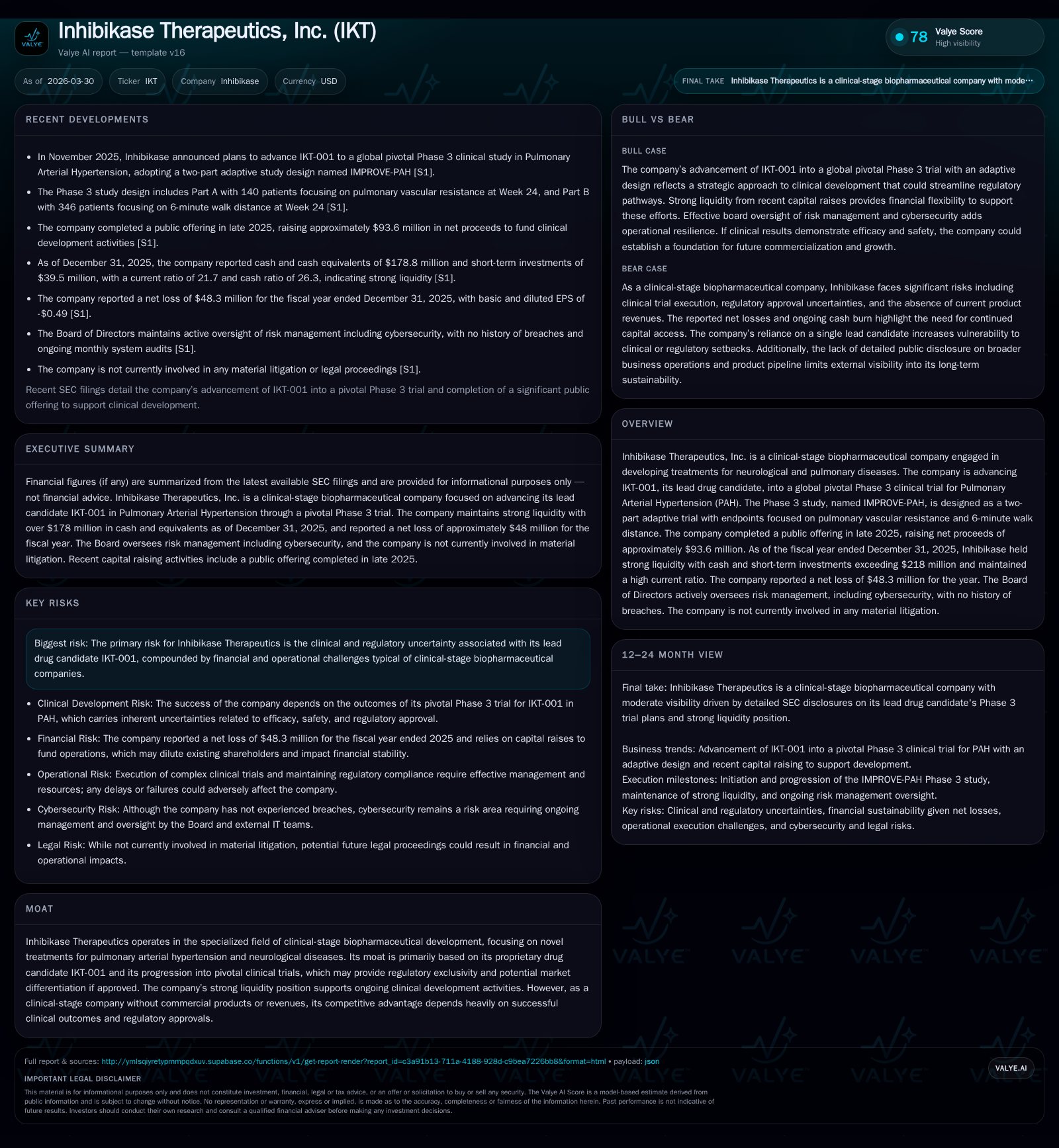
Inhibikase Therapeutics is advancing its lead candidate, IKT-001, into a globally adaptive pivotal Phase 3 trial targeting Pulmonary Arterial Hypertension, emphasizing endpoints such as pulmonary vascular resistance and six-minute walk distance. This clinical momentum coincides with a significant increase in operating losses, which reached $51.97 million in FY2025, up sharply from prior years. The company’s robust liquidity position, bolstered by a $93.6 million capital raise in late 2025, supports ongoing development but underscores the need for sustained funding until potential regulatory approval. Board-level governance initiatives include focused cybersecurity oversight to safeguard critical data integrity throughout the trial process.
Steady Momentum into the IMPROVE-PAH Phase 3 Trial
Inhibikase Therapeutics has elected to advance its lead drug candidate, IKT-001, directly into a global pivotal Phase 3 clinical trial for Pulmonary Arterial Hypertension (PAH), named IMPROVE-PAH [S18]. This marks a strategic shift from the initially planned Phase 2b to a two-part adaptive design following Type C FDA interactions encouraging this approach [S18]. The adaptive trial incorporates Part A — a double-blind, placebo-controlled study assessing pulmonary vascular resistance (PVR) at Week 24 among approximately 140 patients — followed seamlessly by Part B evaluating the six-minute walk distance (6MWD) endpoint in roughly 346 patients also at Week 24 [S18]. Key benefits include an initial dose-titration phase allowing dose optimization, uninterrupted patient enrollment between parts, and potential sample size re-estimation based on Part A results.
This design leverages regulatory precedents for PAH pivotal studies where both hemodynamic markers like PVR and functional outcomes such as 6MWD are recognized as clinically relevant efficacy endpoints. The global scope involves up to about 180 sites worldwide, positioning Inhibikase to generate comprehensive data for FDA review [S18]. The accelerated move reflects confidence bolstered by prior data and regulatory feedback but simultaneously concentrates risk on achieving positive outcomes.
Financial Evolution: Deepening Operating Losses Reflect Development Focus
The intensification of clinical efforts is mirrored in Inhibikase's financial performance through escalating operating losses. For FY2025, operating income recorded a deficit of approximately -$51.97 million compared to -$28.59 million in FY2024—a deterioration of nearly 82% year-over-year [F1]. Correspondingly, net losses widened markedly to about -$48.26 million from -$27.52 million the prior year [F1], exemplifying growing expenses associated with late-stage development activities.
Operating cash flows are also increasingly negative, reaching -$27.78 million in FY2025 versus -$19.15 million in FY2024 [F1]. Capital expenditures remained modest at roughly $13,399 during FY2025 [F1], indicating primary cash burn stems from research and development rather than fixed asset investment.
This loss trajectory is typical of clinical-stage biopharmaceutical firms intensifying trial execution prior to commercialization when revenue streams remain absent.
Evaluating Liquidity Resilience and Capital Structure Management
Despite mounting losses, Inhibikase demonstrates robust liquidity buffers supporting ongoing operations through the costly Phase 3 period. At December 31, 2025, cash and short-term investments stood near $178.8 million with current assets totaling approximately $180.1 million against current liabilities around $8.3 million yielding an exceptionally high current ratio of ~21.7x [F1]. Such ample working capital resources afford flexibility uncommon among peers navigating extensive late-stage trials.
Recent filings indicate no material debt obligations or leverage constraints reflecting prudent capital stewardship preserving solvency amidst expansionary R&D spending [S14][S15][S23].
Strategic Capital Allocation: Public Offering and Warrant Amendments
Funding this scale of development necessitated fresh capital infusion via equity offerings rather than debt instruments. In late 2025, Inhibikase completed an underwritten public equity offering raising net proceeds close to $93.6 million after fees [S19][S20]. This financing round included common stock sales alongside pre-funded warrants designed to minimize shareholder dilution while providing immediate capital inflow [S20].
Additionally, the Company amended terms on outstanding Series A-1 and B-1 warrants to align incentives with its expedited clinical development strategy for IKT-001 advancement [S16][S17]. These warrant adjustments enhance financing flexibility while managing potential dilution overhang from convertible securities.
Consistent with its clinical-stage status and lack of revenues, no dividends or share repurchases occurred during this period; all capital was directed toward pipeline advancement [S9][S10][S11][S12][S13].
Clinical and Regulatory Outlook: What Investors Should Track
The IMPROVE-PAH study serves as the linchpin catalyst underpinning Inhibikase’s growth prospects contingent upon positive outcome realization. Primary milestones include commencement of Part A patient enrollment anticipated in Q1 2026 followed by adaptive transition into Part B without delay [S18]. Interim data readouts especially from PVR changes will be closely monitored by regulators given their established correlation with PAH morbidity.
Regulatory risk remains significant; failure to meet pivotal endpoints could affect approval timelines or require additional studies potentially extending cash burn horizons [S4]. Conversely, success would solidify IKT-001's differentiation potentially translating into orphan drug exclusivity and market entry barriers for competitors.
Continuous FDA engagement will be critical; subsequent filings including New Drug Application (NDA) hinge upon robust trial results supportive of safety and efficacy benchmarks.
Governance Spotlight: Board Oversight on Cybersecurity and Risk
Inhibikase places considerable emphasis on governance practices specifically relating to operational risk management including cybersecurity—a critical factor given reliance on electronic data capture systems across multinational trials [S1][S8]. The Board exercises direct oversight through reviewing policies annually coupled with monthly management reports arising from dedicated external IT audits ensuring rapid identification and remediation of vulnerabilities.
This structured approach mitigates risks inherent in distributed data environments preserving clinical integrity essential for regulatory scrutiny while maintaining stakeholder confidence.
Summary of Key Financial Metrics: Revenue Absence, Loss Trajectory, and Cash Flows
The following table distills core annual financial indicators illustrating Inhibikase’s fiscal evolution over four years through FY2025:
Historical performance (annual)
| FY | Net ($mm) | CFO ($mm) | OpInc ($mm) | Capex ($) | Net YoY |
|---|---|---|---|---|---|
| 2025 | -48 | -28 | -52 | 13399 | -75.4% |
| 2024 | -28 | -19 | -29 | 0 | -44.6% |
| 2023 | -19 | -18 | -20 | 14238 | -5.4% |
| 2022 | -18 | -17 | -18 | 243255 |
Source: SEC companyfacts cache [F1].
Capital returns and efficiency (annual)
| FY | FCF ($mm) | ROE% |
|---|---|---|
| 2025 | -28 | -27.9 |
| 2024 | -19 | -29.0 |
| 2023 | -18 | -173.3 |
| 2022 | -18 | -85.8 |
Source: SEC companyfacts cache [F1].
All figures USD millions except percentages; OpInc = Operating Income; Net = Net Income; CFO = Operating Cash Flow; Capex = Capital Expenditure; Equity includes accumulated deficit adjustments [F1]
Approximate ROE calculated for FY2025 stands at roughly -27.9%, reflective of net losses against shareholders’ equity highlighting ongoing investment stage challenges [F1]. Negative free cash flow near $27.8 million reinforces dependency on external financing as internal cash generation remains insufficient.
Disclaimer: This analysis is prepared solely for informational purposes regarding Inhibikase Therapeutics’ business developments and financial condition as reported publicly up to March 30, 2026.
Disclaimer: This is research-only, informational analysis and not investment advice. It may include AI-generated interpretation and general industry context. Always verify important details using primary sources.

Comments