
Gores Holdings X Faces Liquidity Strains and Sponsor Control Ahead of Mandatory Business Combination
GTEN’s limited operating history, regulatory reviews, and sponsor voting power complicate its plans to complete a business combination before May 2027.
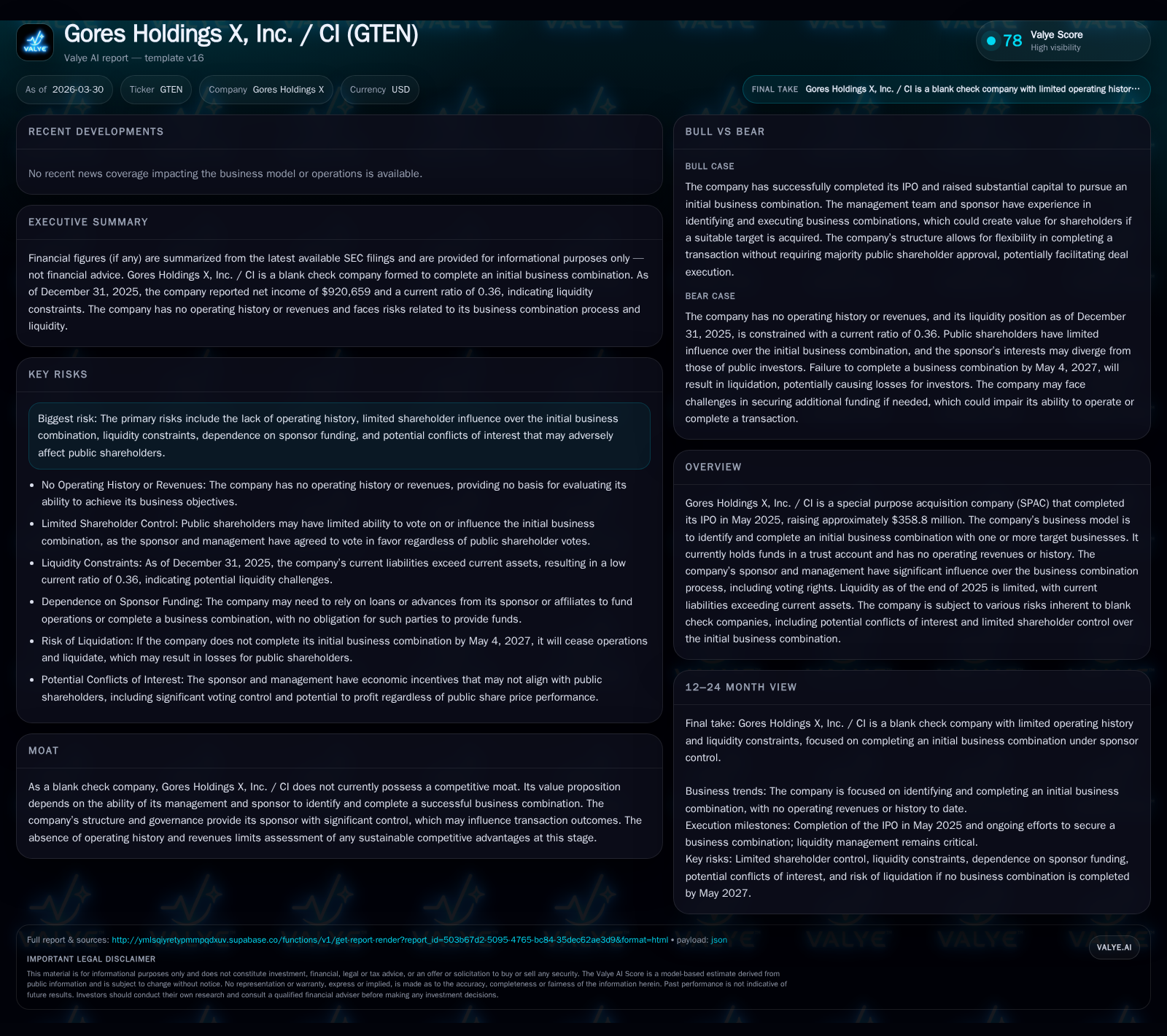
Gores Holdings X, Inc. (GTEN) is a blank check company formed through a May 2025 IPO that raised approximately $358.8 million. The company has no operating history or revenues and holds IPO proceeds in a trust account while seeking a business combination. As of year-end 2025, GTEN reported an operating loss of $1.85 million but net income of about $0.92 million due to non-operating gains. Liquidity pressures are evident with current liabilities significantly exceeding current assets, yielding a current ratio of 0.36. Sponsor control is extensive, including voting founder shares in favor of the business combination regardless of public shareholder opinion and potential share purchases that affect voting dynamics. Public shareholders primarily rely on redemption rights, which may complicate deal execution. Regulatory reviews, including CFIUS considerations for foreign involvement, and legal risks present additional challenges as GTEN aims to complete a business combination by May 2027 or face liquidation.
SPAC Formation and Capital Structure
Gores Holdings X, Inc., trading as GTEN, was established as a special purpose acquisition company through its May 2025 IPO which raised approximately $358.8 million. These proceeds are held in a trust account reserved exclusively for funding the company's initial business combination transaction [F1]. By design, GTEN has no revenues or operating history since inception.
The trust account mechanism safeguards investor capital until deployment but inherently delays revenue generation and operational cash flow.
Financial Overview and Liquidity Position
For the fiscal year ended December 31, 2025, GTEN reported an operating loss of $1.85 million primarily related to IPO expenses and organizational costs without offsetting revenues [F1]. However, net income was positive at approximately $0.92 million mainly due to non-operating income such as interest earned on trust assets.
Liquidity metrics reveal constraints: current assets totaled $975,309 against current liabilities of $2,686,141 resulting in a current ratio near 0.36—a level indicative of working capital deficiency that necessitates sponsor support or other financing to sustain operations during the search for target businesses [F1][S7][S15].
Historical performance (annual)
| FY |
|---|
| 2025 |
Source: SEC companyfacts cache [F1].
Governance Dynamics and Sponsor Influence
Sponsor control is pronounced; founders and insiders have contractually agreed to vote their founder shares in favor of any proposed business combination regardless of public shareholder dissent [S1]. These insiders may also acquire additional shares or warrants before closing deals potentially diluting public float and influencing vote outcomes [S26].
This structure expedites decision-making but elevates governance risk by limiting public shareholders’ influence over critical decisions including approval processes and redemption rights.
Shareholder Rights and Redemption Mechanisms
Public shareholders primarily rely on redemption rights permitting exit via cash payments prior to consummation if they disapprove proposed transactions [S1][S8][S12]. However, redemptions introduce complexities: they can deter targets wary of uncertain cash outflows post-announcement and reduce deal liquidity necessary for minimum cash thresholds common in SPAC transactions.
Thus, shareholder influence beyond redemption remains limited.
Regulatory and Legal Risk Environment
Material risks include potential litigation against management relating to fiduciary duties which could divert resources and attention [S3][S4][S6]. Regulatory reviews such as those conducted by CFIUS pose possible delays or blocks particularly if foreign ownership or sensitive technologies are involved—significant given the May 2027 deadline for completing the business combination [S18][S22].
Moreover, Cayman Islands jurisdiction provisions constrain shareholder remedies relative to U.S.-incorporated entities; forum selection clauses may increase costs or limit dispute avenues for investors [S16][S25][S28].
Failure to finalize a business combination within the prescribed timeframe will result in liquidation with distributions limited to remaining trust account funds less expenses—potentially diminishing shareholder value below IPO levels.
Outlook and Strategic Considerations
While GTEN does not provide explicit guidance on target sectors or deal structures in filings analyzed here, market participants should monitor developments closely for indications of transaction progress.
Sponsor incentives aligned with promote structures and potential dilution from warrants warrant thorough due diligence once targets emerge publicly.
Post-combination capital structure may involve leverage but lacks direct disclosure at this stage.
Capital Allocation Approach: Trust Account Constraints
GTEN's capital management centers on preserving IPO proceeds within the trust account until consummation of qualifying transactions [F1][S26]. This preserves principal but restricts flexibility: no dividends or buybacks have been declared given absence of earnings generation thus far.
ROE stands at approximately -2.9%, reflecting initial operating losses without revenue streams post-IPO [F1]. Sponsor loans provide working capital outside the trust account but carry repayment obligations contingent on successful deal closure introducing counterparty risk [S7][S15].
Investor returns depend primarily on successful execution of the initial business combination rather than near-term cash flows.
This analysis relies entirely on disclosed information from GTEN’s SEC filings including annual (10-K) and quarterly (10-Q) reports as of March 30, 2026. It highlights key financial metrics alongside governance structures and risk factors shaping GTEN’s path through the SPAC lifecycle toward an initial business combination under significant timing pressure.
Disclaimer: This is research-only, informational analysis and not investment advice. It may include AI-generated interpretation and general industry context. Always verify important details using primary sources.

Comments