
21Shares Solana ETF’s Volatility and Validation: Tracking SOL’s Passage
A detailed look at 21Shares Solana ETF’s approach to delivering passive exposure to SOL while navigating staking rewards, liquidity frameworks, and regulatory complexity.
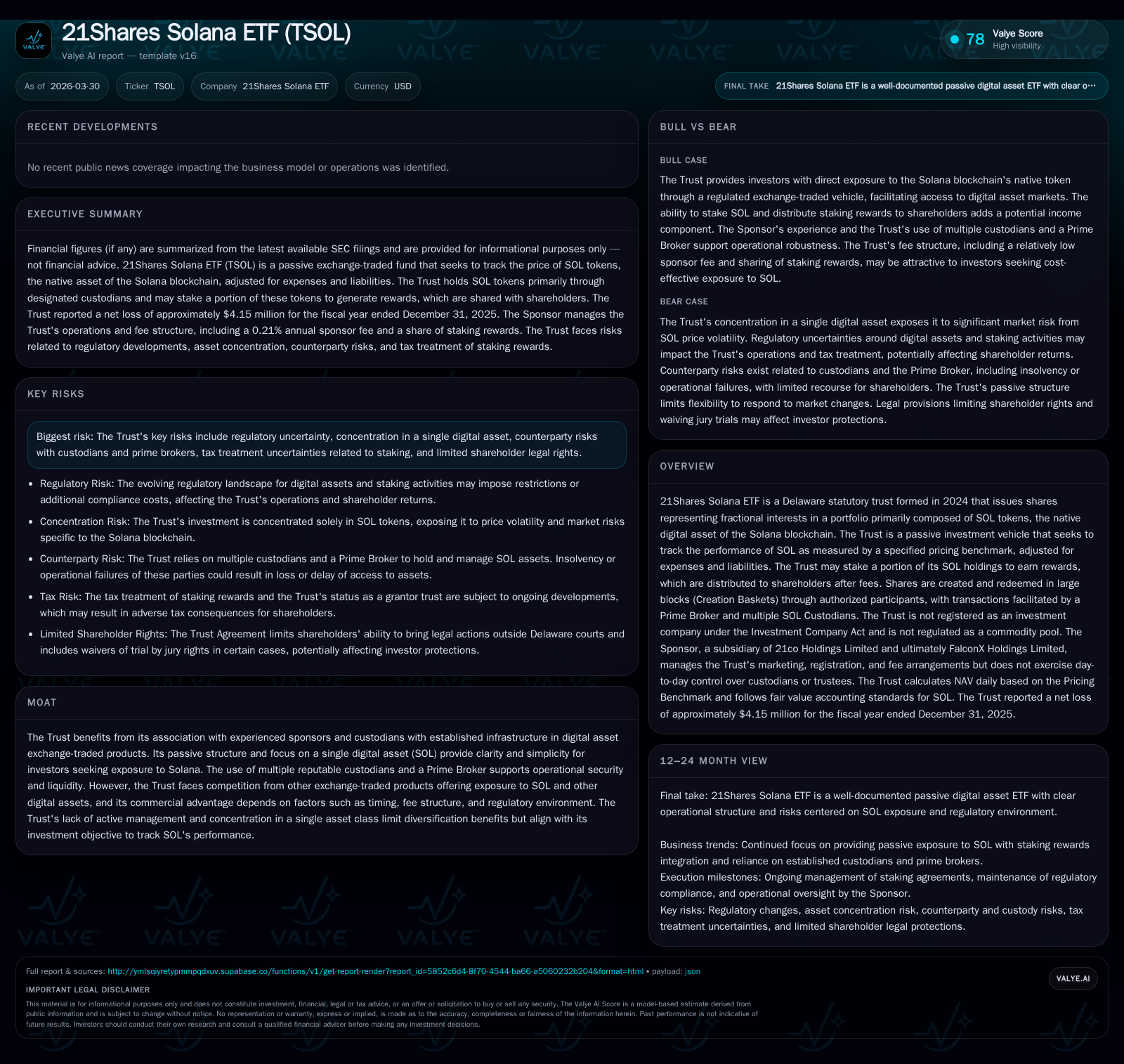
The 21Shares Solana ETF (TSOL) launched in 2024 as a Delaware statutory trust designed to offer investors a straightforward way to access SOL’s performance. Its passive structure reflects the underlying Solana token price fluctuations, augmented by staking rewards that are carefully balanced against liquidity needs and legal constraints. Despite negative net income in 2025 driven primarily by market volatility and operating expenses, the trust leverages a robust authorized participant creation/redemption model facilitated by multiple custodians and a prime broker. Regulatory uncertainty, technological risks inherent to the Solana blockchain, and counterparty exposures represent ongoing challenges, even as the sponsor’s global crypto ETP expertise offers a degree of operational stability. Monitoring future SOL price dynamics, regulatory clarity, and staking protocol evolution will be essential for assessing TSOL’s continued viability.
Origins and Historical Performance: Tracking SOL Since Inception
21Shares Solana ETF (TSOL) was established in 2024 as a Delaware statutory trust designed to provide passive exposure to the native token of the Solana blockchain (SOL). The Trust aims to track the CME CF Solana-Dollar Reference Rate's performance, adjusted for expenses [S1]. It does not engage in active management or use leverage or derivatives.
For the fiscal year ending December 31, 2025, TSOL reported net losses of approximately $4.15 million USD with a return on equity (ROE) of -72.3% according to company facts [F1]. This financial outcome primarily reflects pronounced volatility in SOL prices alongside operating expenses largely related to Sponsor fees.
Between January 1, 2024 and December 31, 2025, SOL prices fluctuated widely from lows near $81.25 to highs near $295 per token [S1], causing significant net asset value swings for TSOL shareholders given its concentrated exposure.
Historical performance (annual)
| FY |
|---|
| 2025 |
Source: SEC companyfacts cache [F1].
Note: Equity figures underlying ROE are from the latest available data in [F1].
Staking Rewards as Growth Drivers and Structural Nuances
Solana operates on a proof-of-stake consensus mechanism allowing token holders such as TSOL to delegate tokens for staking services that secure the network while generating rewards. TSOL contracts with third-party staking providers including Figment Inc., Coinbase Crypto Services LLC, and Twinstake Ltd. under agreements executed early in 2026 [S3],[S23].
Staking contributes positively by increasing token holdings beyond price appreciation but is carefully balanced against liquidity needs driven by redemptions and mandatory unbonding periods intrinsic to the Solana protocol [S23]. Typically, TSOL stakes between approximately 70-90% of its total SOL holdings.
Rewards generated are subject to fees paid both to service providers (generally low single-digit percentages) and the Sponsor (10% of net rewards after deduction), which reduces gross yield capture [S18]. These staking rewards are intended for direct distribution to shareholders quarterly.
Tax implications also influence staking decisions since staking income may generate shareholder tax liabilities distinct from capital gains treatment [S2]. The Sponsor exercises discretion over staking participation accordingly.
Regulatory and Operational Risks Defining Trust Resilience
TSOL faces ongoing regulatory uncertainty particularly regarding whether SOL constitutes a "security" under U.S. law—a matter presently unsettled [S11],[S20]. The Sponsor currently believes SOL is not a security based on public information but recognizes this determination carries legal risk.
Potential regulatory outcomes include forced registration under investment company statutes or mandated liquidation adversely affecting shareholder value. The SEC has intensified examinations focusing on risk disclosures, pricing practices, custody safeguards, and fraud prevention in digital asset funds generally [S10].
Operationally, risks include vulnerabilities inherent in Solana's relatively young protocol such as potential forks or scaling challenges that could impact valuation or investor confidence [S1],[S4].
Custodial counterparty risk exists despite multi-custodian arrangements (Coinbase Custody Trust Company LLC, BitGo Bank & Trust N.A., Anchorage Digital Bank N.A.), as liability protections limit recourse absent gross negligence or willful misconduct [S14].
Prime brokerage arrangements further introduce counterparty risk since assets are held in omnibus accounts without full segregation—facilitating liquidity but increasing exposure should insolvency occur [S7],[S14].
Trust Agreement provisions limiting litigation avenues—including exclusive Delaware jurisdiction clauses and waivers of jury trials—may restrict shareholder recourse options [S2].
Liquidity Mechanisms and Capital Structure Dynamics
TSOL shares trade publicly on Cboe BZX Exchange under ticker TSOL with creation/redemption mechanisms designed to keep trading prices closely aligned with NAV. Only authorized participants may transact directly with the Trust through "creation baskets" typically sized at multiples of 10,000 shares [S5],[S26].
Creation can be effected either through cash deposits converted into SOL by third-party counterparties or via direct delivery of SOL tokens into custodian accounts held by Coinbase Custody, BitGo Bank & Trust N.A., or Anchorage Digital Bank N.A., ensuring diversified custody arrangements [S5],[S8]. Redemptions similarly settle through cash proceeds or in-kind token distributions.
The Trust charges a Sponsor fee annually approximating 0.21% of NAV payable weekly in SOL and covering ordinary operating expenses excluding extraordinary items such as litigation costs [S18]. Spread costs during cash creations/redemptions are borne by authorized participants alone.
No leverage or derivatives are utilized; prudent asset safety considerations guide conservative operational posture avoiding collateralization risk [S8].
Investor Returns, Capital Allocation, and Stewardship Insights
As a statutory trust without investment company registration status under the Investment Company Act of 1940, TSOL does not pay dividends nor conduct share repurchases. Instead distributions relate solely to direct pass-through staking rewards paid quarterly to shareholders [F1],[S16],[S18],[S21],[S25],[S26].
The fee structure internalizes operating costs into NAV management while aligning incentives toward sustaining product viability amid competitive pressures from other digital asset ETPs.
Reported net losses reflect structural challenges exposed by volatile underlying assets combined with fixed operational costs covered by fees.
Future Growth Pathways Within a Maturing Crypto Ecosystem
TSOL’s growth prospects depend on broader institutional adoption of digital assets generally—and specifically confidence in Solana’s network robustness coupled with scalability improvements.
The Sponsor draws on extensive experience managing over $7.56 billion across more than sixty digital asset exchange-traded products globally since 2018—leveraging operational expertise across jurisdictions despite regulatory uncertainties [S6].
Regulatory developments remain critical unknowns; proposed SEC custody rule amendments could reshape service provider eligibility requiring costly adjustments potentially disrupting operations temporarily [S10].
Expanding staking participation balanced prudently against liquidity constraints imposed by unbonding periods alongside competitive fee positioning relative to alternatives will be key factors shaping future viability.
Key Milestones and Metrics To Monitor in TSOL’s Trajectory
While explicit company milestones beyond regulatory filings are limited, an analytical focus should track:
- SOL token spot price movements and volatility patterns influencing NAV;
- Regulatory clarifications from SEC/CFTC affecting classification and custody rules;
- Updates on staking reward rates from service agreements such as those with Figment Inc.;
- Protocol upgrades impacting unbonding periods or fork handling within Solana network;
- Custody regulation changes potentially altering provider landscape;
- Quarterly SEC filings revealing legal proceedings or material policy changes affecting fees or staking approach.
Monitoring these indicators will inform assessments of TSOL’s capacity to sustain market relevance amid evolving economic conditions inherent in crypto-asset ecosystems.
Disclaimer: This analysis is based solely on publicly disclosed data without endorsement or recommendation.
Disclaimer: This is research-only, informational analysis and not investment advice. It may include AI-generated interpretation and general industry context. Always verify important details using primary sources.

Comments