
HCM III Acquisition Corp. at the Crossroads of Initial Business Combination and Market Challenges
A blank check company with $253 million trust funding navigates SPAC regulatory shifts and market competition to create shareholder value.
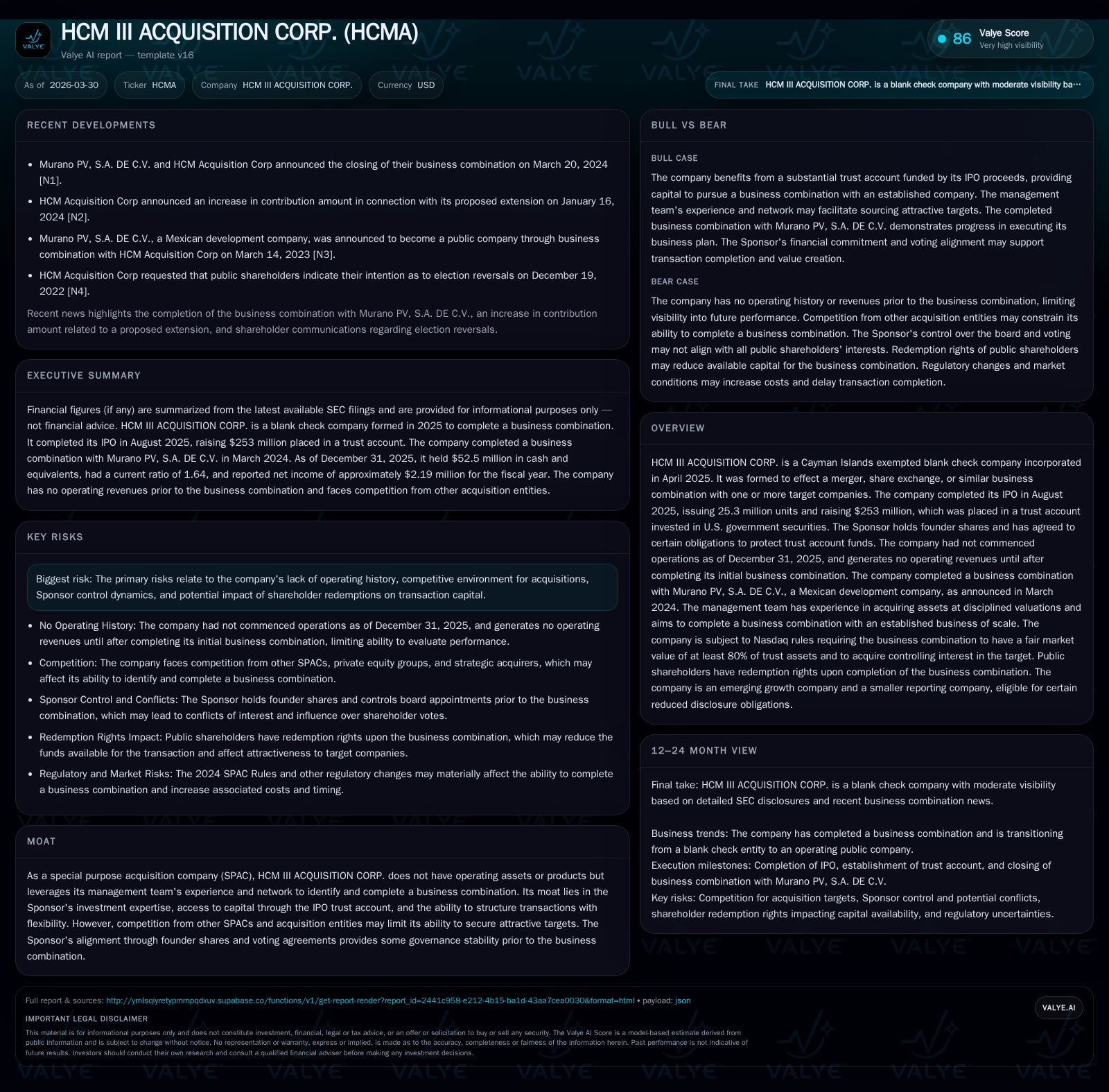
HCM III Acquisition Corp. (HCMA) is a Cayman Islands-based blank check company formed in April 2025, designed to consummate a business combination with an established growth company. After raising $253 million in an August 2025 IPO and placing proceeds in a trust, HCMA had not begun operations by end-2025, consistent with typical SPAC profiles. The company faces structural risks including no operating history and potential shareholder redemption pressure that could limit its ability to close deals. Its management team leverages prior investment experience but must navigate evolving SPAC rules and a competitive target acquisition environment. Capital allocation remains focused on preserving trust funds for future combinations, with limited working capital to cover ongoing expenses, raising concerns about sustaining operations absent deal closure or additional funding.
Company Overview and Formation
HCM III Acquisition Corp. was incorporated as a Cayman Islands exempted blank check company on April 15, 2025. Its purpose is to consummate one or more business combinations through merger, share exchange, asset acquisition or similar transactions to create an operating public company.[S1][S13]
The company conducted its Initial Public Offering on August 4, 2025, selling 25,300,000 units at $10 each. The gross proceeds of approximately $253 million were placed in an interest-bearing trust account invested exclusively in U.S. government securities with maturities capped at 185 days or less.[S3][S16]
The Sponsor contributed an initial $25,000 for expenses pre-IPO and holds roughly 8.4 million founder shares obtained through recapitalization and original issuance at nominal cost (~$0.003 per share). The Sponsor's founder shares carry special voting rights enabling pre-combination board appointment control.[S3][S13]
Additionally, private placement warrants raised another $6.4 million concurrent with the offering sold to Sponsor and underwriters.[S3][S16]
Historical Financial Performance to Date
As a SPAC with no commercial operations before completing a business combination, HCMA’s financial metrics are dominated by non-operating activity related to trust account earnings and issuance-related costs.
Historical performance (annual)
| FY |
|---|
| 2025 |
Source: SEC companyfacts cache [F1].
Operating loss reflects early-stage administrative expenses and IPO costs while positive net income includes interest earned on the trust account.[F1]
Business Model & Operational Status
HCMA had not commenced operational activities nor generated revenue through December 31, 2025.[S1][S6]
It intends to pursue an initial business combination target characterized by scale and growth prospects led by experienced management teams—typical for post-IPO SPACs seeking established companies suitable for public markets.[S1][S13]
The management team’s prior investment record is highlighted as foundational yet not necessarily predictive of success in this venture.[S5]
Industry & Regulatory Context
Revised regulations introduced in mid-2024 have tightened the landscape for SPACs including enhanced disclosure regimes and shareholder protections with possible impact on deal timing and costs. These increased governance requirements potentially elevate transaction complexity—and costs—compared to earlier SPAC cycles.
Growth Prospects & Transaction Considerations
Success depends on locating a suitable target willing to merge/affiliate under commercially attractive terms meeting minimum fair value thresholds (aggregate fair market value of at least 80% of trust assets).[S9][S21]
No specific acquisition targets have been publicly identified,[S1] though management is actively exploring opportunities consistent with their investment philosophy.[S13]
Competition among SPACs intensifies pressure on valuations and availability of attractive opportunities. The ability to provide flexible transaction structures leveraging cash from trust accounts alongside equity offerings enhances deal-making adaptability.[S15]
Shareholder redemption rights allow exit either via vote or tender offer mechanisms subject to caps limiting block redemptions without consent (e.g., maximum ~10-15% limits), aiming to balance shareholder interests against deal completion risks.[S11][S24]
Sponsor voting agreements imply strong alignment behind potential deals but may raise governance questions where public investor interests differ.[S6][S17]
Capital Allocation & Liquidity Positioning
As of December 31, 2025, HCMA held approximately $253 million net proceeds secured in its trust account exclusively for use toward completing business combination(s).[F1][S16][S3]
Available cash outside the trust was just over $50K—the working capital surplus reflects outstanding payables versus current liquidities—adequate only for administrative overhead short term absent additional financing.[F1]
No dividends or buybacks have occurred given the company's strategic focus on preserving capital pre-combination; warrants remain outstanding without entitlement to dividends or redemption returns if no deal closes within mandated timeframe.[S6][S24]
Sponsor obligations include indemnification provisions safeguarding the trust account from diminution resulting from third-party claims relating to Company operations or prospective targets.[S17]
Failure to consummate an initial business combination before expiration of the Completion Window (typically two years from IPO) will likely lead to liquidation of trust funds pro rata among shareholders with warrants expiring worthless.[S10]
Risks Summary & Governance Dynamics
Key risks include:
- Lack of operating history precluding traditional performance evaluation metrics.
- Potential misalignment between Sponsor majority voting power via Class B shares versus public shareholders.
- Redemption rights that can reduce available capital below desired thresholds jeopardizing deal consummation.
- Compressed timelines forcing accelerated due diligence increasing risk exposure.
- Changes in regulatory frameworks (SPAC Rules '24) potentially increasing compliance burdens and extending timeframes.
- Concentration risk inherent in single acquisition entities reliant upon selecting appropriate targets within mandated windows.
- Disclosure limitations as a smaller reporting company reducing detailed risk factor disclosure despite material uncertainties.[S1][S27][S28]
The Sponsor's aligned incentives—including forfeiture provisions and founder share waivers on liquidation distributions—seek to stabilize governance but cannot eliminate all conflicts inherent in SPAC structures.[S6][S17]
Investor Outlook & Monitoring Points
Critical inflection points include:
- Announcement and characterization of proposed initial business combination(s).
- Shareholder approval processes or tender offer arrangements indicating market reaction.
- Redemption levels exercised by public shareholders impacting deal capital structures.
- Any external financing arrangements augmenting available capital beyond the trust account balance.
- Regulatory developments related to Cayman Islands domiciled entities affecting legal structuring.
- Post-combination operational metrics once business integration commences.
Conclusion
HCM III Acquisition Corp. embodies typical early-stage SPAC characteristics: solid IPO funding locked within secure trust arrangements underpinning the initial acquisition pursuit but constrained by zero operating history and reliance on Sponsor-driven strategy execution amid regulatory tightening.
Its eventual success hinges upon identifying accretive targets capable of delivering sustainable value growth for both new entity stakeholders and legacy investors while navigating redemption dynamics intrinsic to SPAC frameworks.
The current financial snapshot reveals preservation-focused capital management with negative operational results due solely to preliminary setup activities offset by non-operating interest income,[F1] underscoring the essentially placeholder status awaiting transformative corporate events.
Investors should weigh structural risks inherent in SPACs alongside management’s track record when assessing this blank check enterprise’s prospects moving into initial combination phases.
This memorandum is intended solely for informational purposes and does not constitute investment advice or recommendations regarding HCM III Acquisition Corp or any securities discussed herein. Readers should conduct their own comprehensive due diligence before making any investment decisions.
Disclaimer: This is research-only, informational analysis and not investment advice. It may include AI-generated interpretation and general industry context. Always verify important details using primary sources.

Comments