
Paychex’s Sustained Growth Fueled by Integrated HCM and Strategic Expansion
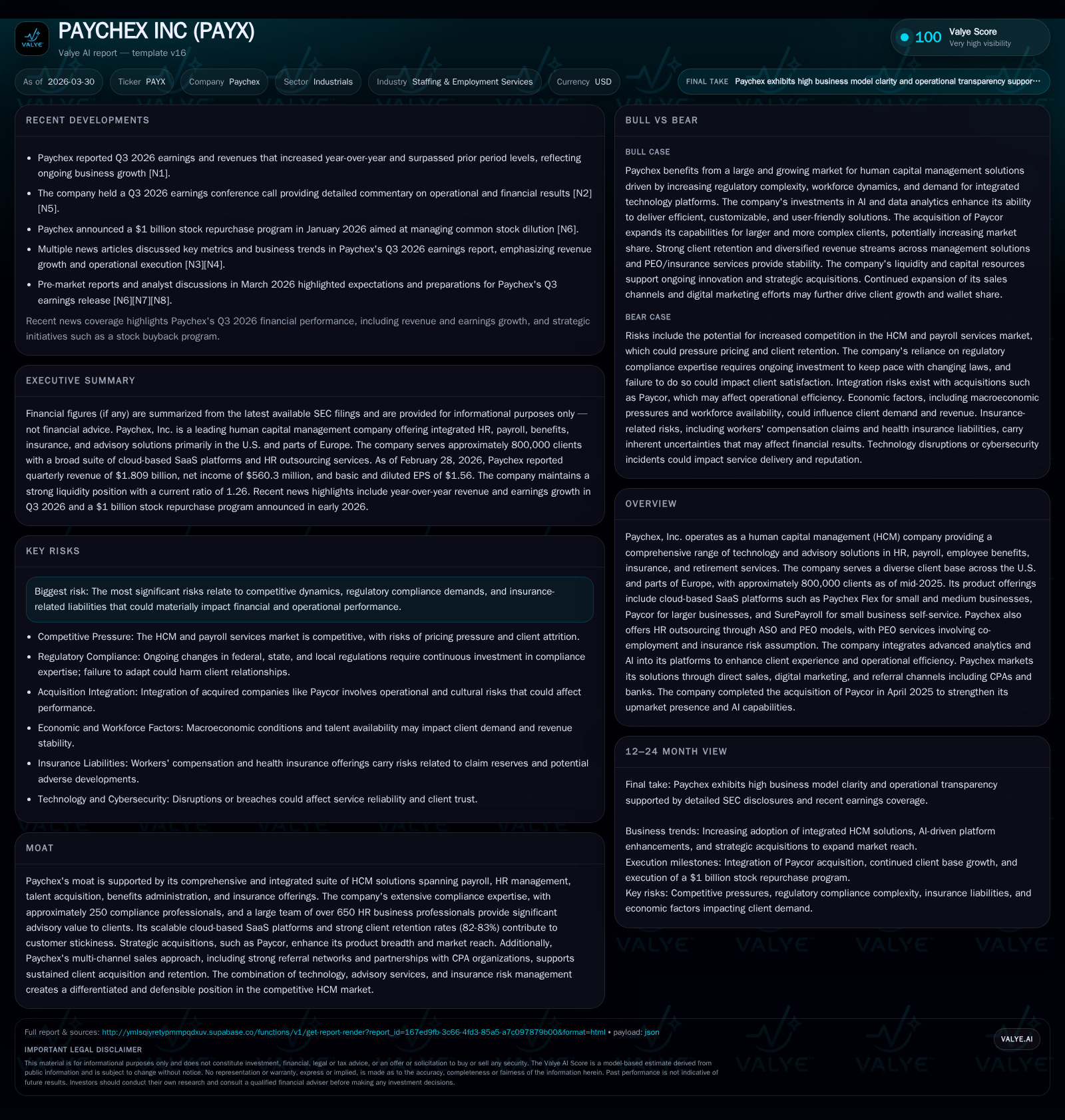
Paychex leverages a broad, integrated human capital management platform and recent strategic acquisitions to drive consistent revenue growth, client retention, and disciplined capital returns.
Paychex Inc., a leading human capital management provider, has demonstrated solid top-line expansion and operating income growth over recent years, supported by its cloud-based SaaS solutions and extensive advisory expertise. The acquisition of Paycor expanded its product footprint upmarket while advanced AI integration enhances client experience and operational efficiency. High client retention rates and multi-channel sales strategies underpin recurring revenue streams, although competitive pressures and regulatory complexities pose ongoing risks. Capital allocation remains prudent with steady dividends, share buybacks, and robust free cash flow generation.
A History of Solid Revenue and Operating Income Growth
Paychex has maintained a consistent growth trajectory through FY2022 to FY2025 with revenues expanding from $4.61 billion to $5.57 billion, a compound annual growth rate exceeding 6% over the period [F1]. Operating income also increased steadily albeit at a slower pace — up 20% over these three years to $2.21 billion in FY2025. This moderation reflects investments in platform upgrades and scale infrastructure noted by the accelerating capital expenditures which rose nearly 19% year-over-year in FY2025 to $192 million [F1][S15].
Operating cash flow remained robust and stable at around $1.9 billion in FY2025 supporting a strong free cash flow profile (approximately $1.7 billion after subtracting capex). These cash generation metrics underpin Paychex’s capacity for substantial dividend distributions as well as ongoing share repurchases.
Historical performance (annual)
| FY | Rev ($bn) | CFO ($mm) | OpInc ($bn) | Capex ($mm) | Rev YoY |
|---|---|---|---|---|---|
| 2025 | 5.6 | 1901 | 2.2 | 192 | +5.6% |
| 2024 | 5.3 | 1898 | 2.2 | 161 | +5.4% |
| 2023 | 5.0 | 1699 | 2.0 | 143 | +8.6% |
| 2022 | 4.6 | 1506 | 1.8 | 133 |
Source: SEC companyfacts cache [F1].
Capital returns and efficiency (annual)
| FY | Div ($mm) | Buybacks ($mm) | FCF ($mm) |
|---|---|---|---|
| 2025 | 1449 | 105 | 1709 |
| 2024 | 1315 | 169 | 1736 |
| 2023 | 1175 | 145 | 1556 |
| 2022 | 1000 | 145 | 1373 |
Source: SEC companyfacts cache [F1].
Financials reflect measured revenue expansion accompanied by incremental margin pressures from technology investments [F1].
Drivers Behind Paychex’s Client Retention and Expanding Market Reach
At the core of Paychex's durable growth is its ability to retain approximately four-fifths of its client base annually (~82-83%), a figure underscored in recent Q3 reports surpassing expectations [N12]. This loyalty results from multiple interlocking factors: Paychex offers comprehensive cloud-based offerings including Paychex Flex tailored for small/mid-sized enterprises, alongside Paycor for larger customers, all seamlessly integrating payroll with HR functions, benefits administration, insurance products, and retirement solutions [S1][N12].
The embedded advisory component — featuring about 250 compliance professionals and more than 650 human resources specialists — adds substantial value by helping clients navigate complex regulatory landscapes while optimizing workforce management [S1]. Additionally, the firm's multichannel sales approach leverages direct sales forces enhanced by digital marketing strategies plus influential referrals through CPA networks and financial advisors creating significant switching costs around data continuity and trusted expertise.
This client lifecycle management is strengthened through Payroll Derived Data Analytics enabling targeted upsell of complementary services over time — boosting non-payroll revenue contribution currently exceeding half of total revenue streams according to recent earnings commentary [N12][S1].
Recent Acquisitions Elevate Product Breadth and Upmarket Presence
In April 2025 Paychex completed its strategic acquisition of Paycor HCM — a move designed explicitly to scale capabilities into larger enterprise segments while accelerating AI-powered innovation across its platforms [S1][N2]. The integration facilitates cross-selling opportunities whereby Paychex broadens penetration within existing customer accounts while expanding its brand reach into new market verticals.
Post-acquisition filings highlight that AI/ML-driven analytics enable predictive workforce insights aiming to reduce client operational costs and compliance risks more effectively than competitors reliant on legacy systems [S1]. This enhancement aligns with industry trends where machine learning models are increasingly embedded in workflow automation for human resources processes such as talent acquisition forecasting, employee engagement analytics, and compliance monitoring.
Technological Innovation: AI-Driven Enhancements to the Paychex Flex Platform
Paychex’s SaaS platforms have integrated generative AI capabilities that automate routine workflows across payroll processing, tax filing compliances via natural language processing tools, and improved customer service interfaces featuring virtual assistants providing real-time answers on complex labor regulations [N2][S1]. These innovations not only increase operational efficiencies but also enhance user experience—a key competitive differentiator.
However, filings explicitly acknowledge associated execution risks: software development delays or systemic defects could disrupt client operations or incur financial penalties; cybersecurity threats remain an ongoing concern given the sensitive nature of payroll data handled on cloud infrastructure [S1]. Safeguards include continuous system audits, partnerships with specialized cybersecurity firms, and layered authentication protocols but residual risk exposure remains intrinsic to cloud-based HCM service providers.
Near-Term Headwinds and Growth Constraints to Monitor
Despite robust momentum, Paychex faces several notable challenges that could constrain growth or pressure margins [S9][N3]. Competition intensifies from pure-play SaaS payroll/HCM vendors offering highly modular point solutions appealing especially to tech-savvy startups or niche sectors unfamiliar with heavy advisory service models.
Regulatory complexity also escalates as federal/state legislation evolves impacting wage laws, benefits mandates, and privacy requirements necessitating costly compliance upkeep potentially impacting pricing power or service level economics [S9]. Insurance liabilities from PEO operations underlying workers’ compensation reserves exhibit inherent estimation uncertainty which could materialize adverse adjustments affecting earnings volatility [S9][S14].
Maintaining high client retention rates amid these pressures may require continued investments in product innovation balanced against cost control measures.
Capital Allocation: Dividends, Buybacks, and Cash Flow Dynamics
Capital discipline remains evident with FY2025 dividends amounting to approximately $1.45 billion — a significant cash return reflecting confidence in steady free cash generation estimated at roughly $1.71 billion post-capital expenditure [F1][S7]. Share repurchases led to retirements totaling $104.5 million for the year but notably below historical peaks indicating possible shift toward preserving dry powder amid technology investments or market volatility.
Equity grew steadily reaching around $4.13 billion by FY2025 with an implied return on equity near 3.9%, suggesting available capacity for measured leverage enhancements if aligned with prudent risk management frameworks [F1]. Capex outlays rose sharply (19% YoY) emphasizing strategic prioritization of platform enhancement projects particularly those incorporating AI functionalities [F1][S15].
What Investors Should Watch Next: Earnings Milestones and Regulatory Risks
Looking forward through early calendar year fiscal Q3 commentary, stakeholders should monitor several critical indicators highlighted during recent earnings disclosures [N1][N2]:
- Progression of AI rollout across solution tiers impacting client adoption rates and satisfaction scores;
- Penetration ratio of non-payroll revenues maintaining momentum above the pivotal ~50% threshold demonstrating successful cross-sell conversion;
- Client additions velocity versus attrition dynamics reflective of competitive positioning;
- Any updates on regulatory risk exposure including litigation matters or reserve adequacy particularly associated with PEO insurance claim liabilities detailed in latest quarterly filings [S25];
- Capital allocation shifts balancing shareholder returns against ongoing investment spending commitments.
These factors collectively will shape near- to medium-term operational outcomes without fabricating speculative performance metrics.
Disclaimer: This analysis is based solely on publicly available information as of March 30, 2026; it does not constitute investment advice nor imply any recommendation regarding securities.
Disclaimer: This is research-only, informational analysis and not investment advice. It may include AI-generated interpretation and general industry context. Always verify important details using primary sources.

Comments