
FG Nexus’ Strategic Shift to Ethereum Treasury and SPAC Support Tests Growth Amid Volatile Markets
FG Nexus Inc. pivots toward digital asset treasury management focused on Ethereum and merchant banking services for SPACs, navigating regulatory uncertainty and capital reallocation.
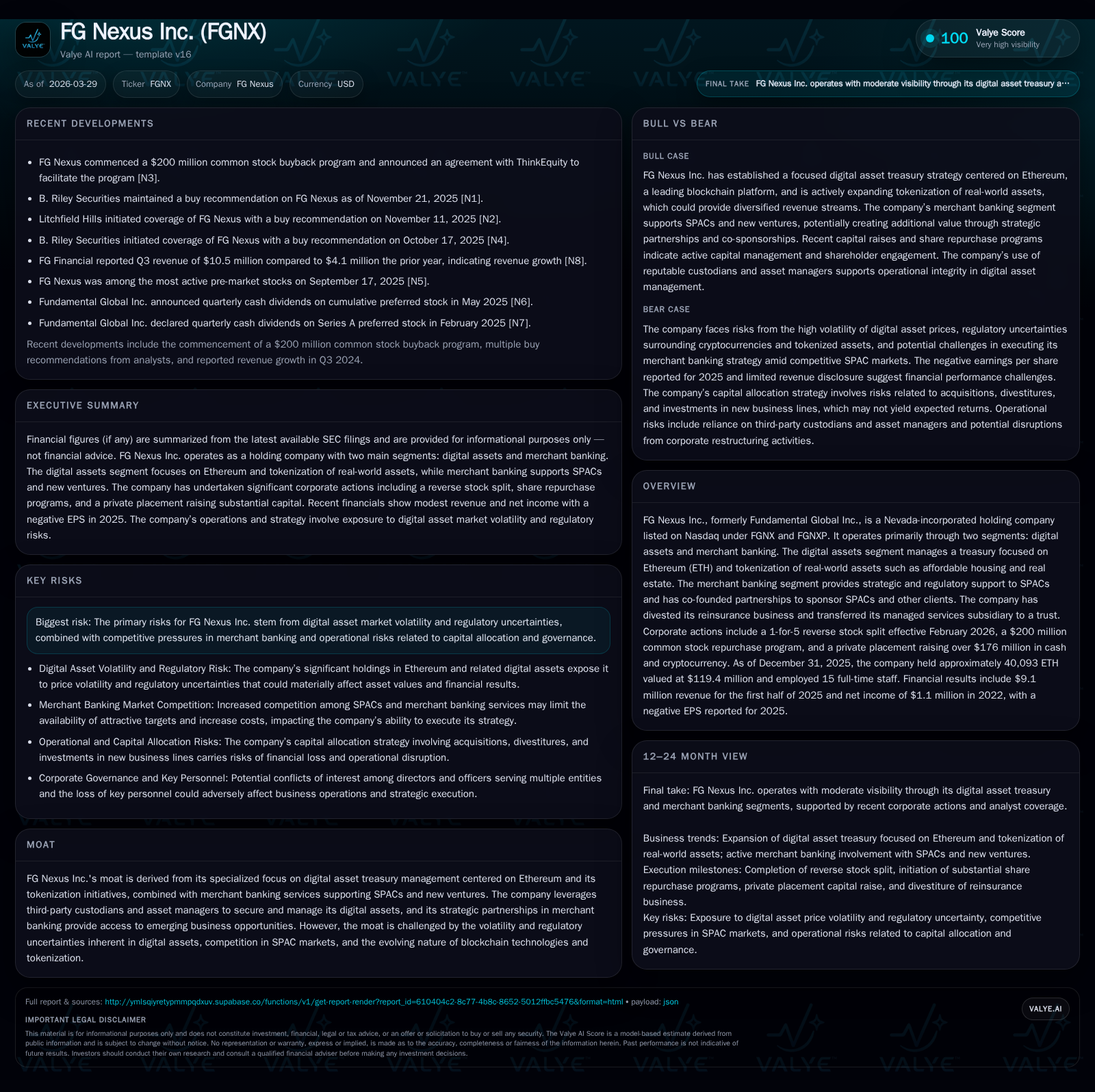
FG Nexus Inc., formerly known as Fundamental Global Inc., has transformed its core business model over recent years, divesting legacy operations like reinsurance and repositioning into two primary segments: a digital assets treasury focused predominantly on Ethereum, and merchant banking activities supporting SPAC formation and strategic ventures. Despite substantial revenue growth by 2024, the company reported rising operating losses in 2025 reflecting investment in its new strategy, alongside significant share repurchases and capital raises. Key risks include exposure to cryptocurrency market volatility and evolving regulatory frameworks. Monitoring the successful commercialization of tokenized real-world assets and the impact of ongoing capital deployment will be critical to assessing future financial trajectories.
Company Overview and Historical Performance
FG Nexus Inc., originally Fundamental Global Inc., undertook a significant strategic transformation culminating in its September 2025 name change and reincorporation in Nevada [S14]. The company exited historically unrelated businesses such as reinsurance—completing final divestitures in early 2026—and transitioned into two dominant segments: Digital Assets and Merchant Banking.
Revenue for the combined entity experienced considerable growth through legacy operations with $32.0 million recorded in FY2024 compared to just $4.9 million in FY2021, highlighting a historical shift from modest operations toward expansion [F1]. However, despite top-line expansion, operating income deteriorated substantially, shifting from moderately negative figures into a substantial operating loss of $64 million by FY2025 [F1], primarily driven by costs associated with restructuring, investing in digital assets (notably Ethereum), and developing strategic merchant banking ventures.
Net income was positive at $1.09 million in FY2022 but the company has since reported losses consistent with its investment phase [F1]. Operating cash flow remained negative at -$6.25 million for FY2025 with capex minimal near $81K historically indicating limited fixed asset spending [F1]. Equity stood at $74.2 million at the end of FY2024 [F1], supporting ongoing operations.
Historical performance (annual)
| FY | CFO ($mm) | OpInc ($mm) | Capex ($) |
|---|---|---|---|
| 2025 | -6 | -64 | |
| 2024 | -5 | -25 | |
| 2023 | -4 | 81000 | |
| 2022 | -11 | 81000 |
Source: SEC companyfacts cache [F1].
Capital returns and efficiency (annual)
| FY | FCF ($mm) |
|---|---|
| 2025 | |
| 2024 | |
| 2023 | -4 |
| 2022 | -11 |
Source: SEC companyfacts cache [F1].
Digital Assets Segment: Ethereum Focus and Tokenization Strategy
FG Nexus’ strategic pivot centers on digital asset treasury management primarily focused on Ethereum (ETH), which supports smart contracts, DeFi applications, stablecoins, and tokenization of real-world assets [S1][S17]. As of December 31, 2025, the company held approximately 40,093 ETH with an estimated fair value of $119.4 million [S17]. Early in Q1 2026, the portfolio included a combination of ETH and wrapped staked ETH (WSETH) valued around $64.6 million combined [S17].
The July 2025 private placement raised gross proceeds near $176 million comprising cash and cryptocurrency contributions that bolstered this treasury strategy [S9]. FG Nexus uses third-party custodians Anchorage Digital Bank N.A., BitGo Trust Company Inc., alongside asset manager Galaxy Digital Capital Management LP under formal agreements to secure assets while pursuing long-only ETH-based investment strategies [S12][S16].
Tokenization efforts focus on affordable housing projects, real estate portfolios via subsidiaries like FG Communities Inc., reinsurance-linked digital products through divested legacy units still partly influencing strategy, among other real-world assets—sectors benefiting from blockchain-based fractional ownership models attracting institutional interest [S17].
Key risks include price volatility affecting consolidated book value; custodial insurance policies are pooled among custodian clients and may not fully indemnify losses; regulatory uncertainties globally impose operational challenges; potential classification as an investment company under U.S law may increase compliance burdens [S11][S19][S21].
Merchant Banking Segment: SPACs and Strategic Partnerships
The merchant banking segment provides strategic, administrative, and regulatory support for newly formed Special Purpose Acquisition Companies (SPACs) via its platform alongside co-founding FG Merchant Partners LP to co-sponsor SPAC vehicles [S17].
This division also incubates or sponsors ventures such as Craveworthy LLC (a fast casual restaurant chain) and FG Communities Inc., a manufactured housing community operator leveraging blockchain tokenization themes alongside traditional merchant banking roles [S17].
The segment operates amid intense competition with increased regulatory scrutiny post-SPAC booms earlier this decade. Charter amendments dramatically increased authorized shares for common (180 billion) and preferred (100 billion) stock enhancing fundraising flexibility [S10][S13].
Capital Allocation and Corporate Actions
FG Nexus has demonstrated proactive capital management balancing growth ambitions with shareholder returns:
- A one-for-five reverse stock split effective February 13, 2026 reduced outstanding common shares to about 6.55 million aiming to improve share price metrics and listing compliance [S14].
- An open-ended common stock repurchase program capped at $200 million was authorized September 2025; through March 23, 2026 about $34.9 million was spent repurchasing ~2.2 million common shares representing roughly a quarter of pre-split outstanding shares; additionally ~$5 million was spent acquiring ~202 thousand Series A preferred shares representing about a quarter of that class outstanding [S5][F1].
- At-the-market offerings generated approximately $15.5 million gross proceeds before suspension pending market conditions post-late-2025 issuance [S13].
- Asset sales include Quebec real estate proposed for sale around CAD$15 million (~$11 million USD), expected netting about $8-$9 million after loan repayment mid-2026 if completed [S6], plus final stages exiting reinsurance unlocking collateral funds ($3.3 million released), cash payments ($1 million), plus promissory notes accruing interest till mid-2027 supporting liquidity [S6][S7].
- Cash & equivalents were nearly $13.4 million as of December 31, 2025 providing operational runway amid negative cash flows typical for growth investments [F1].
The interplay between buybacks alongside equity issuances reflects efforts to optimize capital structure amidst volatile crypto markets.
Risk Profile: Market Volatility, Regulatory Complexity & Operational Challenges
Risk disclosures highlight multiple vulnerabilities:
- Volatility in cryptocurrency prices directly impacts balance sheet valuations through mark-to-market adjustments on ETH holdings affecting earnings stability [S19][S15].
- Regulatory frameworks remain fragmented internationally with possible SEC designation of cryptocurrencies as securities adding compliance complexity or limiting access to essential service providers for treasury management [S11][S19].
- Custodial insurance coverage is pooled rather than bespoke; severe loss scenarios could result in unrecovered asset impairments [S11][S12].
- Legal contingencies mainly involve asbestos litigation tied to legacy subsidiaries; reserves approximate $0.9 million currently considered immaterial but warrant monitoring [S4].
- Cybersecurity threats pose operational risks impacting cryptographic wallet security or proprietary systems leading to potential financial losses or reputational damage.
- Maintaining Nasdaq listing standards post-reverse split remains an ongoing conditional factor influencing liquidity profiles.
These risks underscore challenges inherent in pioneering blockchain finance strategies while managing structural uncertainties.
Outlook Considerations: Catalysts And Metrics To Watch
While no explicit forward guidance is provided several milestones deserve attention:
- Completion of Quebec property sale anticipated H1-2026 could materially enhance liquidity supporting operations or further digital acquisitions.
- Ethereum network adoption trends including protocol upgrades will influence valuation trends underpinning corporate assets.
- Progress commercializing tokenization especially within affordable housing or real estate verticals may unlock diversified revenue beyond crypto appreciation.
- Merchant banking success depends on pipeline health regarding SPAC co-sponsorship deals plus ramping activity by FG Merchant Partners across target sectors.
- Additional buyback activity against financial results provides insight into management confidence regarding stock valuation.
- Regulatory changes affecting custody norms or security classifications could alter expense structures or operational agility.
FG Nexus embodies a hybrid case study balancing decentralized finance ambitions with traditional merchant banking legacies amid evolving macroeconomic conditions.
This analysis is based solely on publicly available filings up to March-April 2026 without any forward-looking investment guidance or recommendations.
Disclaimer: This is research-only, informational analysis and not investment advice. It may include AI-generated interpretation and general industry context. Always verify important details using primary sources.

Comments