
Republic Digital Acquisition Co’s SPAC Path Hinges on Business Combination Execution by 2027 Deadline
As a newly formed blank check company with $300 million IPO proceeds, Republic Digital Acquisition Co is focused on fintech, software, and cryptocurrency targets but faces critical timing and execution risks.
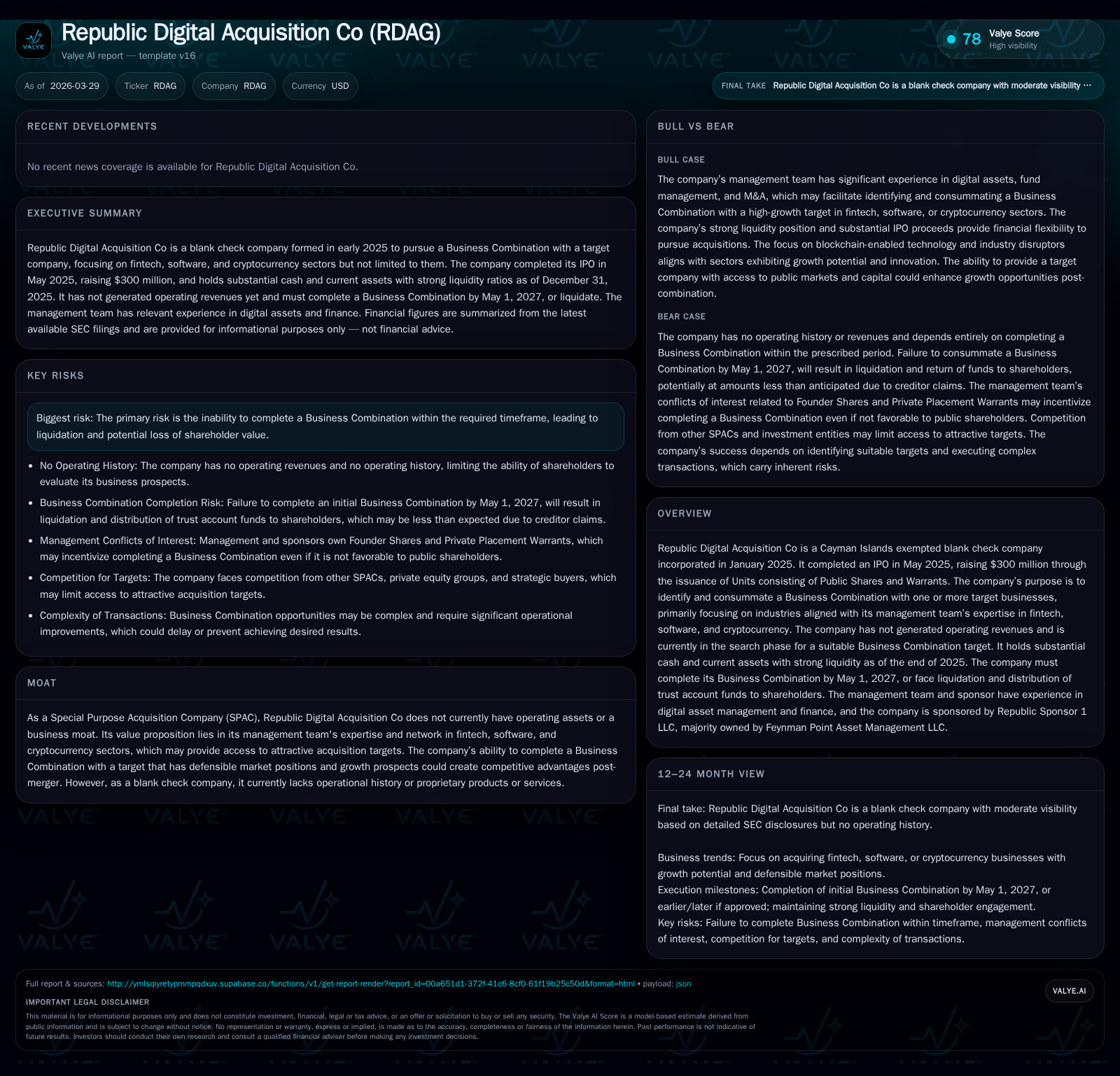
Republic Digital Acquisition Co (RDAG) was incorporated in early 2025 and raised $300 million via IPO in May 2025 to pursue an initial Business Combination by May 1, 2027. It operates as a Cayman Islands exempted blank check company without operating revenues or assets beyond cash held in trust. Its management team brings fintech and crypto sector expertise to identify blockchain-enabled companies with proven products and good growth prospects. Its returns to date reflect costs related to IPO and operations pre-combination, with net income from non-operating sources. Key risks center on the ability to complete a qualifying merger in time and the limitations and complexities of conducting such Business Combinations amid growing competition among SPACs. Capital allocation focuses on preserving trust funds for merger execution rather than dividends or buybacks.
Company Background and Formation
Republic Digital Acquisition Co (RDAG) was incorporated on January 23, 2025 as a Cayman Islands exempted blank check company. It completed its Initial Public Offering (IPO) on May 1, 2025, issuing 30 million Units at $10 each including a partial over-allotment exercise. This raised gross proceeds of approximately $300 million which were placed into a Trust Account earmarked solely for acquiring one or more businesses through an initial Business Combination (a "de-SPAC" transaction) [S1][S17].
The company’s Management Team, led by CEO Joseph Naggar alongside CFO Rob Urgo and COO Jonathan Knipper, has extensive experience across fintech, software, digital asset management, and cryptocurrency sectors. Their collective expertise is intended to source acquisition candidates primarily within blockchain-enabled technology companies with compelling growth prospects [S14][S17].
Historical Performance and Financial Summary
As a blank check entity engaged mostly in organizational activities, Republic Digital Acquisition Co has not generated operating revenues since inception. The only income recorded through FY ending December 31, 2025 relates to non-operational results while operating income reflected expenses associated chiefly with underwriting fees, deferred fees, legal costs, and other offering expenses [F1][S1][S17]. The latest financial snapshot as of late 2025 shows:
Historical performance (annual)
| FY |
|---|
| 2025 |
Source: SEC companyfacts cache [F1].
Operating losses are expected given the absence of business operations and normal start-up costs. The positive net income figure likely stems from accounting treatment of non-cash or financing-related activities [F1]. Cash equivalents reported remain modest outside the larger Trust Account balance.
Business Model and Growth Prospects
Republic Digital Acquisition Co’s business model centers entirely on identifying an optimal initial Business Combination target by May 1, 2027 — exactly two years post-IPO closing. The company aims to target firms that leverage blockchain technology across fintech, software platforms, or cryptocurrency infrastructure fields presenting proven products and sustainable revenue streams [S14][S4].
The planned acquisition should ideally exhibit:
- Differentiated technology disrupting incumbents.
- Defensible market positioning.
- Ability to generate free cash flow supporting sustained growth.
- Management teams amenable to public company transition benefits [S4].
However, Republic is not restricted from pursuing targets outside these verticals though it acknowledges such investment might not leverage its team’s direct expertise fully [S14]. Successful combination would provide the acquired entity access to public markets enhancing capital flexibility for expansion or further acquisitions [S18].
Competitive dynamics have increased since SPAC proliferation; securing attractive targets at reasonable valuations constitutes a key challenge going forward [S1].
Capital Allocation Policy and Shareholder Returns
With all capital from IPO proceeds deposited into an interest-bearing Trust Account under federal regulations that restrict premature use except for permitted expenses or redemption payments, Republic’s financial stewardship prioritizes capital preservation ahead of completing the initial Business Combination [S10][S19].
Sponsor and insiders hold Founder Shares and Private Placement Warrants purchased at nominal prices; however they have waived redemption rights ensuring their shares do not dilute funds available for Public Shareholders upon liquidation or de-SPAC redemption [S25].
Currently:
- There are no dividends paid nor share repurchases executed given lack of earnings or free cash flow generation [F1][S3].
- Redemptions by Public Shareholders will be permitted during shareholder votes on proposed Business Combinations or if combination is not consummated by deadline.
- Redemptions are limited: no shareholder can redeem more than 15% of Public Shares without consent mitigating destabilizing mass redemptions that could jeopardize transactions [S12][S16].
Future capital returns depend entirely on success in completing a value-accretive Business Combination; absent successful acquisition the company will liquidate distributing trust funds less dissolution expenses [S27].
Risks Associated With Execution
Key risk factors highlighted include:
- Failure to consummate a qualifying Business Combination by May 1, 2027 triggers mandatory liquidation at roughly $10 per share minus permitted expenses—yielding minimal upside beyond return of principal [S1][S27].
- Competition among numerous SPACs seeking finite pool of attractive fintech/blockchain targets could raise acquisition costs or cause delays [S1][S21].
- Complex mergers requiring operational improvements may prevent achievement of forecasted results causing investor dissatisfaction post-merger [S1].
- Sponsor conflicts may emerge as founders hold low-cost Founder Shares incentivizing approval even if Public Shareholders face dilution or weaker prospects [S26].
- Limited operational history impairs shareholders' ability to evaluate management capabilities prior to combination [S1].
Additionally, regulatory compliance issues arise given the company's Cayman Islands jurisdiction coupled with aspirations to comply fully with US SEC rules post-merger which may impose execution challenges [S10][S22]. Technicalities surrounding redemptions require shareholders’ strict adherence to procedures involving delivery of share certificates or DWAC electronic transfers within narrow time windows [S9].
Outlook and What To Watch For
Management must complete an initial Business Combination before expiration of the Combination Period ending May 1, 2027—or seek shareholder consent for extension which would trigger redemption rights again. Accomplishing this milestone will involve publicly announcing target deals well in advance along with proxy filings detailing transaction economics for shareholder consideration.
Investors should monitor:
- Official filings announcing selection of potential combination candidates.
- Proxy statements possibly soliciting shareholder approval including redemption procedures.
- Announcements about any extensions requested beyond May 2027.
- Changes in sponsor/shareholder transactions where insiders purchase shares potentially impacting float liquidity.
- Any indications about raising additional financing via equity-linked securities or debt if merger requires more cash than Trust Account holds [S19].
Given its pure-play SPAC nature devoid of operations until combination closes, RDAG’s trajectory will hinge entirely on timely execution against market dynamics governing SPAC deals especially within fast-evolving fintech/crypto sectors.
Conclusion
Republic Digital Acquisition Co exemplifies a modern blank check vehicle targeting high-growth blockchain-centric industries leveraging experienced leadership positioned to unlock synergies through strategic mergers. While bolstered by robust capital resources from its IPO Trust Account totaling approximately $300 million plus earned interest secured against ordinary operating expenditures so far lost - it faces quintessential SPAC risks: intense competition for targets; time sensitivity mandated by regulatory deadlines; uncertainties related to integration complexity post-combination; potential conflicts inherent between founder incentives versus public shareholder interests.
Investors attuned to the spartan early state can evaluate RDAG principally based on its management pedigree credibility and its ability ultimately deliver accretive transactions satisfying stringent criteria favoring defensible tech innovation alongside consistent cash flow metrics. Until acquisition transpires successfully within prescribed timelines — returns remain linked exclusively to pro-rata disbursement from protected Trust Account reserves.
This report is prepared solely for informational purposes referencing public regulatory filings and does not constitute investment advice or recommendation regarding any security. Readers should carefully consider the company’s disclosures including risk factors before making any investment-related decisions.
Disclaimer: This is research-only, informational analysis and not investment advice. It may include AI-generated interpretation and general industry context. Always verify important details using primary sources.

Comments