
Karbon Capital Partners’ Financial Footing and SPAC Prospects After IPO
A comprehensive evaluation of Karbon Capital Partners as a newly public SPAC focusing on financial foundation, execution risks, and capital allocation strategy.
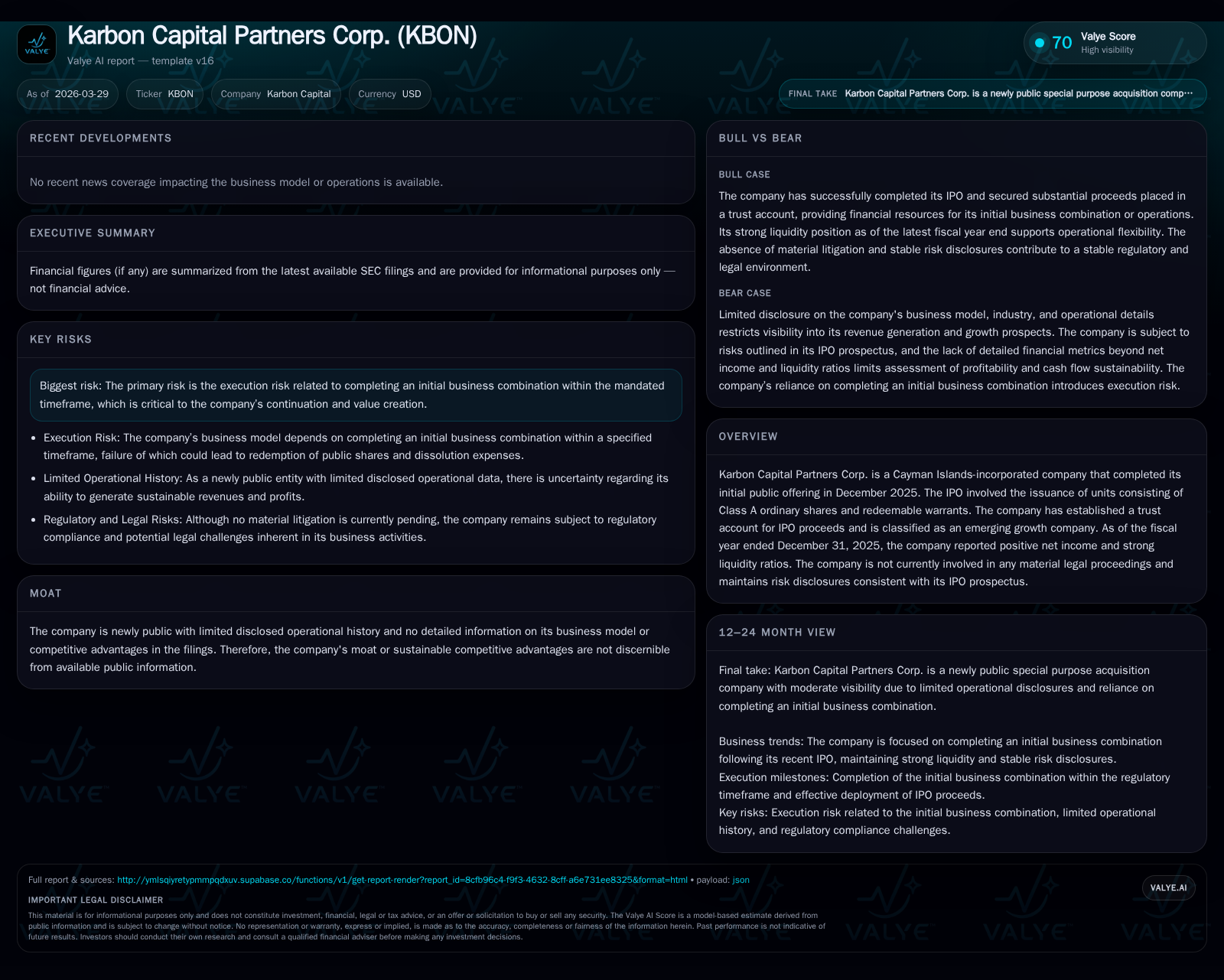
Karbon Capital Partners Corp. completed its IPO in December 2025, issuing approximately 34.5 million units composed of Class A shares and redeemable warrants. The company’s initial fiscal year showed positive net income with strong liquidity but an operating loss reflecting pre-combination expenses. The primary risk centers on timely execution of a qualifying business combination within the mandated timeframe to preserve shareholder value. Liquidity remains robust with no debt reported, while capital allocation follows standard SPAC conventions prioritizing cash preservation over dividends or buybacks. Future growth is contingent on successful deal execution rather than proven operational drivers, warranting close market scrutiny of merger progress.
IPO Completion and Initial Financial Status
Karbon Capital Partners Corp. undertook its initial public offering on December 12, 2025, raising gross proceeds of approximately $345 million through the issuance of around 34.5 million public units [S6][S8][S9][F1]. Each unit comprises one Class A ordinary share and one-fourth of one redeemable warrant exercisable for a Class A share at $11.50 per share [S3]. Concurrently, the company completed a private placement of 890,000 similar units to its sponsor, Karbon Capital Partners Core Holdings, LLC, further buttressing its capital base [S15][S16]. Proceeds from these sales were placed in a trust account earmarked for the initial business combination enabling safe custody until deployment [S15]. The company is classified as an emerging growth company pursuant to SEC regulations [S8], which frames its status within early development stages with attendant disclosure exemptions.
This IPO event marks the inception point of KBON's operational timeline, establishing foundational capital and governance structures such as an amended memorandum and articles of association filed contemporaneously [S22]. Its unit-based structure combining shares with fractional warrants aligns with prevalent SPAC frameworks allowing deferred equity capital infusions through warrant exercises.
Historical Financial Snapshot: Income and Liquidity Metrics
Despite being newly public and pre-revenue from operations related to any business combination, Karbon Capital Partners reported a positive net income of $357,006 for fiscal year ending December 31, 2025 [F1]. Contrastingly, it recorded an operating loss of $240,284 attributable primarily to administrative expenses incurred during this phase before any core transaction activity commenced [F1].
Liquidity remains a standout strength: current assets totaled approximately $1.02 million against current liabilities near $205 thousand, yielding a current ratio near 4.96—an indicator of substantial short-term financial buffer relative to obligations [F1]. Nevertheless, return on equity measured –3.1% underscores that asset utilization has not yet translated into meaningful profitability beyond financing gains or other non-operating items [F1]. This reflects typical patterns in newly listed SPACs where initial costs precede value-accretive transactions.
Historical performance (annual)
| FY |
|---|
| 2025 |
Source: SEC companyfacts cache [F1].
Execution Risk: Business Combination Deadline and Implications
At the core of Karbon Capital Partners’ risk profile lies the imperative to complete an initial business combination within designated time limits set forth at IPO—typically within two years or slightly extended if a letter of intent exists [S4][S12]. Failure to consummate such a transaction triggers redemption rights for public shareholders which can significantly dilute valuation prospects or precipitate wind-down scenarios.
Disclosure documents consistently emphasize this execution risk without material updates post-IPO filing, underscoring it as an ongoing fundamental uncertainty rather than a transient risk factor [S2][S4][S12]. Market participants accustomed to SPAC dynamics recognize this milestone as decisive to KBON’s future corporate viability and shareholder value retention.
Capital Structure and Liquidity Analysis
Karbon’s capital structure is straightforward: equity financing dominates through public units combining Class A shares with fractional redeemable warrants exercisable at $11.50 [S7][S10][F1]. There was no reported usage of debt or other leverage instruments as of December 31, 2025 [F1], simplifying balance sheet risk considerations.
Proceeds from public and private unit offerings are securely held in trust accounts managed by Continental Stock Transfer & Trust Company acting as trustee to ensure preservation pending business combination deployment [S13][S14][S15]. Withdrawal from the trust principal is tightly restricted aside from permitted tax payments from interest accrued or dissolution costs up to defined thresholds [S15].
This clean capital base affords KBON flexibility in deal negotiations without immediate pressure from creditors while maintaining investor protections via trust fund safeguards—hallmarks of sound SPAC structural design.
Capital Allocation Approach: Warrants, Dividends, and Buybacks
The investment vehicle has issued redeemable warrants bundled within units (one-fourth warrant per share purchased), exercisable post-combination at a strike price above IPO price ($11.50) providing potential incremental capital inflows upon exercise [S6][S8][S9][S11][S16]. The warrants are non-redeemable prior to specific conditions ensuring holders maintain rights until at least post-merger events occur.
Consistent with conventional SPAC practice in nascent phase companies aimed at preserving cash for acquisition opportunities, Karbon has adopted no dividend distribution policy nor undertaken share repurchases since listing [S6][S8][S9]. This absence is expected given typical venture timelines needing maximum liquidity availability ahead of merger expenditures.
Future Growth Path: Merger Targets and Strategic Constraints
While the company’s future growth hinges almost entirely on consummating an attractive initial business combination that can propel operational scaling and value creation, there are no explicitly disclosed industry targets or vertical focuses in public filings or prospectus documentation so far.
Key limiting factors remain anchored in timing constraints for closing qualifying deals within regulatory windows; protracted deliberations or adverse deal economics could cap growth upside considerably if deadlines approach without success. Thus pipeline sufficiency and transaction quality will critically dictate trajectory going forward.
What Markets Should Watch Next
Looking ahead, investors and analysts must closely monitor quarterly Form 10-Q/8-K filings detailing updates about ongoing merger searches or negotiations by Karbon’s management team as primary barometers of progress toward executing its mandate. Significant announcements relating to selection of target companies or definitive merger agreements will serve as pivotal valuation inflection points.
Additionally, activity around warrants—such as exercises or secondary market trading volumes—will provide insight into investor confidence levels post-IPO. Given the lack of operating revenue streams independent from acquisition outcomes at this stage, market sensitivity remains largely driven by execution milestones rather than conventional earnings metrics.
Disclaimer: This report is provided solely for informational purposes based on available SEC filings and does not constitute investment advice or recommendations regarding Karbon Capital Partners Corp. (KBON). Readers should consider consulting their own financial advisors about the suitability of any securities involved.
Disclaimer: This is research-only, informational analysis and not investment advice. It may include AI-generated interpretation and general industry context. Always verify important details using primary sources.

Comments