
Talon Capital Corp. Emerges as Focused Energy Sector SPAC with $249M IPO Trust
A Cayman Islands SPAC with an energy sector focus, Talon Capital Corp. secured $249 million in IPO proceeds held in trust as it embarks on its initial business combination.
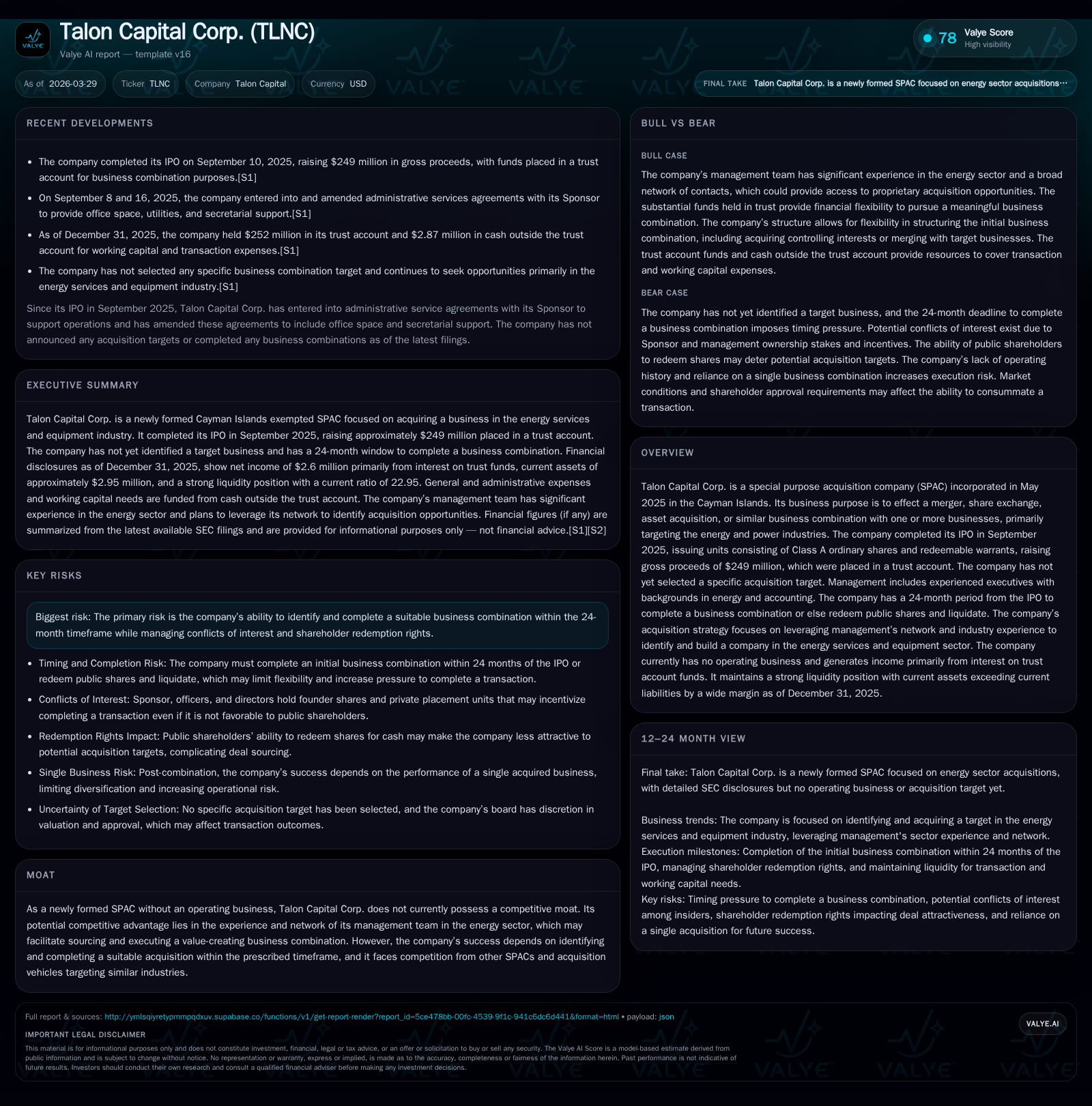
Talon Capital Corp., founded in May 2025 and based in the Cayman Islands, completed its $249 million IPO in September 2025 as a special purpose acquisition company (SPAC) targeting energy and power sector businesses. The company holds the IPO proceeds in a trust account, generating interest income that offsets ongoing administrative expenses incurred pre-combination. Management's extensive energy industry experience underpins Talon's potential to identify an attractive acquisition within the 24-month deadline. The SPAC's liquidity profile is strong, with almost all funds secured in restricted trust assets and working capital loans optionally available from sponsors. Key risks revolve around timely deal execution amid shareholder redemption rights. Post-merger growth depends on successful integration of the target and realizable synergies within the energy services marketplace.
Foundational Financials: IPO Proceeds, Trust Account, and Initial Income
Talon Capital Corp. consummated its initial public offering (IPO) on September 10, 2025, issuing 24.9 million units at $10 each, raising gross proceeds of approximately $249 million [S1][S8][F1]. Simultaneously, the company sold an additional 779,000 private placement units to the Sponsor and Cohen & Company Securities LLC for approximately $7.79 million [S1][S8].
Critically, all net proceeds from the public units were deposited into a trust account dedicated to preserving investor capital until the SPAC completes a qualifying business combination or liquidates [S1][S8]. The Trust Account invests exclusively in short-dated U.S. Treasury securities or money market funds comprised solely of direct U.S. government obligations with maturities under 185 days to minimize risk [S1].
Interest accrued on these trust account holdings for the period from inception (May 2025) to December 31, 2025 totaled roughly $3.17 million. This non-operating income exceeded the general and administrative expenses (about $547k), resulting in positive net income of approximately $2.63 million despite zero operational revenues [S1][F1]. Notably, Talon can only withdraw interest earned for limited working capital purposes capped at either $500k or 5% of annual interest earned—whichever is less—preserving principal integrity within the Trust Account [S1][S8].
Underwriting arrangements led to cash underwriting fees totaling about $4.04 million net of reimbursements and deferred underwriting fees nearing $10.2 million deducted from gross proceeds [S1]. These fees represent typical upfront compensation within SPAC structures but reduce immediate liquidity.
History of Formation and Organizational Activities Through Inception
Founded as a Cayman Islands exempted company on May 1, 2025, Talon Capital has not engaged in operating activities beyond corporate organization and IPO preparations during its initial months through year-end 2025 [S1][S2]. The company’s efforts after going public have concentrated on prospect identification aligned with its stated goal of effecting a business combination targeted predominantly at energy and power sector businesses [S1][S20].
Being early stage and pre-merger, Talon's expenses relate primarily to compliance costs typical for newly registered public entities—including legal, accounting, audit fees—and due diligence investigations required for prospective transactions [S1]. No revenue-generating operations exist yet.
Management Expertise and Industry Network as Strategic Assets
Management credentials comprise leaders with significant experience specifically in energy sector transactions—Chairman/CEO Charlie Leykum brings over two decades of engagement across traditional and renewable energy domains; CFO Gerald Cimador contributes more than 30 years in accounting with prior roles at similarly structured blank check companies [S1][S20].
Their prior involvement with Sentinel (a blank check company focused on energy infrastructure) offers valuable lessons especially given Sentinel’s discontinued merger attempts and eventual liquidation—a cautionary backdrop underscoring the challenges inherent to SPAC execution [S20].
This background underscores Talon's strategy to harness sector-specific insight and networks to identify opportunities potentially overlooked by more generalized acquirors [S1], critical for creating shareholder value in an environment crowded with competing acquisition vehicles.
Business Combination Timeline and Target Industry Focus
Talon Capital is legally bound by a contractual completion window requiring consummation of its initial business combination by September 10, 2027—exactly two years from its IPO closing—else it must redeem all outstanding public shares at approximately the original per-share price plus interest earned (net of permitted withdrawals), followed by company dissolution [S1][S23]. This "use-it-or-lose-it" window imposes meaningful pressure on management to identify and close on viable target(s) within this timeframe.
Though not restricted geographically or exclusively limited beyond stated focus sectors, Talon prioritizes targets within energy services and equipment segments including both traditional hydrocarbons infrastructure as well as emerging power generation assets consistent with evolving industry trends [S1][S20][S21].
Liquidity Profile and Capital Structure Details
At December 31, 2025, Talon’s balance sheet showed cash held in its Trust Account amounting to roughly $252.1 million inclusive of accrued interest. Outside this restricted pool was approximately $2.87 million earmarked for operating needs including target evaluation costs [F1][S8]. The current ratio stood near an impressive 22.95x reflecting nominal current liabilities ($128k) relative to readily accessible liquid assets ($2.95m) exclusive of trust funds [F1].
No outstanding balance exists against working capital loan commitments extended conditionally by sponsors—their offer totals up to $1.5 million convertible into private placement units upon consummation — giving Talon enablers but no immediate debt obligations [S3][S4][S6].
Additional contractual commitments include monthly administrative fees payable to Talon Capital Sponsor LLC approximating $40k covering office space, utilities, secretarial support until merger close or liquidation occurs [S6][S18].
Shares issued consist principally of Class A ordinary shares comprising public shareholders’ voting interests alongside founder shares held by sponsors subject to forfeiture terms based on over-allotment exercises post-IPO [S13][S25]. Temporary equity classification applies appropriately per ASC Topic 480 given redemption features associated with Public Shares.
Risks Associated with Acquisition Deadlines and Shareholder Dynamics
Foremost risk stems from failure to complete a qualifying business combination within the contractual deadline which triggers mandatory redemption of public shares at net asset value plus dissolution proceedings—impacting investor liquidity timing albeit partially protective financially [S17][S23].
Furthermore, shareholder redemption rights can complicate negotiations; target firms may perceive dilution risk or uncertainty impacting valuation terms if large portions of public shares opt for redemption reducing deal proceeds actually available [S16][S17]. The Sponsor’s commitment to vote their founder shares favorably irrespective of other shareholder sentiment injects governance complexity around approval thresholds but aims to ensure transaction closure once aligned internally [S17].
Market-wide factors influencing financing availability and due diligence efficacy—including macroeconomic shifts impacting energy demand/sentiment or regulatory changes—pose extrinsic uncertainties limiting transactional flexibility despite management efforts [S16].
Path to Future Growth: Opportunities Within Energy Sector Acquisitions
While currently devoid of operating businesses or forecast financial projections specific to potential targets, Talon’s pathway toward growth will hinge heavily upon successful acquisition execution enabling it to capitalize on structural themes prevailing in energy markets.
Sector expertise affords advantages akin to specialized private equity vehicles focusing on midstream consolidation or renewables platform creation where technical know-how differentiates winners from generic roll-up plays. Post-acquisition value creation would likely derive from synergies achieved via operational optimization or expansion into adjacent markets leveraging existing relationships cultivated by founders.
Growth constraints remain contingent upon timing pressure imposed by the mandated business combination deadline alongside competitive pressures from other SPACs vying for similar quality assets in an increasingly cautious capital allocation environment.
Capital Allocation Plans: Potential Use of Funds and Returns Expectations
Prior to completing its initial business combination, capital allocations are effectively limited: no dividends or share repurchases occur given SPAC structure; rather funds outside the Trust Account support evaluating targets and associated transaction costs including travel or advisory expenses [S19][F1].
Upon transaction consummation, flexibility increases allowing deployment of cash proceeds toward purchase prices combined with issuer share issuance or debt financing tailored per negotiated deals accounting for seller preferences or growth funding needs. Sponsor private placement units may convert providing further alignment incentives between sponsors and new shareholders while dilutive effects are contractually managed through anti-dilution provisions and board approvals [S13][S14][S23].
Returns metrics such as ROE remain negative (-36.3%) reflecting absence of operating earnings rather than operational deficiencies common among early-stage SPAC entities preparing for transformative acquisitions [F1].
Key Metrics Snapshot: Analyzing Net Income, Operating Expenses, and Current Ratios
Historical performance (annual)
| FY |
|---|
| 2025 |
Source: SEC companyfacts cache [F1].
Net income reflects netting interest income against operating expenses related chiefly to administrative overhead typical for a non-revenue entity preparing for merger activities while sustaining regulatory compliance obligations. Current ratio illustrates strong liquidity predominantly supported by restricted trust balances outside normal working capital usage highlighting conservative cash stewardship ahead of deal closure.
Critical Milestones to Monitor Towards Business Combination Completion
Important upcoming checkpoints include:
- Announcements regarding selection or exclusivity agreements with potential target(s).
- Updates on investor communications regarding merger proposals including schedule for shareholder votes or tender offers.
- Filing amendments extending business combination deadlines if necessary (subject to shareholder approval).
- Execution timing for due diligence processes marking transition from exploratory phase toward definitive agreement.
- Any signs of sponsor loan drawdowns indicative of tightened operational finances ahead of transaction closure.
These events merit close attention as indicators signaling progress beyond formative stages towards transformative corporate restructuring affecting shareholder value realization.
This analysis is based strictly on disclosed SEC filings as of March 27, 2026 ([F1], [S#]) without projecting investment outcomes or providing recommendations. Investors should consider broader market conditions alongside company disclosures when evaluating Talon Capital Corporation's strategic trajectory.
Disclaimer: This is research-only, informational analysis and not investment advice. It may include AI-generated interpretation and general industry context. Always verify important details using primary sources.

Comments