
Lands' End, Inc. Balances Legal Resolutions with Modest Growth in Apparel and Uniforms
Lands' End has emerged from protracted litigation with resolved legal risks, sustaining its foothold in uniform manufacturing while incrementally growing digital sales.
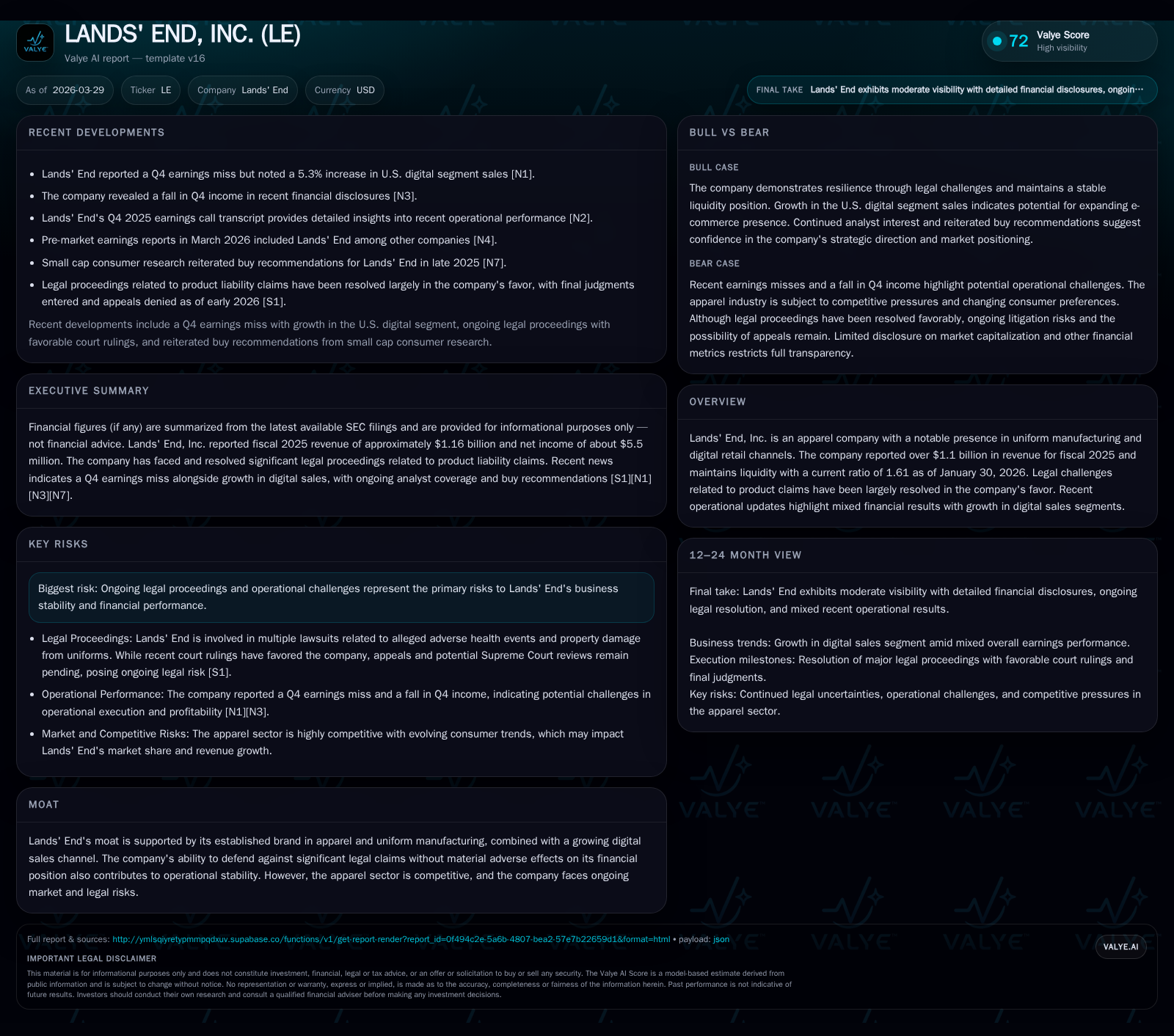
Lands' End, Inc. reported stable revenue of $1.16 billion for fiscal 2025 with modest growth in key digital retail channels compensating for margin pressures in apparel and uniform segments. The company successfully defended itself against significant class-action lawsuits related to uniform product claims, resolving remaining claims without adverse financial impact. A transformative IP monetization deal with WHP Global introduces new capital flexibility while the company maintains conservative cash flow and a robust liquidity position. Looking forward, Lands' End faces a competitive apparel market and must balance ongoing strategic adjustments with sustained digital channel expansion.
Historical Performance: Revenue Stability Despite Sector Pressures
LANDS' END delivered fiscal year 2025 revenues totaling approximately $1.16 billion, representing a moderate year-over-year increase of roughly 0.7% compared to the prior fiscal year [F1]. This top-line stability comes after navigating industry-wide pressures along with fairly flat demand for core apparel products. Operating income contracted by around 13.1% to $44.3 million in FY25 versus FY24, signaling margin pressures potentially tied to cost inflation and competitive pricing dynamics within both apparel and uniform manufacturing segments [F1]. Net income also declined from prior levels to $5.5 million, down nearly 11.6%, though this followed a recovery from the sizable losses experienced in FY23 [F1]. Operating cash flow dipped by 6.6%, falling to approximately $49.6 million, while capital expenditures were reduced by over 22%, suggesting an effort to balance investment with operational efficiency [F1].
The uniform manufacturing division remains a core business line contributing steadiness to revenue streams amid retail fluctuations. The company’s ability to leverage longtime relationships in uniforms supports ongoing demand even as apparel sales fluctuate with consumer trends . Reduced capex spending is consistent with efforts across the sector to manage cash generation carefully during market uncertainty.
Historical performance (annual)
| FY | Rev ($mm) | Net ($mm) | CFO ($mm) | OpInc ($mm) | Rev YoY | Net YoY |
|---|---|---|---|---|---|---|
| 2025 | 1163 | 6 | 50 | 44 | +0.7% | -11.6% |
| 2024 | 1154 | 6 | 53 | 51 | +104.8% | |
| 2023 | -131 | 131 | -78 | -943.0% | ||
| 2022 | -13 | -36 | 25 |
Source: SEC companyfacts cache [F1].
Capital returns and efficiency (annual)
| FY | Buybacks ($mm) | FCF ($mm) | ROE% |
|---|---|---|---|
| 2025 | 20 | 2.3 | |
| 2024 | 15 | 2.6 | |
| 2023 | 12 | 96 | -54.1 |
| 2022 | 8 | -68 | -3.3 |
Source: SEC companyfacts cache [F1].
Legal Proceedings Resolved: Implications for Operational Stability
Lands' End carried the overhang of multiple class-action lawsuits between 2019 and early 2024 that alleged health risks and product defects related to its manufactured uniforms [S4][S5][S8]. These actions sought nationwide class certification for affected employees, claiming damages exceeding $5 million per case and extensive personal injury allegations [S4]. Key legal milestones include an August 2021 denial of plaintiffs’ motion for class certification on uniform performance claims and partial summary judgments awarded to Lands’ End on warranty-related issues [S5]. Further rulings in July 2022 excluded plaintiffs’ expert opinions due to lack of scientifically valid methods, leading to summary judgment favoring Lands’ End on personal injury claims [S5].
Subsequent settlements fully resolved remaining property damage claims valued at approximately $110,000 without material financial impact on the company [S8]. Appeals filed by plaintiffs have been denied through January 2026 with a pending petition to the U.S Supreme Court due by April, which Lands' End continues defending vigorously while assessing no material adverse effects on financial position or operating results thus far [S8]. Removal of this legal uncertainty eliminates significant risk contingencies that had shadowed forecasting and investor confidence.
Digital Channel Growth: Revamping Customer Engagement
While overall financial results have shown mixed margins, Lands’ End’s U.S.-based digital sales segment expanded meaningfully by +5.3% in Q4 FY25 despite headwinds elsewhere [N1]. This uptick illustrates evolving consumer behavior favoring online apparel purchasing, where Lands’ End’s brand recognition provides competitive advantage . Management commentary during the Q4 earnings call highlighted ongoing investments in e-commerce user experience improvements and targeted marketing aimed at deepening direct-to-consumer digital engagement [N2].
This digital channel growth serves as an increasingly critical moat element enabling Lands’ End to sustain sales volumes amid brick-and-mortar retail softness common across legacy apparel providers.
Future Prospects amid Competitive Apparel Landscape
Lands’ End faces well-documented competitive challenges from large incumbents as well as niche fast-fashion entrants within the apparel segment . The company’s stable liquidity ratio of around 1.61 provides operating flexibility enabling reinvestment into strategic areas including digital retail innovation and product development [F1]. Nonetheless, residual litigation uncertainties — notably the outstanding Supreme Court petition — warrant caution as any adverse outcome could impose reputational or financial consequences despite current favorable rulings [N1][S8].
The firm’s ability to sustain modest growth will hinge on successfully scaling its digital platform alongside maintaining durable B2B relationships underpinning its uniform manufacturing business.
Capital Allocation Strategy: Managing Returns in Transition
Lands’ End reported an approximate return on equity near 2.3%, reflecting limited profitability impacted by cyclical pressures and recent restructuring activities [F1]. The absence of dividend payments post-2016 confirms management’s prioritization of cash preservation over yield distribution amid corporate transition phases [F1]. Share repurchase activity has been modest, with buybacks totaling around $11.9 million in FY23 and less than $10 million combined over two recent years [F1], indicative of conservative capital returns.
Notably, a transformative transaction completed January 26, 2026 involves contribution of all intellectual property assets tied to the Lands’ End brand into a newly formed LLC (IPCo), immediately followed by sale of a controlling 50% stake in IPCo to WHP Global for $300 million cash consideration [S10][S11][S15]. This move supplies significant liquidity infusion used primarily for debt repayment and bolsters strategic flexibility.
Under the related License Agreement, IPCo will grant royalty-bearing licenses back to Lands’ End Direct Merchants covering key product lines, generating minimum annual royalties starting at $50 million — securing long-term royalty revenue streams while de-risking IP ownership concentration [S20]. This complex capital arrangement marks a shift toward monetizing brand assets while maintaining operational control.
Financial Health Snapshot: Liquidity and Cash Flow Dynamics
The company's current ratio stood at a solid 1.61 as of January 30, 2026 reflecting ample current assets relative to liabilities which supports short-term solvency and operational funding needs without stress [F1]. Operating cash flow declined moderately by about 6.6% year-over-year yet remains positive at roughly $49.6 million after capex spend which itself was cut by nearly one-quarter signaling prudent expenditure controls amid uncertain demand dynamics [F1].
Free cash flow measured conservatively (CFO minus capex) approximates $20 million providing modest cushion for working capital or selective reinvestment opportunities; this FCF generation is critical given historically low net income levels constraining internal funding sourced from retained earnings alone.
What To Watch: Pending Litigation Outcomes and Market Adaptation
Key indicators for monitoring Lands' End's trajectory include outcomes related to potential U.S Supreme Court review of the plaintiffs’ petition concerning dismissed class actions set for possible hearing before April 9, 2026 — any reversal could revive litigation risks or compensation exposure [S8][N1]. Moreover, sustaining momentum within its digital retail channel will be vital as e-commerce accounts grow from currently underpenetrated bases amid changing consumer preferences documented during earnings calls [N2].
The strategic partnership structure with WHP via IPCo offers avenues for future monetization events such as IPOs or asset sales that could materially affect ownership profiles and capital returns contingent on achieving specific EBITDA multiples, underscoring importance of IPCo’s operational success amid competitive fashion sector dynamics [S11][S27]. Given these structural shifts alongside steadier uniform demand foundations, close scrutiny of quarterly segment disclosures will provide advance signals about competitive positioning effectiveness.
_ Disclaimer: This analysis is intended solely for informational purposes based on publicly available documents including SEC filings and news reports as of March-April 2026; it does not constitute investment advice or recommendations._
Disclaimer: This is research-only, informational analysis and not investment advice. It may include AI-generated interpretation and general industry context. Always verify important details using primary sources.

Comments