
From IPO to Integration: OTG Acquisition Corp. I's Strategic Setup and Growth Prospects
OTG Acquisition Corp. I, a Cayman Islands-based SPAC, has structured its financial and governance framework post-IPO to pursue a transformative business combination.
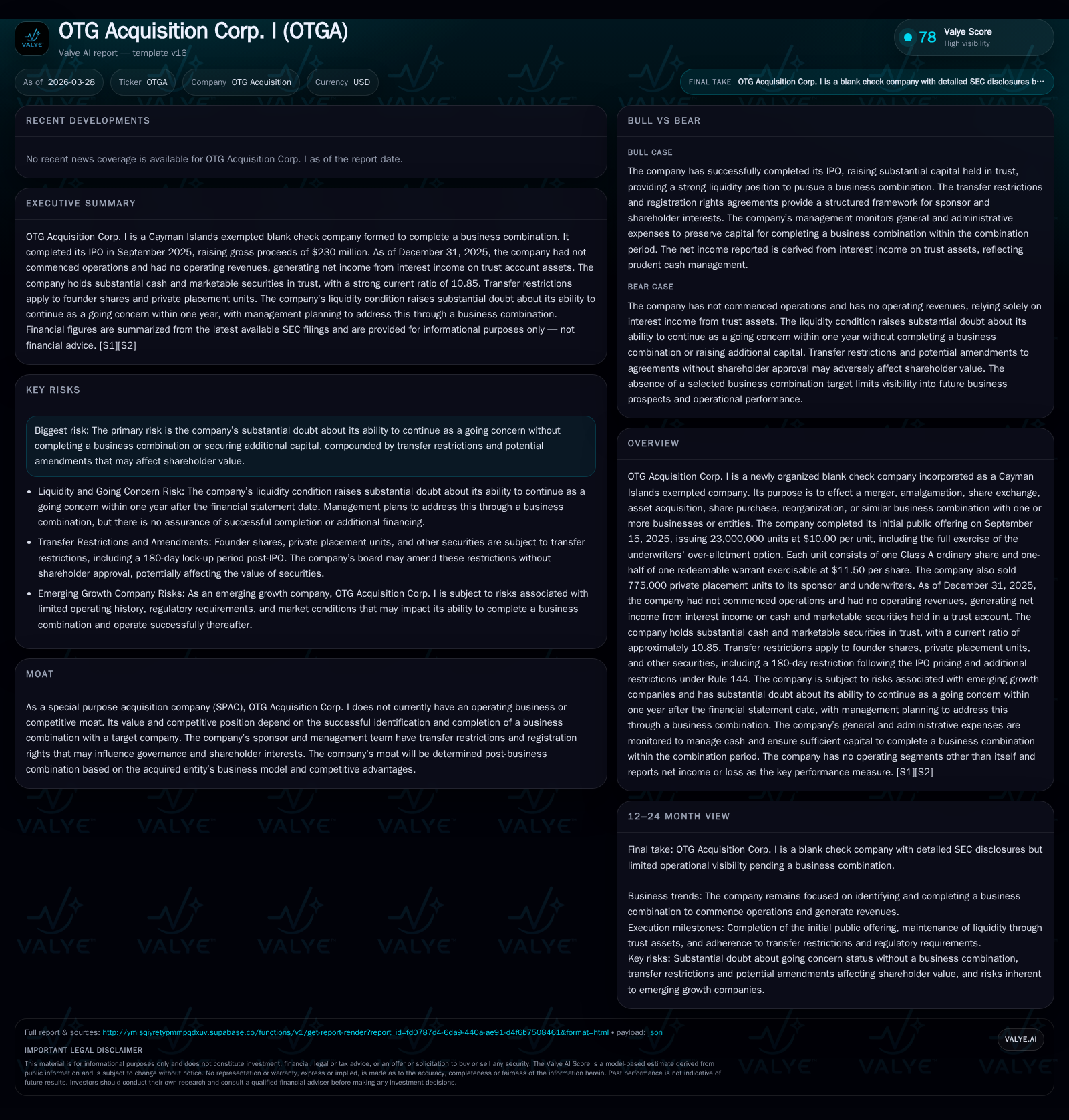
OTG Acquisition Corp. I completed its IPO in September 2025, raising approximately $232 million through a unit sale including a full over-allotment exercise and private placement to the sponsor and underwriters. As a blank check company, OTGA remains without operations, generating non-operating income solely from interest on trust-held securities. Its future growth depends entirely on executing a business combination within prescribed timelines amid governance structures favoring sponsor influence. Liquidity remains ample but contingent on deal closure to sustain operations beyond one year. Investors should focus on upcoming deal announcements and amendments affecting shareholder rights.
Building from the Ground Up: OTGA’s IPO and Initial Capital Structure
OTG Acquisition Corp. I was incorporated as a Cayman Islands exempted company specifically as a special purpose acquisition company (SPAC) designed to effectuate a business combination with one or more operating businesses [S1]. The company completed its initial public offering (IPO) on September 15, 2025, issuing 23 million units at $10 each, which included the full exercise of the underwriters’ overallotment option of 3 million units [S1][S3]. Each unit consists of one Class A ordinary share coupled with one-half of a redeemable warrant exercisable at $11.50 per share [S1]. Complementing the public offering, OTGA also sold 775,000 private placement units to its sponsor (OTG Acquisition Sponsor LLC) and the underwriting syndicate at an identical price per unit, yielding gross proceeds of $7.75 million [S1][S13].
Founder shares issued amounted to 5.75 million Class B ordinary shares—approximately 20% of total equity excluding private placement shares held by insiders—issued at nominal value ($25,000 total) reflective of customary economics typical in SPACs emphasizing sponsor alignment yet heavily weighted towards sponsor control during the pre-combination phase [S1][S13]. Both founder shares and private placement units are subject to transfer restrictions designed to prevent premature liquidity events that might disrupt the coordination required to consummate a strategic transaction [S1][S13].
The bulk of the IPO proceeds were placed in an interest-bearing trust account invested predominantly in U.S. Treasury bills, amounting to roughly $233.7 million as of December 31, 2025 [S1][S14]. This trust structure aligns with industry norms to safeguard investor funds pending business combination execution.
Historical Financial Overview and Income Metrics Post-IPO
Since inception (June 12, 2025), OTGA has not engaged in any operating activities or revenue-generating ventures; consequently, all financial performance centers around administrative costs and interest income derived from the trust account holdings [S1][F1]. General and administrative expenses totaled approximately $338,695 for the reporting period ending December 31, 2025 [F1]. In contrast, interest income earned on trust-held securities was approximately $2.52 million over the same period [F1]. The net effect is a reported positive net income of around $2.18 million despite operating losses driven by start-up costs [F1].
Liquidity metrics underscore robust financial health characteristic of a newly capitalized SPAC: current assets summed nearly $926,058 (primarily cash equivalents and prepaid expenses), while current liabilities were minimal at roughly $85,331 resulting in an impressively high current ratio near 10.85x [F1], indicative of significant working capital cushions relative to short-term obligations.
Historical performance (annual)
| FY |
|---|
| 2025 |
Source: SEC companyfacts cache [F1].
Table: FY 2025 Financial Highlights for OTGA [F1]
Governance Dynamics: Sponsor Agreements, Transfer Restrictions, and Shareholder Rights
OTGA’s governance framework reflects typical SPAC conditions emphasizing sponsor control while balancing public investor protections [S1]. The letter agreement governing sponsor relations delineates substantive transfer limitations on founder shares and private placement units; these provisions restrict transfers generally until at least one year post-initial business combination or certain stock price thresholds are met [S1]. Amendments to these agreements can be approved without shareholder consent but require sponsor approval alongside board concurrence—affording insiders significant flexibility but potentially introducing conflicts between sponsor interests and minority shareholders.
Further entrenching sponsor influence post-business combination are rights allowing nomination of up to three directors for as long as sponsors hold relevant securities covered by registration agreements—a mechanism ensuring continued influence over board composition during critical transition phases [S1][S15]. Transfer restrictions also apply specifically after de-SPAC events limiting early liquidation opportunities for founders while enabling orderly integration processes.
These governance dimensions include sector-specific mechanisms such as "earn-outs" restrictions on securities transfers connected to PIPE financings or founder surrender options that may be triggered strategically pre- or post-business combination [S1]. Such alignments are often negotiated upfront given their impact on deal incentives and ultimate shareholder value realization.
Liquidity Profile and Going Concern Considerations
While OTGA currently possesses strong liquidity largely locked into trust assets earmarked exclusively for business combination purposes ($233.7M as reported at year-end), liquidity external to this trust is limited due to non-operating status and lack of ongoing cash flow generation outside interest income on trust holdings [S6][F1]. Cash flows from operating activities were negative primarily due to recurring admin expenses totaling roughly half a million dollars through YE2025 [S4].
Management disclosures explicitly signal "substantial doubt" over the company’s ability to continue as a going concern absent completion of an initial business combination or acquisition of additional financing within the prescribed term (generally two years from IPO date) reflecting standard guidance under ASC Topic 205-40 [S6][S8]. Without successful deal closure or capital infusion — which could include loans or equity injections primarily from sponsors or third parties — operational continuity will be at risk requiring cost curtailment or liquidation measures.
This explicit risk recognition grounds investor expectations in regulatory reality where most blank check entities must either consummate qualifying mergers promptly or return capital rather than continue indefinitely without declared operations.
Projected Growth Path Through Business Combination Execution
As an unoperated entity pending business combination execution, OTGA’s growth prospects revolve entirely around successful identification and closing of a suitable acquisition target within its operational timeframe [S1]. The company has no revenue streams or operational assets outside cash reserves designated for merger purposes.
Post-merger growth potential will depend critically upon the nature of the acquired enterprise’s market position, competitive moat (if any), management capabilities brought onboard via the transaction, and broader industry dynamics — none of which are disclosed or predictable prior to announcement.
The sponsor plays an indispensable role in deal sourcing strategy; given they control founder shares representing roughly one fifth of outstanding equity along with governance rights influencing board makeup post-combination—they form key value creators or downside risks depending on their ability to identify viable targets amid competitive deal landscapes.
Capital Allocation Practices: Equity Structure, Dividends, and Buybacks
Current capital allocation activities remain limited given OTGA’s blank check status precluding traditional corporate returns such as dividends or share repurchases [S9][F1]. Founder shares constitute about 20% ownership pre-combination but carry transfer restrictions delaying monetization opportunities; private placement units similarly bear constraints until post-de-SPAC periods elapse without redemption triggers.
Net income generated predominantly from trust interest inflows leads to reported highly elevated approximate ROE exceeding 230%—a reflection more of accounting attribution than operational profitability given nominal equity base relative to interest income accrued [F1].
Registration rights plans grant founders and affiliated underwriters registration opportunities enabling liquidity following de-SPAC transactions but actual capital returns await operational results arising from acquired entities’ cash flow generation.
Key Risks Surrounding Sponsor Influence and Continuity of Operations
Material risks recognized encompass sponsors’ broad amendment powers over foundational agreements sans shareholder consent potentially altering economic interests or governance structures unfavorably for minority investors [S1][S5]. The ability for founders/sponsors/officers to transfer founder shares or private units under renewed arrangements may lead to early divestments compromising continuity in deal execution capacity.
Furthermore, officers’ fiduciary overlaps with other entities raise conflict-of-interest concerns impacting deal sourcing priorities given potential contractual pre-emption clauses directing opportunities elsewhere [S24]. Although no material litigation is currently pending against management entities in their capacities within OTGA’s scope [S5], scrutiny remains warranted.
Transfer restrictions delay insider liquidity while protecting process integrity but can concentrate risk should key personnel exit prematurely before consummation—inciting governance instability common across blank check firms where alignment between public holders and sponsors can be tenuous until final mergers close.
What To Watch: Upcoming Milestones and Deal Catalyst Factors
Going forward attention centers on OTGA’s impending deadlines for completing its initial business combination within its lifecycle stipulated by governing memorandum—typically around two years post-IPO—and associated disclosure updates once definitive merger agreements materialize [S1]. Variations in letter agreement terms or registration rights activation may alter shareholder negotiation power dynamically ahead of merger votes.
Sponsor decisions regarding potential earn-outs arrangements tied to merger valuations or amendments easing transfer constraints could materially influence investment profiles. Market conditions impacting SPAC valuations broadly will also shape timing feasibility especially amid fluctuating sentiment towards de-SPAC transactions globally.
Given absence of announced targets or vertical focus areas thus far coupled with substantial sponsor control leverages embedded structurally—the primary triggers driving share performance will emanate from transaction disclosures detailing prospective industry exposure aligned with broader macroeconomic factors affecting deal valuation metrics.
This report synthesizes publicly disclosed SEC filings through March 27, 2026 (notably the Form 10-K) alongside embedded financial data snapshots without extrapolating beyond available factual evidence. It does not incorporate investment recommendations nor speculate on future events absent direct disclosures.
Disclaimer: This is research-only, informational analysis and not investment advice. It may include AI-generated interpretation and general industry context. Always verify important details using primary sources.

Comments