
Launch One Acquisition Corp. Poised at Critical Juncture to Complete $230 Million SPAC Deal in Healthcare
LPAA’s management expertise and substantial trust account capital position define its race to consummate a healthcare business combination by mid-2026.
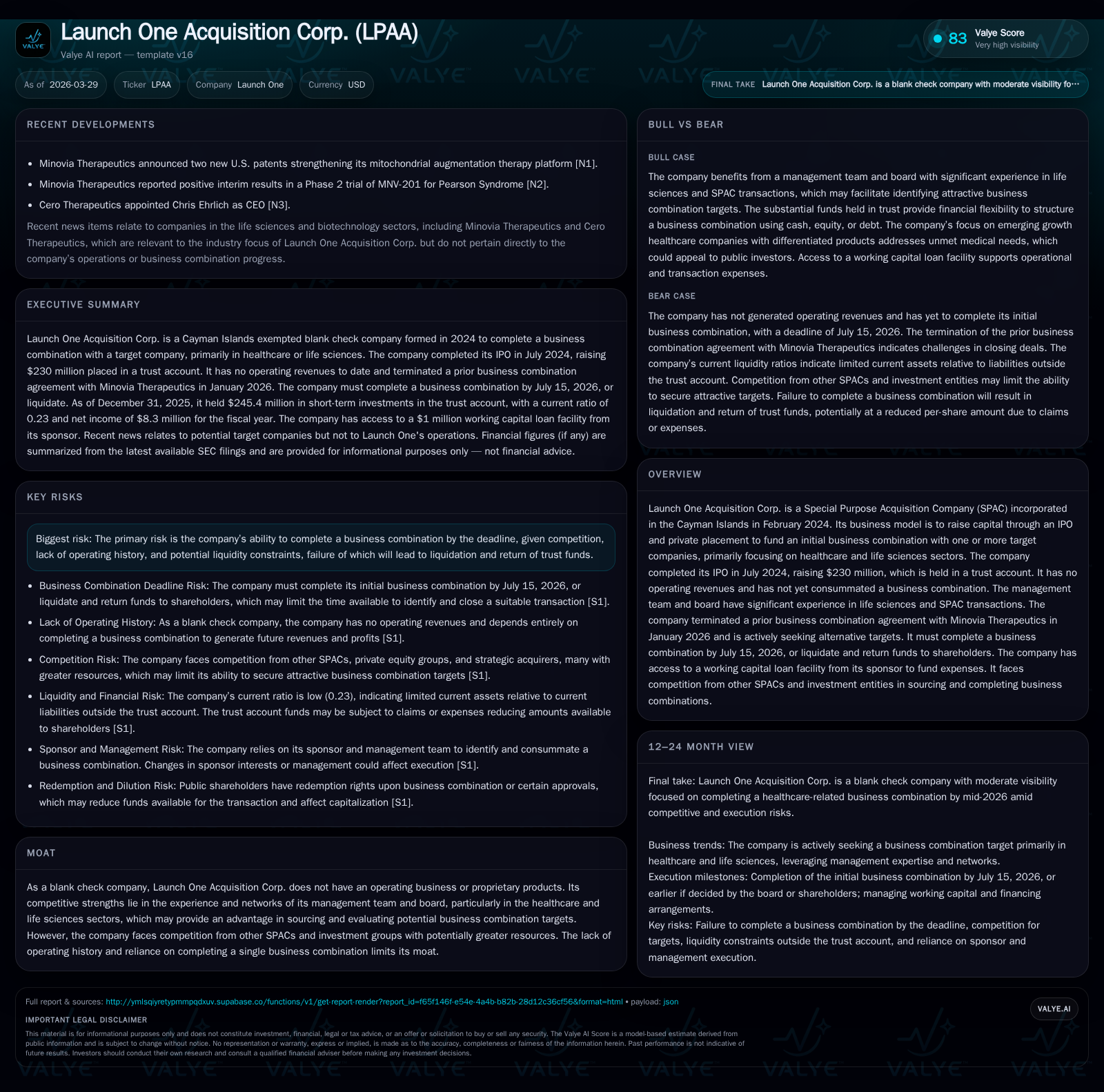
Launch One Acquisition Corp. (LPAA) was incorporated in early 2024 as a Cayman Islands exempted blank check company, focusing on healthcare and life sciences. It raised $230 million in its July 2024 IPO, with proceeds held in trust pending an initial business combination. LPAA has not generated operating revenues and has incurred increasing operating losses typical of a SPAC pre-deal. After terminating its agreement with Minovia Therapeutics in January 2026, the company faces pressure to complete a business combination by the July 15, 2026 deadline or proceed to liquidation. Its capital structure includes public and private placement warrants, and shareholder redemption rights impose constraints on deal execution dynamics.
From Inception to IPO: Foundations of Capital and Expertise
Launch One Acquisition Corp. was incorporated on February 21, 2024, as a Cayman Islands exempted blank check company formed expressly for an initial business combination. While its registration permits any industry pursuit, management focuses on healthcare and life sciences leveraging sector knowledge and networks [S1].
The company completed its Initial Public Offering (IPO) in July 2024, raising gross proceeds of $230 million through issuance of 23 million units at $10 each. Each unit comprised one public share plus one-half warrant exercisable at $11.50 per share [S1]. Concurrently, six million private placement warrants were sold at $1 each—four million purchased by Sponsor—adding $6 million in proceeds [S1]. All IPO proceeds are held intact in a Trust Account managed by an independent trustee for use exclusively in the initial Business Combination or liquidation [S1].
The management team, led by CEO Chris Ehrlich, Chairman Ryan Gilbert, and CFO Jurgen van de Vyver, brings prior SPAC deal experience within healthcare arenas enhancing acquisition prospects [S1].
Financial Performance and Capital Structure: Trust Account Strength amid Operating Losses
LPAA has not recognized operating revenues as expected for a pre-combination SPAC. Operating losses expanded from approximately -$400k in FY2024 to -$1.61 million in FY2025 reflecting increased administrative costs associated with search activities [F1]. Operating cash flow declined over 70% year-over-year underscoring ongoing investments prior to deal closure [F1]. Conversely, net income rose from $5.1 million to $8.3 million primarily due to interest income earned on Trust Account deposits exceeding operational expenses [F1].
At December 31, 2025, current liabilities stood near $0.8 million against current assets of about $180 thousand—a low current ratio typical given that most funds reside outside working capital accounts within the Trust Account ring-fenced for transaction use [F1]. Total equity was negative approximately -$11.56 million largely reflecting accounting for deferred underwriting fees and accrued expenses rather than economic impairment of assets [F1].
The Trust Account balance remains robust at approximately $245 million before redemptions, taxes payable on interest earned, and deferred fees—funds reserved solely for consummating the initial Business Combination or returning investor capital upon liquidation [S12], [S15].
Strategic Focus: Healthcare Sector Expertise amid Competitive Deal Environment
LPAA targets healthcare and life sciences companies exhibiting clinical progress or unmet medical needs with potential for public market success post-merger. Selection criteria emphasize scientific rationale, governance standards suited for public reporting, and valuation aligned with investor expectations [S8]. This focus leverages management's domain expertise facilitating access to proprietary deal flow less accessible to generalist SPACs.
Competition is intense given numerous SPACs pursuing biotech assets often at early development stages amid evolving investor sentiment toward SPAC-mediated listings. Regulatory compliance burdens including Sarbanes-Oxley audit requirements pose additional diligence complexities for target evaluation [S19].
Business Combination Challenges since January 2026 Termination
In January 2026, LPAA terminated its proposed business combination agreement with Minovia Therapeutics after extended negotiations failed to close [S1]. This setback compressed timing ahead of the firm July 15, 2026 deadline mandated by its Amended Articles of Association for completing an initial Business Combination or liquidating thereafter [S1]. The termination may heighten investor scrutiny regarding deal execution capability under tight timelines.
Capital Allocation Framework: Warrants, Insider Purchases, and Redemption Rights
Capital allocation remains conservative pending deal completion. The Private Placement Warrants create potential dilution post-merger; these securities entitle holders to purchase Class A shares at fixed prices impacting post-transaction equity composition [S1], [S4], [S5]. Insider purchases of public shares or warrants are permitted pre- and post-combination under SEC safe harbor rules (Rule 10b-18) potentially used tactically to influence shareholder vote outcomes or manage redemption levels favorably toward deal closure [S4], [S5], [S7].
Public shareholders have redemption rights allowing them to redeem shares at trust account per-share value upon merger completion regardless of vote direction; however, redemptions are limited without prior consent above certain thresholds mitigating risks of minority blocking while preserving liquidity essential for closing transactions successfully [S10], [S21].
Operating expenditures outside the trust fund remain minimal (approximately $30 thousand as of late 2025), partly financed through loans extended by Sponsor secured against Founder Shares pledged under credit agreements capped near $1 million covering working capital needs including legal fees and diligence costs until combination finalization [S24], [S28].
Governance and Sponsor Roles: Balancing Insider Incentives and Shareholder Protections
Sponsor interests align with successful combination completion but involve complexities balancing protections for public shareholders against incentives supporting timely approvals. The Sponsor holds Founder Shares which lack redemption rights upon liquidation but wields voting influence enhanced through acquired public shares or privately exercised warrants outside proxy votes potentially affecting transaction outcomes [S4], [S5], [S7].
Protocols permit insiders to acquire securities from dissenting shareholders who elected redemptions subject to revocation conditions compliant with securities laws designed to prevent abuses while aiding transaction feasibility.
Such insider purchases can reduce public float size possibly impacting liquidity or market quoting continuity—a consideration amid valuation sensitivity during merger execution windows.
Outlook: Milestones Leading up to July 15, 2026 Deadline
The critical upcoming milestone is completing an initial Business Combination no later than July 15, 2026—the contractual expiration date after which pro rata distributions from trust proceeds will be made reflecting residual capital net fees/expenditures per outstanding share held by public investors if liquidation ensues [S1], [S3]. Proxy filings disclosing targets or shareholder meeting notices will provide transparency into transaction terms.
Completion requires shareholder approval thresholds including Sponsor Founder Shares commitments; LPAA intends tender offers or shareholder votes aligned with Nasdaq rules governing significant share issuance or amendments prior thereto.
Failure triggers dissolution distributing trust funds pro rata but exposes investors to timing delays and uncertain claims against trust assets potentially reducing final redemption values below IPO price considering tax liabilities or indemnity claims related to third-party disputes over escrowed funds [S9], [S11], [S15], [S26], [S27].
Risk Profile: Liquidity Constraints and Regulatory Considerations
Key risks include failure to consummate the initial Business Combination within prescribed timelines due to liquidity mismatches if redemptions overly deplete trust resources below minimum cash covenants hindering closing; competition limiting access to attractive targets; regulatory delays tied especially to financial statement audit compliance under Sarbanes-Oxley Act; plus potential claims against trust accounts reducing final liquidation returns although structural safeguards exist around trustee-managed escrow arrangements formed during IPO escrow arrangements protecting shareholder interests as far as practicable under law [F1],[S9],[S11],[S15],[S26],[S27].
Historical performance (annual)
| FY | Net ($mm) | CFO ($) | OpInc ($) | Net YoY |
|---|---|---|---|---|
| 2025 | 8 | -820192 | -1611081 | +62.0% |
| 2024 | 5 | -472305 | -400002 |
Source: SEC companyfacts cache [F1].
Capital returns and efficiency (annual)
| FY | ROE% |
|---|---|
| 2025 | -71.9 |
| 2024 | -51.6 |
Source: SEC companyfacts cache [F1].
Operating losses reflect typical pre-deal expenses of a blank check company while positive net income arises mainly from interest accrued on Trust Account balances ensuring capital preservation.
This analysis synthesizes primary data exclusively from Launch One Acquisition Corp.’s SEC filings through March 27–29, 2026 ([F1],[S1]–[S29]) focusing on corporate structure dynamics without investment recommendations.
Disclaimer: This is research-only, informational analysis and not investment advice. It may include AI-generated interpretation and general industry context. Always verify important details using primary sources.

Comments