
VanEck Bitcoin ETF's Performance and Position in a Turbulent Crypto Market
An analytical review of VanEck Bitcoin ETF’s NAV growth, volatility exposure, fee structure, and regulatory environment amid a challenging cryptocurrency landscape.
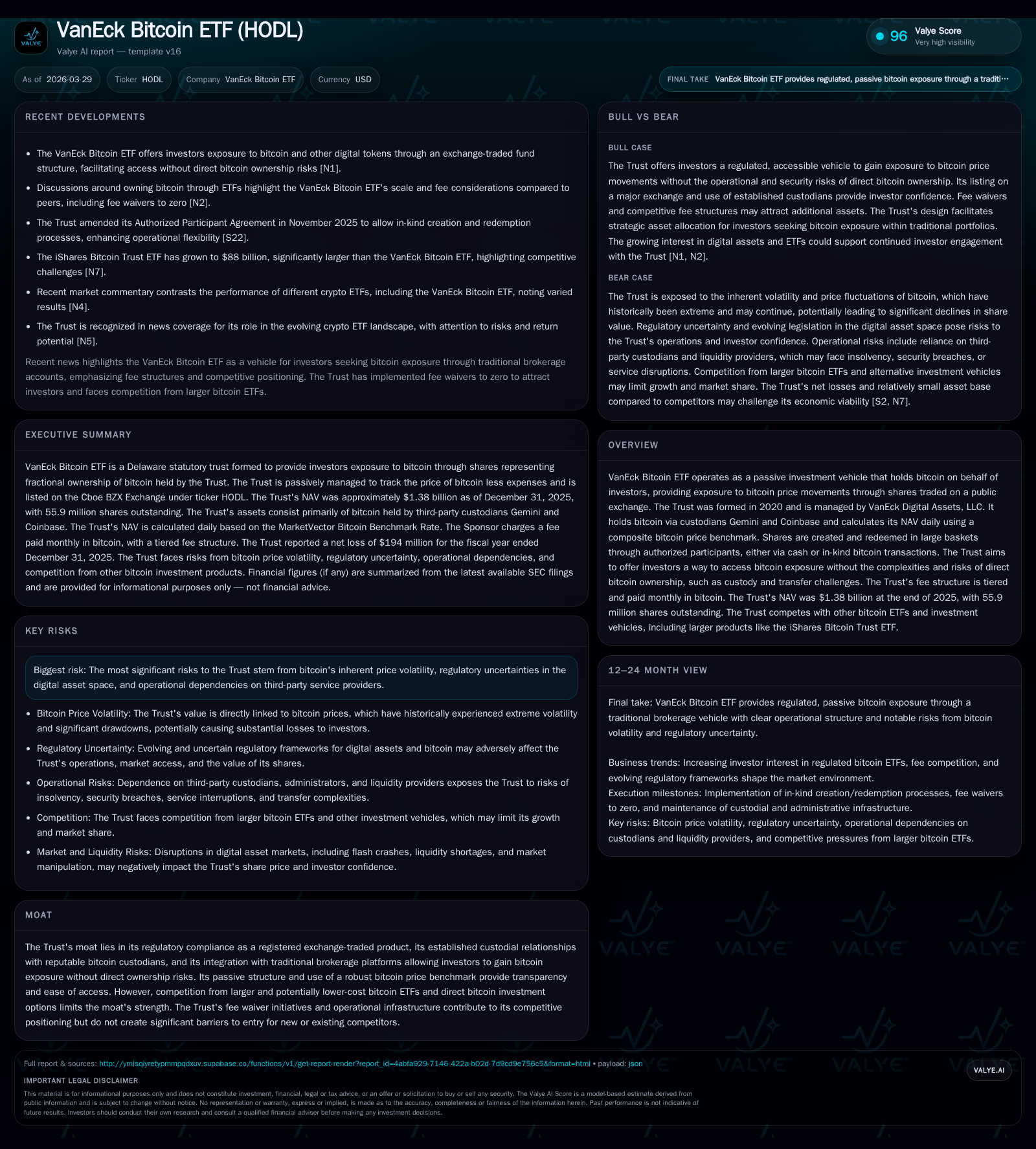
VanEck Bitcoin ETF (HODL) manages $1.38 billion in bitcoin holdings as of 2025 year-end, offering passive market exposure via regulated custodians Gemini and Coinbase. The Trust’s past performance is dominated by bitcoin’s intrinsic price volatility, including the October 2025 Flash Crash, materially impacting NAV and resulting in negative returns. Despite a robust custody framework and regulatory compliance that serve as partial moats, the Fund faces intensified competition from larger, lower-fee bitcoin ETFs and ongoing regulatory uncertainties. The Trust maintains a tiered fee structure paid in bitcoin, with recent fee waivers to improve attractiveness. Capital allocation remains conservative with no distributions or buybacks since inception. Looking ahead, the key catalysts and risks remain tied to bitcoin price dynamics and evolving U.S. digital asset regulation.
Historical NAV Growth and Share Issuance Trends
At December 31, 2025, VanEck Bitcoin ETF reported net assets of approximately $1.38 billion distributed over 55.9 million shares outstanding [F1][S1]. This reflects substantial growth since inception amid several market cycles influencing the underlying bitcoin price. Notably, the Trust executed a four-for-one share split on February 14, 2025, effectively bolstering liquidity by increasing the number of shares without changing total net asset value [S1].
However, despite nominal asset growth, profitability metrics reveal persistent challenges tied to underlying market volatility. The Trust posted a net loss of $194 million for fiscal year 2025 [F1], resulting in a negative return on equity (ROE) of -16.8%. This ROE underscores how fluctuations in bitcoin prices directly impair shareholder returns given HODL’s passive investment mandate without tactical risk mitigation.
Historical performance (annual)
| FY |
|---|
| 2025 |
Source: SEC companyfacts cache [F1].
Table represents available figures without interpolation for missing data points.
Drivers of Past Performance: Volatility, Market Events, and Custodial Stability
Bitcoin’s inherent volatility remains the principal driver of the VanEck Bitcoin ETF's financial performance [S1][S2]. Over the past decade, bitcoin has experienced repeated boom-and-bust cycles marked by rapid appreciations followed by sharp drawdowns—for example, a 77% peak-to-trough decline during the 2021-2022 cycle where prices dropped from $67,734 to $15,632 [S1]. More recently, the “October 2025 Flash Crash” saw bitcoin lose approximately 14% of its value within days amid global macroeconomic pressures and digital asset market dislocations [S1][S2]. This event triggered liquidation cascades totaling roughly $20 billion across various collateralized positions.
Such episodes magnify NAV fluctuations and amplify redemption pressures as investors reassess risk exposures. The Trust does not engage in active management or hedging strategies to buffer these swings [S1], thereby fully transmitting bitcoin price movements to shareholders.
Operational resilience rests heavily on custodians Gemini Trust Company and Coinbase Custody—the entities safeguarding the Fund's bitcoin holdings [S1]. Both custodians have faced heightened regulatory attention: Gemini settled claims relating to its Earn lending program including restitution obligations exceeding $50 million following NYDFS enforcement actions [S3][S14]. Concurrently, Coinbase confronted SEC enforcement threats regarding registration status but avoided court penalties after a dismissal agreement was reached [S9][S15].
While these relationships confer institutional-grade custody benefits—critical in mitigating direct user custody risks—they also introduce dependencies that expose HODL to potential service interruptions or reputational risks if custodians encounter operational or legal setbacks [S6][S11].
Regulatory Landscape Impacting Operations and Competitive Positioning
The digital asset regulatory regime continues to evolve rapidly with significant implications for HODL's operating environment [S5][S6][S7]. Federal and state regulators—including SEC, CFTC, FinCEN, NYDFS—intensify scrutiny over crypto intermediaries.
New York’s BitLicense framework imposes comprehensive AML/KYC protocols on digital asset businesses operating within its jurisdiction [S7]. Custodians servicing HODL must comply or risk operational restrictions impacting service delivery.
Federal initiatives targeting illicit finance via “unhosted wallets” signal intensifying controls over crypto flows [S7], while proposals like the Digital Asset Market Clarity Act may expand CFTC oversight [S18]. These developments could increase compliance costs materially.
High-profile platform failures such as FTX’s bankruptcy continue driving calls for enhanced investor protections and mandatory registrations for trading platforms as securities exchanges or designated contract markets [S2][S21], potentially reshaping market infrastructure.
This complex regulatory mosaic heightens operational complexity for custodians integral to HODL’s structure and may influence investor demand through perceived safety assurances or stigmas attached to certain providers.
Fee Structure and Investment Return Implications
VanEck Bitcoin ETF employs a tiered monthly fee model charged in bitcoin units impacting net returns realized by shareholders [F1]. Unlike traditional fiat-denominated expense ratios reducing NAV directly, fees denominated in bitcoin introduce variability aligned with underlying asset performance.
Recent commentary notes VanEck’s fee waiver initiatives aimed at narrowing cost gaps against competitors like IBIT that benefit from scale-driven lower fees [N2]. Given investors’ sensitivity to expense drag among passive crypto funds, these adjustments seek to improve competitiveness.
However, steep price declines during volatile periods can amplify negative compounding effects on shareholder returns despite relatively low nominal fees.
Market Competition and Operational Constraints Ahead
VanEck faces intense competition from larger Bitcoin ETFs offering lower fees due to scale advantages and from direct bitcoin ownership favored by some investors for cost minimization or control reasons [N2]. This competitive pressure accentuates margin compression challenges.
Additionally, operational risks arise from potential disruptions among authorized participants who facilitate creation/redemption processes essential for aligning share trading prices with NAV through arbitrage mechanisms [S6]. Reduced participation during volatile markets—as observed during late-2025 turbulence—could exacerbate pricing divergences affecting trust valuation stability.
The ability to onboard replacement liquidity providers or authorized participants swiftly under heightened regulation or market stress remains uncertain but critical.
Capital Allocation Review and Financial Metrics Summary
Disclosures indicate minimal cash holdings ($100k at end-2023) relative to total assets concentrated fully in bitcoin holdings [F1], consistent with the Fund’s passive structure focused solely on tracking underlying asset value.
The net loss of $194 million for fiscal year ended December 31, 2025 primarily reflects unrealized depreciation from bitcoin price declines rather than operational expenses independent of asset performance [F1].
The Trust has not distributed dividends nor repurchased shares since inception—reflecting capital preservation priorities amid inherent volatility where forced distributions could crystallize losses prematurely.
With ROE near -16.8%, portfolio managers and investors must carefully consider timing exposures given asymmetric downside risks inherent in cryptocurrency markets under current structures.
Outlook: Catalysts and Risks for 2026
The VanEck Bitcoin ETF's outlook depends primarily on two external factors:
- Bitcoin Price Dynamics: Stabilization or recovery in macroeconomic conditions could spur bitcoin price appreciation benefiting NAV growth; conversely sustained volatility may prolong depressed valuations as seen since prior cycles ending in 2025 [S1][N1].
- Regulatory Evolution: Clarifying federal legislation may reduce uncertainty fragmenting compliance expectations; however aggressive regulations could raise costs or disrupt custody services negatively impacting operations [S5][N2][S7].
Investors should monitor SEC filings for changes in custody arrangements or authorized participant agreements affecting liquidity or fees. Market trends favor scale players with cost efficiencies while niche competitors pursue differentiation through fee waivers and client service innovations [N2].
In summary, VanEck Bitcoin ETF offers structured exposure tracking bitcoin price movements within a regulated framework supported by established custodians amidst an unsettled legislative backdrop. Future performance will closely mirror developments in digital asset pricing dynamics and evolving crypto regulatory architecture.
This analysis is provided solely for informational purposes without investment recommendations or advice. Readers should conduct independent evaluations before making investment decisions related to VanEck Bitcoin ETF or cryptocurrencies generally.
Disclaimer: This is research-only, informational analysis and not investment advice. It may include AI-generated interpretation and general industry context. Always verify important details using primary sources.

Comments