
Entera Bio Faces Funding and Clinical Milestones Challenges as Oral Peptide Platform Advances
The clinical-stage biotech develops oral peptide therapies with Phase 3 trials pending but requires additional capital beyond mid-2026 cash runway.
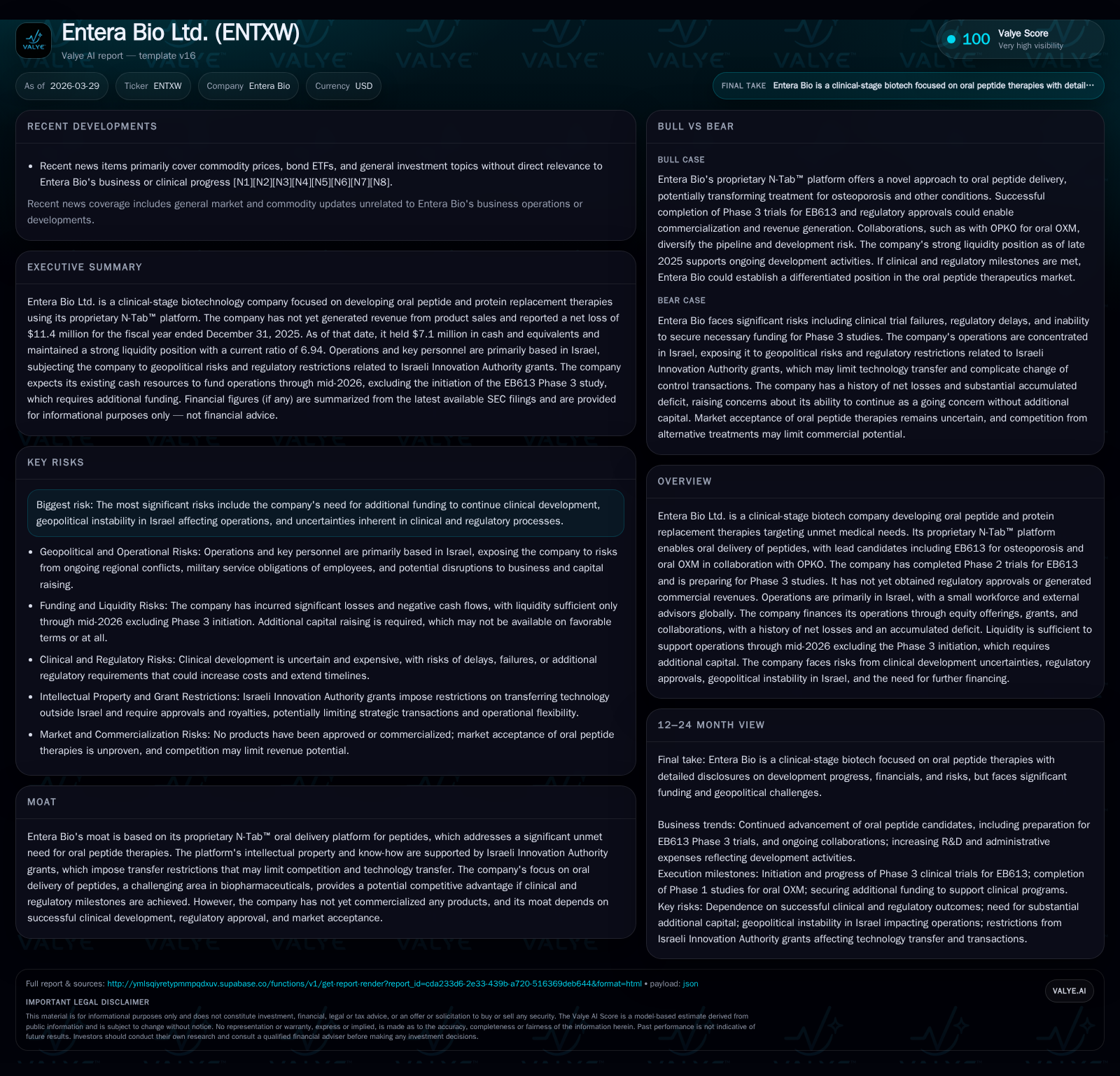
Entera Bio Ltd. focuses on oral delivery of peptide therapies through its proprietary N-Tab™ platform, with lead products EB613 for osteoporosis and oral OXM in collaboration with OPKO. Despite demonstrating proof of concept in Phase 2, the company has no approved products or revenues and continues to incur substantial losses. Its cash position supports operations only until mid-2026 excluding Phase 3 initiation for EB613, highlighting critical dependence on successful capital raises. Risks include clinical, regulatory, geopolitical challenges, and intellectual property complexities.
Company Overview
Entera Bio Ltd. is a clinical-stage biotechnology company pioneering oral peptide and protein replacement therapies aimed at conditions with unmet medical needs. Central to its approach is the proprietary N-Tab™ platform designed to enable stable oral delivery of peptides, a challenging pharmaceutical field given inherent enzymatic degradation barriers to oral peptide absorption. The platform's promise lies in transforming injectable peptide drugs—such as parathyroid hormone analogs—into patient-friendly oral formulations.
Key pipeline assets feature EB613 for osteoporosis—a leading candidate that has successfully completed Phase 2 clinical trials—and an oral oxyntomodulin (OXM) program developed in collaboration with OPKO Health involving a GLP-1/Glucagon receptor-targeting tablet. However, none of these candidates have yet attained regulatory approval or commercialization status.
Historical Financial Performance
Financial results reflect Entera’s pure-play early development stage profile characterized by year-over-year operating losses and no product revenue beyond negligible milestone or research-related income.
Historical performance (annual)
| FY | Rev ($) | Net ($mm) | CFO ($mm) | OpInc ($mm) | Rev YoY | Net YoY |
|---|---|---|---|---|---|---|
| 2025 | 42000 | -11 | -7 | -12 | -76.8% | -19.9% |
| 2024 | 181000 | -10 | -7 | -10 | -7.3% | |
| 2023 | 0 | -9 | -7 | -9 | -100.0% | +32.0% |
| 2022 | 134000 | -13 | -12 | -13 |
Source: SEC companyfacts cache [F1].
Capital returns and efficiency (annual)
| FY | FCF ($mm) | ROE% |
|---|---|---|
| 2025 | -7 | -87.3 |
| 2024 | -7 | -118.1 |
| 2023 | -7 | -85.6 |
| 2022 | -13 | -111.2 |
Source: SEC companyfacts cache [F1].
Entera Bio experienced a steep decline in revenue during FY2025 primarily attributable to the completion of obligations under a specific research services agreement in early 2025 [F1][S2][S10]. Operating losses deepened roughly 20% from the prior year, consistent with increased R&D investments preparing pivotal trials, while net losses follow similar trends due to minimal non-operating income.
Operating cash flow remained negative and consistent with ongoing trial expenditures, while capex spiked modestly due to facility upgrades or equipment investments accompanying clinical scale-up activities [F1]. Equity rose with fresh share issuances including those from strategic partnership financings.
Growth Prospects and Pipeline Development
Entera’s near-term growth driver centers on advancing EB613 into Phase 3 trials for osteoporosis following successful Phase 2 data validating its potential as an orally delivered parathyroid hormone analog—the first of its kind to possibly replace injections in this therapeutic space.
Additionally, the partnered development of oral OXM tablets represents a promising node targeting metabolic disorders such as obesity or diabetes via GLP-1 receptor pathways widely pursued pharma targets.
Nonetheless, full-scale commercialization remains contingent on several milestones:
- Securing sufficient funding to initiate and sustain costly Phase 3 studies for EB613, which current cash reserves do not cover fully [S1][S2].
- Navigating the stringent regulatory environment governing novel oral peptide formulations, including potential requests for additional preclinical or clinical studies delaying approvals [S4][S6].
- Successful demonstration of product safety, efficacy, patient adherence benefits versus existing injectable alternatives.
- Market adoption supported by payor reimbursement strategies amid evolving U.S., EU healthcare regulations impacting drug pricing and access [S11][S19].
A failure in any clinical phase or funding gap could stall development prospects altogether given no alternative revenue streams exist presently.
Forecasts & Upcoming Milestones
The company has not disclosed detailed guidance; however key operational watchers include:
- The timing of EB613 Phase 3 trial commencement—expected post-mid-2026 but contingent on capital raises [S1][S2].
- Ongoing completion of Phase 1 pharmacokinetics (PK) studies linked to next-gen EB613 formulation optimization announced earlier stages.
- Readouts from SAD (single ascending dose) and MAD (multiple ascending dose) Phase 1 studies for the oral OXM candidate developed with OPKO.
- Regulatory engagement outcomes following FDA Type A meeting requests related to Phase 3 design discussions.
Liquidity updates will also be critical given the burn profile increasing as clinical costs escalate.
Capital Structure & Returns Profile
Since inception Entera has raised capital primarily through equity offerings augmented by grants from entities such as the Israeli Innovation Authority (IIA). Notably:
- The collaboration agreement with OPKO involved an equity placement valued at approximately $8 million inducing significant share issuance [S13][S23].
- Leerink ATM Programs have facilitated flexible equity sales totaling nearly $9.8 million net proceeds since initiation.
- Cash balance at end December 2025 stood at roughly $7.1 million after earmarking funds within escrow arrangements tied to collaboration commitments reflecting prudent liquidity management [F1][S13][S23].
Return metrics remain negative driven by ongoing losses necessary in pre-commercial stages, with an implied return on equity approximating -87% given net loss magnitude relative to shareholder equity [F1]. Free cash flow remains negative as well indicating no internal funds generated from operations or asset divestitures yet.
No dividends or buybacks have been declared reflecting typical early biotech lifecycle capital redeployment needs.
Competitive Moat & Intellectual Property Considerations
Entera’s moat is rooted in its proprietary N-Tab™ technology enabling oral administration of peptides typically restricted to injectables due to poor gastrointestinal stability and absorption barriers. This technology is protected partially by patents plus support through IIA grants imposing restrictive conditions around transfer and licensing related exclusively to Israeli jurisdiction effects markedly reducing risk of foreign competitive entry based on technology transfer alone.[S1] Nevertheless patented technologies face inherent biotech sector risks including:
- Patent litigation or invalidity challenges potentially encumbering freedom-to-operate across jurisdictions [S7][S22].
- Dependence on maintaining licensing compliance regarding Israeli legal constraints limiting manufacturing options or ownership structures.
- Potential counterclaims or third-party claims regarding misappropriation adding financial/legal burdens.[S17]
Risk Factors Summary
Prominent risks impacting Entera Bio encompass:
• Capital sufficiency: Existing resources do not cover pivotal Phase 3 spending; fundraising success uncertain which could delay development timelines substantially.[S1][S2] • Clinical/regulatory uncertainties: Extensive trials required; agencies may demand more data causing delays or failure. • Geopolitical risks: Operations based in Israel subject to regional instability potentially disrupting supply chains or workforce. • Pricing & reimbursement: Future payor policies may limit commercial viability even if approved.[S11] • Intellectual property disputes: Litigious biotech environment requiring active patent defense.[S22] • Operational risks: Employee misconduct including regulatory compliance breaches could expose company to fines/judgments.[S14] • Market volatility: Share price sensitive to announcements given no current revenues.[S20]
Conclusion & Monitoring Points (Analysis)
Entera Bio embodies a classical high-risk/high-reward clinical-stage biotech positioned on an innovative oral peptide delivery platform addressing substantial unmet demands especially in osteoporosis therapy. Its financial posture highlights dependency on near-term capital raises aligned tightly with expensive Phase 3 trial initiations scheduled post-Q3 2026 according to current cash projections. Evolving regulatory landscapes combined with operational risks warrant continuous attention given their possible impact on trial duration and eventual market entry feasibility. Should Entera secure requisite funding and successfully advance pivotal programs, it would validate its novel platform potentially disrupting injectable-centric markets offering significant improved patient convenience. Key events warranting close observation include progress updates on financing efforts, regulatory interactions outcomes especially pertaining to EB613 Phase 3 study designs, and interim clinical data releases from both internal and partnered candidates.
This analysis does not constitute investment advice or recommendations but aims to provide a comprehensive understanding of Entera Bio Ltd.’s standing based on publicly available filings and disclosures as of March 29, 2026.
Disclaimer: This is research-only, informational analysis and not investment advice. It may include AI-generated interpretation and general industry context. Always verify important details using primary sources.

Comments