
Hoth Therapeutics’ Path from Clinical Innovation to Commercial Viability
Hoth Therapeutics advances promising clinical-stage therapies while confronting significant financial and operational challenges.
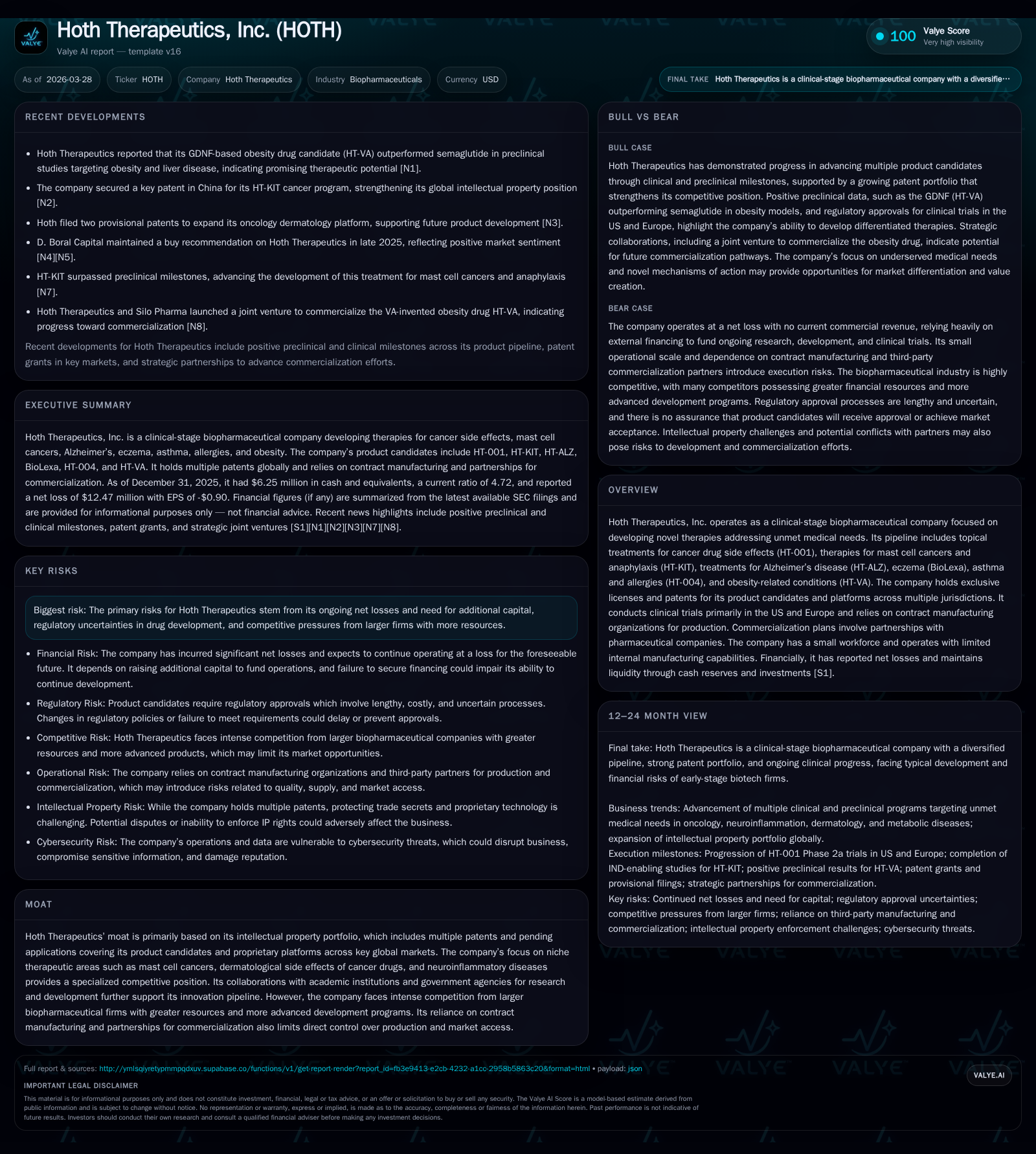
Hoth Therapeutics, a clinical-stage biopharmaceutical company, is developing a diversified pipeline focused on unmet medical needs including cancer therapy side effects, mast cell cancers, and neuroinflammatory diseases. Despite promising progress in clinical trials and expanding intellectual property protections, the company faces persistent net losses, an increasingly negative operating income trend, and liquidity constraints necessitating further capital raises. Success hinges on forthcoming regulatory milestones, managing third-party manufacturing dependencies, and navigating a complex competitive landscape characterized by larger rivals. Investors should watch for Phase 2 trial readouts for HT-001 and the commercialization partnerships that will determine Hoth's transition from development to market presence.
Historical Performance: Growth Patterns and Cost Dynamics
Hoth Therapeutics operates as a clinical-stage biopharmaceutical enterprise focused primarily on advancing experimental therapies from preclinical research through early-phase human trials. Examining its recent financial history exposes a familiar pattern prevalent among emerging biotech companies: escalating investment in research and development is driving widening operating losses against a backdrop of minimal or no product-derived revenues.
From fiscal year (FY) 2022 through FY2025, operating income deteriorated considerably from -$11.1 million to -$12.4 million with the rate of decline accelerating sharply in the latest annual period accounting for a roughly 50.5% YoY drop as per company filings [F1]. Net income followed a similar trajectory plunging from -$11.4 million in 2022 to nearly -$12.5 million in FY2025—an increase in absolute loss of over 52% year-over-year. Despite reporting $1.235 billion revenue measured at Q1 2024 quarter-end, these inflows do not represent commercial sales but are presumably related to one-time licensing fees or research grants given lack of commercialization disclosure [F1]. Operating cash flow remained negative throughout this timeframe with FY2025 clocking just under -$9.8 million reflecting continuous cash burn.
Historical performance (annual)
| FY | Net ($mm) | CFO ($mm) | OpInc ($mm) | Net YoY |
|---|---|---|---|---|
| 2025 | -12 | -10 | -12 | -52.3% |
| 2024 | -8 | -7 | -8 | -4.4% |
| 2023 | -8 | -8 | -8 | +31.0% |
| 2022 | -11 | -9 | -11 |
Source: SEC companyfacts cache [F1].
Capital returns and efficiency (annual)
| FY | ROE% |
|---|---|
| 2025 | -202.7 |
| 2024 | -119.0 |
| 2023 | -89.0 |
| 2022 | -222.0 |
Source: SEC companyfacts cache [F1].
Note: Revenues reported reflect non-commercial sources primarily up to Q1 2024 at $1.235 billion as company has not yet realized commercial sales.
The growing negative margins stem largely from intensified R&D expenditures fueling the progression of multiple drug candidates toward clinical validation stages as well as necessary compliance costs associated with regulatory requirements.
Core Pipeline Developments Catalyzing Potential Growth
At the heart of Hoth Therapeutics’ growth thesis lies its diversified pipeline targeting difficult-to-address diseases with substantial unmet needs and limited effective therapies currently available.
HT-001
This is Hoth’s flagship topical formulation designed specifically to mitigate dermatological side effects caused by epidermal growth factor receptor (EGFR) inhibitors—molecular cancer therapies commonly complicated by dose-limiting skin toxicities such as rash and inflammation [S1]. Licensed exclusively from The George Washington University since early 2020, HT-001 aims to improve patient tolerance to EGFR inhibitors thereby enabling sustained optimal dosing critical for therapeutic efficacy.
The drug moved into Phase 2a clinical trials following FDA clearance in late December 2022 after submission of an IND application [S1]. Subsequently, Hoth expanded study sites into Europe with EMA approvals covering Spain, Poland and Hungary granted by January 2026 enabling broader enrollment reach [S1]. Preliminary interim results from ongoing open-label cohorts suggest favorable efficacy signals supportive enough to continue both open label and blinded randomized arms—a positive harbinger for eventual marketing authorization pursuits.
In parallel, the firm fortified its IP position with three provisional patent applications filed in January 2025 covering new indications beyond EGFR inhibitor-associated skin conditions demonstrating active lifecycle management efforts around HT-001 technology platforms [S1]. Proof-of-concept studies for these additional indications commenced soon thereafter illustrating strategic pipeline diversification aimed at mitigating single-product risk exposures.
HT-KIT
Leveraging intellectual property licensed exclusively from North Carolina State University on targeting KIT receptor tyrosine kinase specific to mast cells, HT-KIT represents a novel therapeutic approach tackling mast cell-derived malignancies and severe allergic reactions like anaphylaxis that remain poorly served by existing options [S1]. By focusing on inhibiting this key receptor required for mast cell proliferation and survival, Hoth hopes to pioneer treatments potentially modifying disease course rather than symptom alone—a meaningful differentiation within this niche segment.
Other Pipeline Assets
Additional investigational products include BioLexa targeting eczema (atopic dermatitis), HT-004 intended for asthma and allergy management via inhalation delivery routes, and HT-VA developed for obesity-related diseases [S1]. This breadth highlights a strategic intent not only on oncology but chronic inflammatory and metabolic conditions where patient populations are large though also clinically heterogeneous.
Clinical Milestones and Regulatory Progress at the Forefront
Hoth’s advancement depends critically on successful navigation through regulated clinical development pathways which serve as both gateways and hurdles.
The pivotal regulatory achievements include recent FDA acceptance of Phase 2a protocols targeting EGFR inhibitor dermatological side effects with trial enrollment actively underway since December 2022 [S1]. Expansion into European Union markets came after securing EMA trial approvals covering multiple member states reflecting competent alignment with multiple jurisdictional demands vital for eventual multi-region filings.
Interim data released during ongoing trials have reportedly shown promising safety profiles along with signs of efficacy sufficient to justify continuation into randomized controlled phases underscoring cautious optimism within management teams [S3]. Proof-of-concept studies undertaken starting January 2026 for newly identified HT-001 indications imply potential label expansions increasing market opportunity should these pan out positively.
The confluence of proceeding trial stages coupled with regulatory flexibility demonstrated across regions may reduce traditional bottlenecks experienced by small biotechs facilitating accelerated timelines relative to classical drug development arcs.
Competitive Moat: Intellectual Property and Niche Therapeutic Focus
Hoth Therapeutics draws defensibility mainly from its robust proprietary intellectual property encompassing issued patents along with pending applications safeguard key underlying technologies across global markets including the United States and Europe [S1,S16]. This IP shield provides exclusivity essential for value capture once products reach commercial stages.
Its concentration in strategically underserved indications such as mast cell cancers or EGFR inhibitor-related dermatological toxicities differentiates it from mass-market pharmaceutical offerings often dominated by established multinational firms possessing substantially greater resources but facing fewer high-barrier niches where innovation can command premium valuations [S16].
Collaborations with leading academic entities such as GW University for HT-001 inventions plus North Carolina State University for HT-KIT underpin continuous scientific rigor while possibly easing cost burdens via grant participation or shared study frameworks—a common advantage exploited by nimble biopharmas seeking credible pipelines without proportionate capital outlays.
However, reliance on contract manufacturing organizations (CMOs) poses operational risks since production control is outsourced entirely; any disruption could delay development or commercialization penalizing competitive positioning amid faster actors [S6,S12]. Maintaining flexible manufacturing arrangements will be critical going forward.
Capital Structure, Liquidity, and Allocation Efficiency
On balance sheet strength parameters, Hoth Therapeutics reported approximately $6.25 million in cash equivalents alongside total current assets roughly $6.86 million against current liabilities of about $1.45 million at the end of FY2025 yielding a healthy current ratio near 4.7x indicative of short-term solvency buffer despite ongoing cash outflows [F1,S23].
Yet financial metrics highlight substantial profitability challenges; calculated return on equity based on FY2025 net loss ($12.47 million) against shareholder equity ($6.15 million) approximates negative 203% signaling no earnings returns thus far amid heavy reinvestment into R&D activities instead of distributions or buybacks which have not been announced or recorded [F1].
Operating cash flow reflects sustained burn patterns consistent with loss-making drug developers investing heavily ahead of revenue realization while balancing working capital cautiously to forestall liquidity crises frequently experienced by peers requiring emergency capital infusions or dilution events.[F1]
Given current runway limitations compounded by intensifying development costs including expanded geographic trial footprints plus compliance expenditures related to complex healthcare regulatory regimes necessitate imminent additional financing rounds if timeline adherence is maintained.[S23]
The company’s strategy emphasizes preserving available funds primarily towards advancing pipeline candidates through key clinical milestones preferring partnership agreements over internal commercialization infrastructure expenditures reflective of typical industry models deployed by smaller biotechs entering markets dominated by large licensees or collaborators.[S16]
Risks: Financial Sustainability and External Regulatory Pressures
Hoth Therapeutics confronts an array of intertwined risks fundamentally originating from its early-stage status combined with biotechnology sector structural challenges:
- Capital Dependence: Continuous funding needs driven by prolonged R&D cycles heighten exposure to equity dilution or unfavorable financing terms potentially jeopardizing product timelines if capital access constricts unexpectedly.[S4]
- Regulatory Complexity: Compliance mandates cover extensive layers including FDA drug approval processes under FDCA; HIPAA privacy rules concerning patient data; Anti-Kickback statutes guarding against improper inducements; federal False Claims acts ensuring reimbursement integrity; plus international equivalents complicating approval harmonization.
- Manufacturing Reliance: Outsourced contract manufacturers lacking vertical integration control introduce risks around quality consistency regulatory compliance failures leading to delays or costly corrective actions.[S6,S12]
- Competitive Intensity: Larger pharmaceutical companies equipped with broader R&D budgets more advanced product candidates enforce pressure limiting market share even post-launch particularly if competitors target overlapping indications.[S16]
- Healthcare Policy Volatility: Legislative reforms such as Medicare Part D modifications affecting drug pricing dynamics plus ongoing shifts in market access parameters could restrict return profiles undermining commercial viability prospects.[S7,S17]
- Legal Proceedings & Compliance: Potential exposure exists around litigation over patent infringements trade secrets breaches or government enforcement actions tied to healthcare fraud allegations though currently no material proceedings reported.[S10]
Cumulatively these factors prescribe vigilant risk monitoring essential during critical phases leading up to commercialization attempts.
Outlook: Key Catalysts and Watchpoints for Investors
Looking forward without explicit guidance disclosed,[N# absent] several critical milestones stand out:
- Interim/full readouts from ongoing Phase 2a trials investigating HT-001’s efficacy/safety profile remain pivotal triggers influencing regulatory trajectories plus investor sentiment.
- Initiation/progress evaluation of proof-of-concept studies aimed at broadening HT-001’s indication footprint which could materially expand commercial potential beyond original dermatologic applications.[S1]
- Securing strategic licensing agreements or partnerships facilitating market access expertise while sharing commercial risk will be decisive given limited internal sales/marketing capabilities.[S16]
- Monitoring cash runway adequacy vis-à-vis current burn rates amidst evolving clinical priorities indicating pressing need for fresh capital infusions near-term.[F1,S23]
- Regulatory environment developments related to drug approval conditions reimbursement policies pricing regulations particularly post-OBBBA implementation impacting orphan drug exclusivities could alter competitive economics substantively.[S24,S26]
Absent confirmed profitability horizons investors must weigh prospective technological breakthroughs against existential financial sustainability concerns inherent in biopharmaceutical innovation cycles characterized by high attrition yet transformative reward opportunities underpinned by intellectual property barriers anchored around specialized therapeutic areas.
This analysis is based solely on public disclosures filed with the Securities and Exchange Commission through March 28, 2026 and does not constitute investment advice.
Disclaimer: This is research-only, informational analysis and not investment advice. It may include AI-generated interpretation and general industry context. Always verify important details using primary sources.

Comments