
Verde Clean Fuels Suspends Permian Basin Project Amid Capital-Intensive Industry Challenges
The company reported widening losses despite strong liquidity and shifts its growth strategy to capital-lite technology licensing.
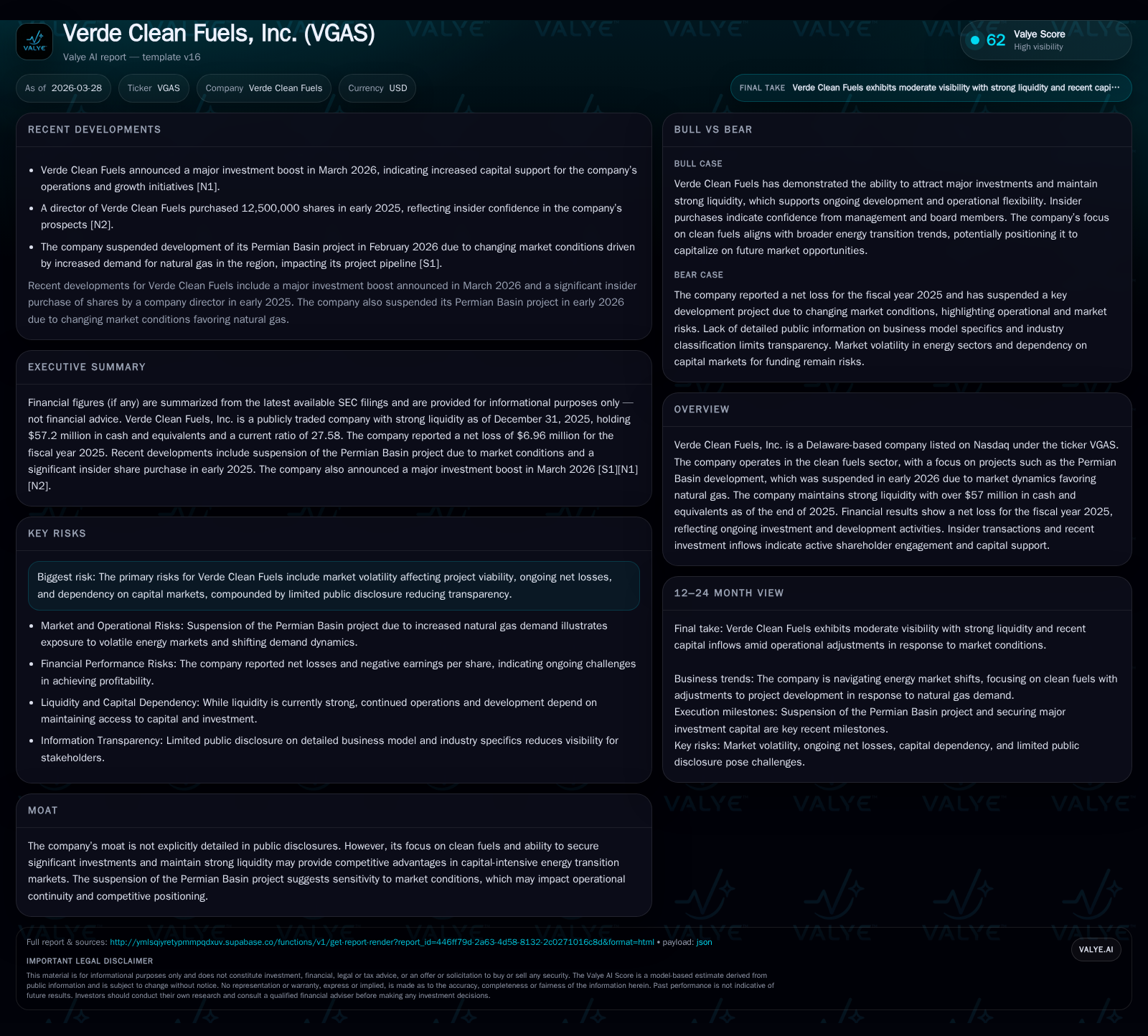
Verde Clean Fuels, Inc. continued to post net losses in fiscal 2025 while maintaining a robust cash position of over $57 million. The suspension of its key Permian Basin project underscores sensitivities to evolving market dynamics favoring natural gas over renewable fuels. Moving forward, the company plans to emphasize licensing its proprietary STG+® technology rather than developing capital-intensive commercial plants. Executing this pivot successfully depends on securing partnerships and navigating regulatory risks in the clean fuels sector.
Historical Performance and Financial Overview
Verde Clean Fuels has exhibited a pattern of sustained operating losses over the past four years, characteristic of an enterprise investing heavily in clean fuel technology development and project execution. Operating income worsened from a loss of approximately $5.7 million in FY2022 to a loss of $16.5 million in FY2025, revealing an intensification of investment or cost pressures during this timeframe [F1]. Correspondingly, net income declined further into negative territory, swinging from a loss of around $3.7 million in FY2022 to nearly $7.0 million by FY2025.
The company's cash flow dynamics underscore ongoing operational burn; operating cash flow has hovered near negative $9 million annually for the past three years despite increased capital spending. Capital expenditure jumped materially by over 200% in 2025 compared to the prior year—from roughly $2.5 million to $7.7 million—possibly reflecting escalation in plant development activities or technology deployment preparations [F1]. Despite these losses and investment activities, Verde Clean Fuels ended FY2025 with a robust cash balance exceeding $57 million and minimal current liabilities (~$2.1 million), resulting in a very high current ratio (27.58), signaling strong short-term liquidity.
Historical performance (annual)
| FY | Net ($mm) | CFO ($mm) | OpInc ($mm) | Capex ($mm) | Net YoY |
|---|---|---|---|---|---|
| 2025 | -7 | -9 | -16 | 8 | -108.7% |
| 2024 | -3 | -9 | -12 | 3 | -21.5% |
| 2023 | -3 | -9 | -11 | 0 | +25.8% |
| 2022 | -4 | -1 | -6 |
Source: SEC companyfacts cache [F1].
Capital returns and efficiency (annual)
| FY | FCF ($mm) |
|---|---|
| 2025 | -17 |
| 2024 | -11 |
| 2023 | -9 |
| 2022 |
Source: SEC companyfacts cache [F1].
Note: Revenue figures were not disclosed publicly.
Strategic Developments and Future Growth Prospects
Verde Clean Fuels' core strategic thrust has shifted markedly during recent years—from direct construction and operation of commercial-scale production plants toward a capital-light approach focused primarily on licensing its patented STG+® technology platform alongside engineering and operational support services [S1]. This pivot aims to mitigate capital intensity risks while leveraging proprietary technology as a recurring revenue stream.
The suspension announced in early 2026 of the Permian Basin Project—a flagship initiative under a joint development agreement with Cottonmouth Ventures—reflects immediate market headwinds where natural gas demand outstripped renewable fuels economics within that region's evolving energy landscape [S6][N1]. Management indicated that resumption depends heavily on future market conditions and securing final investment decisions (FID), which remain uncertain given current dynamics.
Key drivers for future growth include:
- Successful commercial licensing of the STG+® process technology to well-capitalized third parties;
- Expansion into engineering services that complement licensing efforts;
- Navigating federal Renewable Fuel Standards (RFS) policies and state-level low-carbon fuel credits effectively;
- Potential recovery or new partnership formations for commercial plant developments if market conditions warrant.
Conversely, significant constraints loom from regulatory volatility—including evolving EPA regulations—and competition for projects that could inflate costs or delay execution timelines [S1][S4]. Environmental compliance liabilities tied to hazardous material management also present ongoing operational risks.
Forecasts, Milestones, and Leadership Change
No explicit revenue or profit guidance was disclosed for upcoming periods; however, key milestones will likely center on negotiating additional licensing contracts for STG+® technology and identifying new development opportunities aligned with the company's capital-lite strategy [N1][S12]. Monitoring advancements on prior projects such as any reactivation of Permian Basin operations will be critical indicators of strategic momentum.
In March 2026, leadership transitioned from Ernest Miller to George Burdette as CEO while retaining Burdette's CFO role concurrently [S16]. Burdette brings over two decades' expertise in financial and corporate leadership within energy infrastructure sectors, previously holding senior roles at renewable gas platforms and solar companies—which may enhance strategic execution capabilities given the firm's current refocus.
Returns and Capital Allocation
Verde Clean Fuels does not currently generate positive returns; crude approximations suggest an unusually high ROE reading driven by negative equity metrics—an accounting artifact rather than genuine profitability signal [F1]. Operating cash flows continue negative trends around $8.9 million annually despite increased capex spending which reached $7.7 million in FY2025.
Capital allocation has thus far prioritized liquidity preservation and project funding without distributing dividends or repurchasing shares—typical for developmental stage clean energy firms reliant on capital markets access [S14][S16]. Insider transactions and recent infusion of investments reflect active shareholder engagement supporting ongoing operations amid persistent losses.
Risks Summary
The company's outlook is tempered by several risk vectors including:
- Market volatility impacting project viability due to fuel price dynamics favoring natural gas;
- Dependence on securing adequate financing through capital markets given continued operational deficits;
- Regulatory uncertainty particularly concerning U.S environmental policies impacting renewable fuel credits;
- Potential legal exposure stemming from disputes over technology licensing rights such as those initiated by Five Star Clean Fuels seeking declaratory judgments regarding STG+® usage rights [S1][S12];
- Execution risk inherent in transitioning business models under shifting leadership.
Sector Context Analysis
Verde operates within the intersecting domains of cleantech innovation and energy transition infrastructure—a sector characterized by high upfront capital commitments paired with extended commercialization timelines and complex regulatory environments shaping incentives like RIN credits under federal RFS programs. The emphasis on transitioning to capital-lite licensing models mirrors broader industry trends where scalability often depends less on physical asset ownership and more on intellectual property deployment across established downstream producers.
Conclusion
Verde Clean Fuels' financial trajectory emphasizes intensive investment phases underscored by sizeable net losses but supported by substantial liquidity reserves as it reorients its growth strategy away from direct facility construction toward technology licensing models amid challenging market realities exemplified by the Permian Basin project's suspension. Leadership changes aim to reinforce financial stewardship during this critical inflection point; however, realizing stable revenue growth hinges on successful contract executions, favorable policy frameworks for low-carbon fuels, effective risk mitigation around regulatory compliance, legal contestations, and evolving energy commodity markets.
This report is prepared solely for informational purposes reflecting publicly available data as of March 28, 2026. It does not constitute investment advice or recommendations.
Disclaimer: This is research-only, informational analysis and not investment advice. It may include AI-generated interpretation and general industry context. Always verify important details using primary sources.

Comments