
Tariffs and Patent Expirations Constrain Retractable Technologies’ Growth and Margins
Retractable Technologies faces elevated tariffs on China imports while navigating patent lifecycle and regulatory costs.
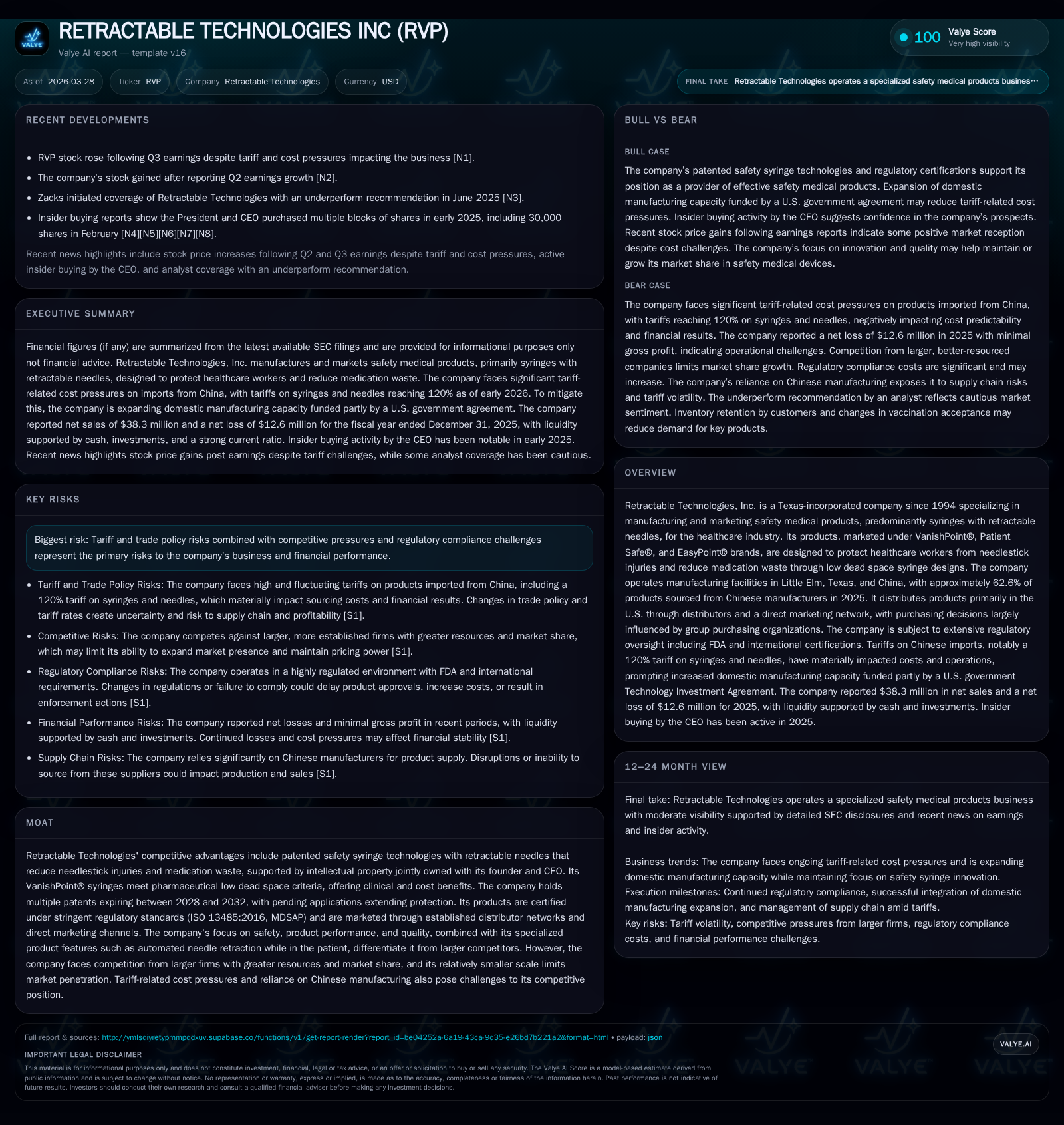
Retractable Technologies Inc. expanded revenues by 15.6% in 2025, fueled by increased syringe and needle unit sales primarily in the U.S., but operating losses remain substantial at over $21 million. Heightened tariffs on Chinese imports — now totaling around 120% on syringes and needles — have materially pressured cost of goods and margins despite efforts to domesticize manufacturing. The company’s patent protection on key safety syringe technologies extends only until 2032, challenging its moat amid competitive pressures. Liquidity is sufficient for the near-term, yet sustained losses and tariff-driven cost inflation weigh on free cash flow and returns.
Company Overview
Retractable Technologies Inc. (RVP) is a Texas-based medical device manufacturer specializing in safety syringes featuring patented automated retractable needles designed to prevent needlestick injuries among healthcare workers. Since its founding in 1994, the company has focused primarily on syringes marketed under brands such as VanishPoint®, EasyPoint®, and Patient Safe®. These products incorporate clinically relevant features like low dead space to minimize medication waste — a key differentiator endorsed by pharmaceutical manufacturers.
Manufacturing operations include facilities in Little Elm, Texas, complemented by outsourced production primarily concentrated in China. In 2025, Chinese suppliers accounted for about 62.6% of product sources, down from prior years where reliance exceeded 80%, reflecting the company’s strategic pivot towards increasing domestic output amid escalating trade tensions ([S1], [S4], [S8]).
Historical Performance
The company’s annual revenue trajectory showed a meaningful rebound in 2025 following pandemic-era disruptions:
Historical performance (annual)
| FY | Net ($mm) | CFO ($mm) | OpInc ($mm) | Capex ($mm) | Net YoY |
|---|---|---|---|---|---|
| 2025 | -13 | -7 | -21 | -5.7% | |
| 2024 | -12 | -12 | -21 | 1 | -69.5% |
| 2023 | -7 | 3 | -11 | 1 | -238.1% |
| 2022 | 5 | 17 | -1 | 17 |
Source: SEC companyfacts cache [F1].
Capital returns and efficiency (annual)
| FY | Buybacks ($mm) | FCF ($mm) | ROE% |
|---|---|---|---|
| 2025 | -16.9 | ||
| 2024 | 8 | -13 | -13.6 |
| 2023 | 8 | 2 | -7.1 |
| 2022 | 8 | 0 | 4.8 |
Source: SEC companyfacts cache [F1].
(FY = Fiscal Year; CFO = Cash Flow from Operations; Capex = Capital Expenditures)
Increased revenues (+15.6% YoY) were led by higher domestic sales (+9.7%) mainly due to growth in VanishPoint® and EasyPoint® products ([S9], [F1]). International revenues surged more sharply (+64%), driven by EasyPoint® needle volumes expanding over 160%, though price discounts internationally constrained gross margins ([S9]). Despite top-line growth translating only minimally into operating results: margins remain challenged partly due to an inventory write-down approximating $2.2 million from expiring lots and about $1.8 million tariff-related costs impacting cost of goods sold ([S9], [S13]).
The company also recorded a non-cash impairment charge near $954 thousand tied to older equipment replaced under its Technology Investment Agreement (TIA) with the U.S. Department of Defense ([S9]).
Tariff Impact and Manufacturing Shifts
A key constraint to margin improvement stems from tariffs imposed on Chinese imports. Syringes and needles imported from China have been subject initially to a Section 301 tariff of 100%, which rose effectively to around 120% as of March 2026 after adjustments including a new ad valorem duty following the Supreme Court vacating certain International Emergency Economic Powers Act (IEEPA) tariffs ([S1], [S25]).
With approximately two-thirds of products sourced from China—some falling under these tariffs—the resultant cost pressure is material. For context, the company expensed roughly $1.8 million of tariffs in 2025 alone ([S1]).
In response, Retractable Technologies accelerated transition plans to increase domestic manufacturing capacity specifically for popular products such as the critical 1mL and EasyPoint® needle lines as well as developing domestic capability to produce smaller volume syringes like the new planned commercial-scale production of the previously import-reliant 0.5 mL syringes ([S1], [S16]). These investments add capital expenditure demands that pressure short-term cash flows.
Intellectual Property Protection and Competitive Moat
A cornerstone competitive advantage lies in patented automated needle retraction technologies licensed exclusively from founder Thomas J. Shaw since 1995 ([S12], [S15]). Patents expiring between 2028-2032 shield core VanishPoint® designs; ongoing modifications under patent review could extend exclusivity beyond that timeline.
However patent expiration introduces risk for competitors mimicking prior designs without infringing newer patents—a known industry challenge where innovation cycles are critical for defense (). The firm also holds trademarks for its product brands underpinning market recognition.
Future Growth Prospects
Potential near-term growth drivers include continued ramp-up of domestic manufacturing mitigating tariffs' cost impacts plus anticipated recoveries or normalization in vaccination-related demand following inventory drawdowns reported among U.S. customers post-pandemic ([S16], [S18]). Incremental product enhancements pending FDA review represent pipeline opportunities but are not expected commercially available within calendar year 2026 ([S16]).
Structural challenges persist:
- Trade policies remain uncertain with tariffs likely continuing to elevate input costs.
- Competitive pressures may intensify post-patent expiry window around early next decade.
- Purchasing decisions heavily influenced by group purchasing organizations can limit pricing power or impose penetration barriers.
- Regulatory compliance costs may rise with ongoing adherence demands across global markets including EU MDR certification efforts ([S7], [S22]).
Financial Health and Capital Allocation
As of December 31, 2025:
- Cash and equivalents stood at $2.6 million with current assets totaling over $63 million against current liabilities near $9.6 million yielding a strong current ratio around 6.57x indicating solid short-term liquidity ([F1], [S6]).
- Shareholders’ equity declined year-over-year from approximately $87 million to $74 million due mainly to net losses incurred during the year ([F1]).
Operating cash flows remained negative at about -$7 million despite being an improvement versus prior year’s deeper outflow (-$11.5 million). Capital expenditures were elevated relative to immediate prior years reflecting investment into domestic capacity building ([F1]).
Free cash flow was estimated negative roughly $8.5 million in fiscal year 2025 (operating cash flow minus capex), underscoring ongoing funding needs amid losses as tariffs weigh heavily ([F1]). No common dividends or share repurchases occurred during this period though preferred stock dividends were fully paid without arrears ([S23]). The company carries moderate long-term debt obligations alongside substantial liabilities related to TIA government contracts (~$58 million), which support manufacturing expansion initiatives ([F1], [S10], [S11]).
Return on equity remains negative at approximately -17%, driven by consecutive annual net losses that have eroded accumulated earnings despite sizable invested capital ([F1]).
Regulatory Environment and Risks
Compliance with intricate FDA regulations globally shapes product release timelines and cost structures dramatically for Retractable Technologies ([S7], [S22]). Additionally:
- Data privacy laws affecting patient health data use are becoming more stringent,
- U.S healthcare fraud and abuse laws impose operational controls,
- International certifications require continuous investment targeting ISO13485:2016 standards along with MDSAP compliance;
- Pursuit of CE marking under EU MDR is active but remains incomplete, all imposing ongoing administrative burdens.
Risks also stem from dependence on Chinese manufacturing despite mitigation efforts. Sudden supply disruptions or tariff escalations could cause material operational interruptions given sizable import reliance (~62%) ([S8], [S25]). Further competitive threats loom as patents expire through next decade potentially inviting product commoditization if innovation pace slows (). Customer concentration risk exists noting three significant customers represented over half total net sales consistently over recent years ([S8]), highlighting dependency dynamics common within medical device distribution networks.
Summary and What To Watch
Retractable Technologies operates within a specialized niche marked by proprietary safety-focused syringe technology addressing essential healthcare worker safety concerns combined with medication dosing efficiency innovations like low dead space designs. In fiscal terms recent acceleration in revenues was overshadowed by persistent operating losses exacerbated by structural headwinds such as punitive tariff environments and evolving regulatory frameworks. Mitigation strategies via scaling U.S manufacturing constitute essential efforts underway though profitability inflection remains elusive through early stages. Patent expiration dates proximate within less than a decade merit vigilance regarding competitive erosion risks. Investors should monitor:
- Progress on domestically manufactured product volumes,
- Changes or reliefs in U.S.-China trade policy especially impacts on tariffs inside healthcare consumables sector,
- Regulatory approval status for pipeline safety devices,
- Seasonal fluctuations affected by vaccination cycles post-COVID era,
- Margins improvement reflecting supply chain optimization or pricing power adjustments. Overall financial resilience is supported by a strong balance sheet but cash burn trends highlight operational fragility demanding attention especially if top-line growth stalls or cost escalations continue unchecked.
This analysis is based solely on publicly available information including SEC filings through March 2026 and company disclosures without making investment recommendations or forward-looking judgments beyond stated facts.
Disclaimer: This is research-only, informational analysis and not investment advice. It may include AI-generated interpretation and general industry context. Always verify important details using primary sources.

Comments