
Praetorian Acquisition Corp. Launches to Capitalize on AI-Driven Business Combinations
Praetorian Acquisition Corp. emerges as a Cayman Islands-based SPAC focused on leveraging AI and automation trends for strategic acquisitions.
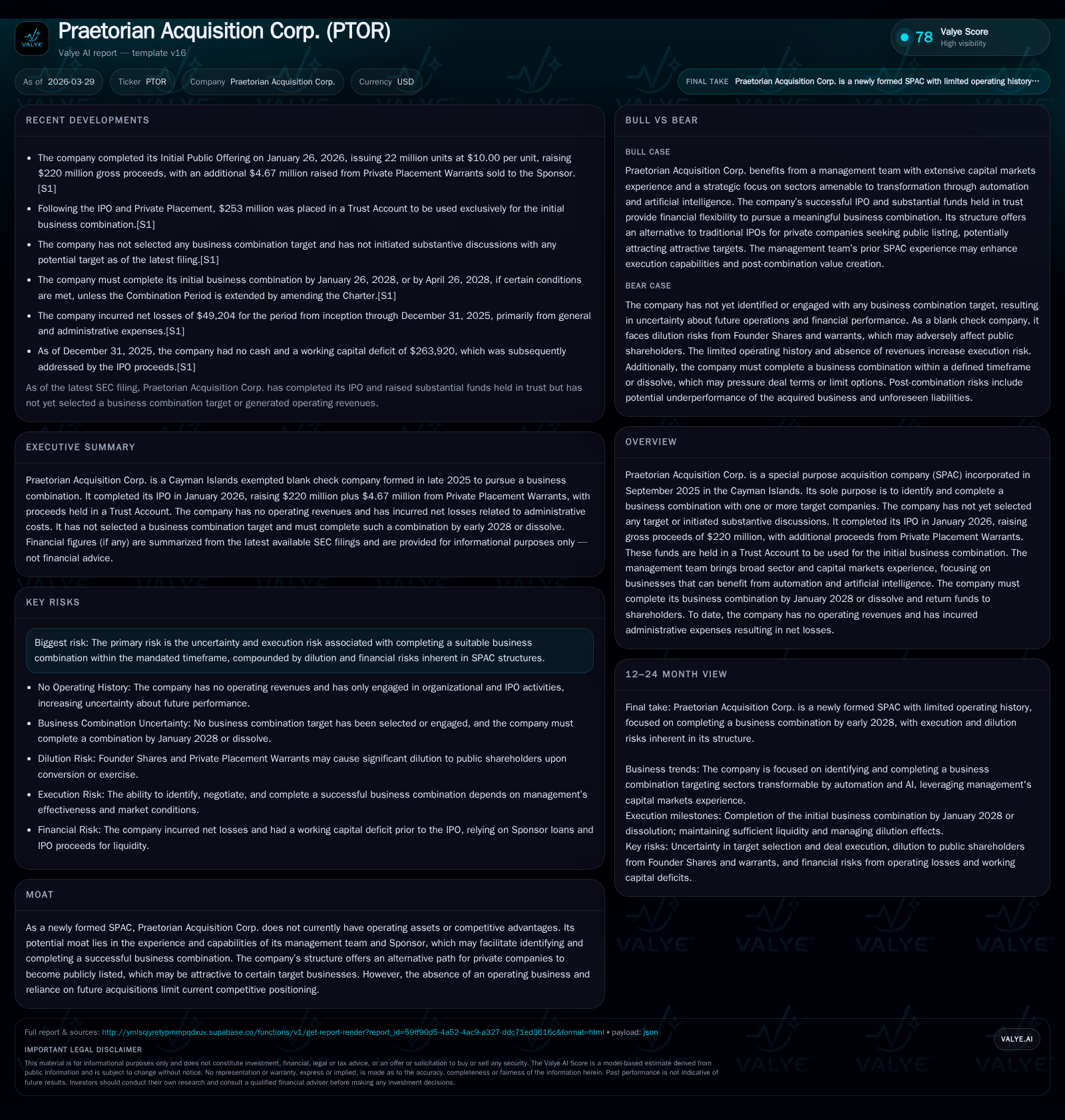
Incorporated in late 2025, Praetorian Acquisition Corp. completed a $220 million IPO in January 2026, positioning itself as a blank check company targeting AI and automation-driven sectors. Without operating revenues to date, the company’s value proposition centers on its experienced management team’s ability to identify synergistic acquisitions within a completion window ending January 2028. The capital structure includes funds secured via both the IPO and private placement warrants, held in a trust account with strict investment guidelines. Execution risk remains elevated given the absence of concrete target engagement, typical of early-stage SPACs.
Company Genesis and Formation Context
Praetorian Acquisition Corp., established on September 29, 2025, functions as a special purpose acquisition company (SPAC) domiciled in the Cayman Islands [S1]. This incorporation choice aligns with common cross-border SPAC structuring designed to provide regulatory flexibility and facilitate capital market access outside traditional U.S. entities. The company's raison d'être is clear: to seek out one or more target companies poised for growth through transformation enabled by automation and artificial intelligence technologies. However, the Company remains without an operating business or selected acquisition targets at present.
Such 'blank check' formations have attracted considerable investor interest for their ability to offer an alternative route to public markets versus traditional IPOs. Nevertheless, this model inherently carries significant risks tied predominantly to execution amid compressed timelines.
Historical Financial Snapshot: Pre-Combination Performance
Financially, Praetorian's activities since inception have been transactional rather than operational. From incorporation through December 31, 2025, the Company recorded no revenues and incurred administrative expenses totaling $49,204—fully reflected as net loss for that period [F1][S1]. This modest cost base reflects initial organizational efforts including preparative work for the IPO and initial due diligence groundwork.
Historical performance (annual)
| FY |
|---|
| 2025 |
Source: SEC companyfacts cache [F1].
At December 31, 2025, Praetorian had no cash on hand and reported a working capital deficit of $263,920 prior to its IPO closing [S1][S5].
Management Expertise and Strategic Focus on AI-Driven Targets
A critical pillar of Praetorian’s strategic positioning lies in its management team’s sector acumen. The group brings extensive experience in global capital markets along with local and cross-border deal origination capabilities geared toward sectors amenable to automation and AI advances [S1]. This focus aims at identifying companies that could maximize operational performance or scale by applying emerging technologies—a theme resonant across current technology-enabled transformations in traditional industries.
While no formal target discussions have commenced yet, management is focused on industries that complement their background and where automation can drive transformation [S1].
Capital Structure and Liquidity Post-IPO
Praetorian’s capital structure post-IPO includes gross proceeds of $220 million from sale of 22 million units priced at $10 each plus $4.67 million from sale of Private Placement Warrants to the Sponsor at $1.00 per warrant [S1][S5][S6]. Following over-allotment option exercise, approximately $253 million was placed into a Trust Account invested solely in short-term U.S. Treasury obligations or money market funds compliant with SEC Rule 2a-7 requirements [S6]. These funds are reserved for use exclusively towards completing a qualified business combination or returning capital upon wind-down.
Working Capital Loans up to $1.5 million remain available from Sponsor affiliates but were unused as of December 31, 2025 [S6][S10]. Offering costs totaled approximately $9.2 million including cash underwriting fees and deferred commissions payable upon consummation of the business combination [S1][S6].
Mandated Timeline and Execution Risk Factors
Praetorian must complete its initial business combination by January 26, 2028—three years from IPO—or else liquidate and return funds held in trust less permitted expenses [S1]. This deadline imposes significant pressure on deal sourcing and execution timelines.
Execution risk is compounded by uncertainty around identifying suitable targets aligned with strategic intent while meeting financial and regulatory criteria. Additionally, dilution risks exist as equity or debt issuances might be necessary alongside cash consideration depending on deal structure and redemption levels [S18].
Failure scenarios include inability to secure shareholder approval or redeem excess shares beyond available cash resources which could force liquidation without generating returns beyond principal preservation.
Prospective Growth Scenarios and Target Sector Opportunities
Although no acquisition candidates have been publicly identified or engaged yet [S1], management intends to focus on established enterprises within traditional sectors ripe for transformation via artificial intelligence and automation capabilities [S1]. Potential areas include industrials, supply chain technology integrators, logistics platforms, or software solutions embedding AI into workflows.
This thematic focus aligns with investor appetite for scalable businesses leveraging technology-driven efficiencies while benefiting from public market access post-combination.
Capital Allocation Framework
Post-business combination financing strategy contemplates using Trust Account proceeds primarily for merger consideration cash payments complemented potentially by share issuance or debt instruments depending on target preferences [S15][S19]. Remaining funds after transaction closure would support working capital needs or further acquisitions by the combined entity.
Reported approximate ROE exceeds 200% based on net losses against equity at December 31, 2025; this figure is not indicative of operational profitability but reflects early-stage balance sheet dynamics pre-combination [F1].
No dividends or share repurchases are anticipated before completing a business combination; sponsor incentives derive mainly from Founder Shares allocations and warrant economics rather than cash distributions [F1][S15].
Governance Structure and Sponsor Alignment Implications
Governance follows conventional SPAC structures with sponsor ownership concentrated through Founder Shares coupled with private placement warrants providing upside upon transaction success [S5]. Sponsor indemnity obligations exist but actual asset backing is limited primarily to securities holdings in the company itself creating conditional risk exposure if valuations decline.
Sponsors provide limited upfront capital beyond loans repaid at IPO close but hold significant influence over deal selection processes. Working Capital Loans remain discretionary rather than mandatory limiting liquidity support absent additional funding rounds prior to deal closure.
Key Upcoming Milestones
Investors should monitor:
- Public announcements naming prospective acquisition targets,
- Proxy filings detailing transaction terms including valuation disclosures,
- Scheduling and outcomes of shareholder votes approving proposed business combinations,
- Tender offer documents supporting redemption procedures,
- Ongoing SEC reporting updates tracking progress towards completion deadlines.
Failure to meet these milestones within the prescribed timeline will trigger liquidation procedures preserving principal invested in Trust Account balances.
This report synthesizes publicly filed SEC disclosures as of March 27, 2026 combined with detailed financial data extracted from regulatory filings without speculative projections beyond documented facts. It is intended solely for informational purposes without constituting investment advice.
Disclaimer: This is research-only, informational analysis and not investment advice. It may include AI-generated interpretation and general industry context. Always verify important details using primary sources.

Comments