
Sphere 3D's Bitcoin Mining Shift: Growth Setbacks and Strategic Refresh
Sphere 3D Corp. has transitioned to enterprise-scale Bitcoin mining, facing revenue declines amid operational refresh and vertical integration efforts.
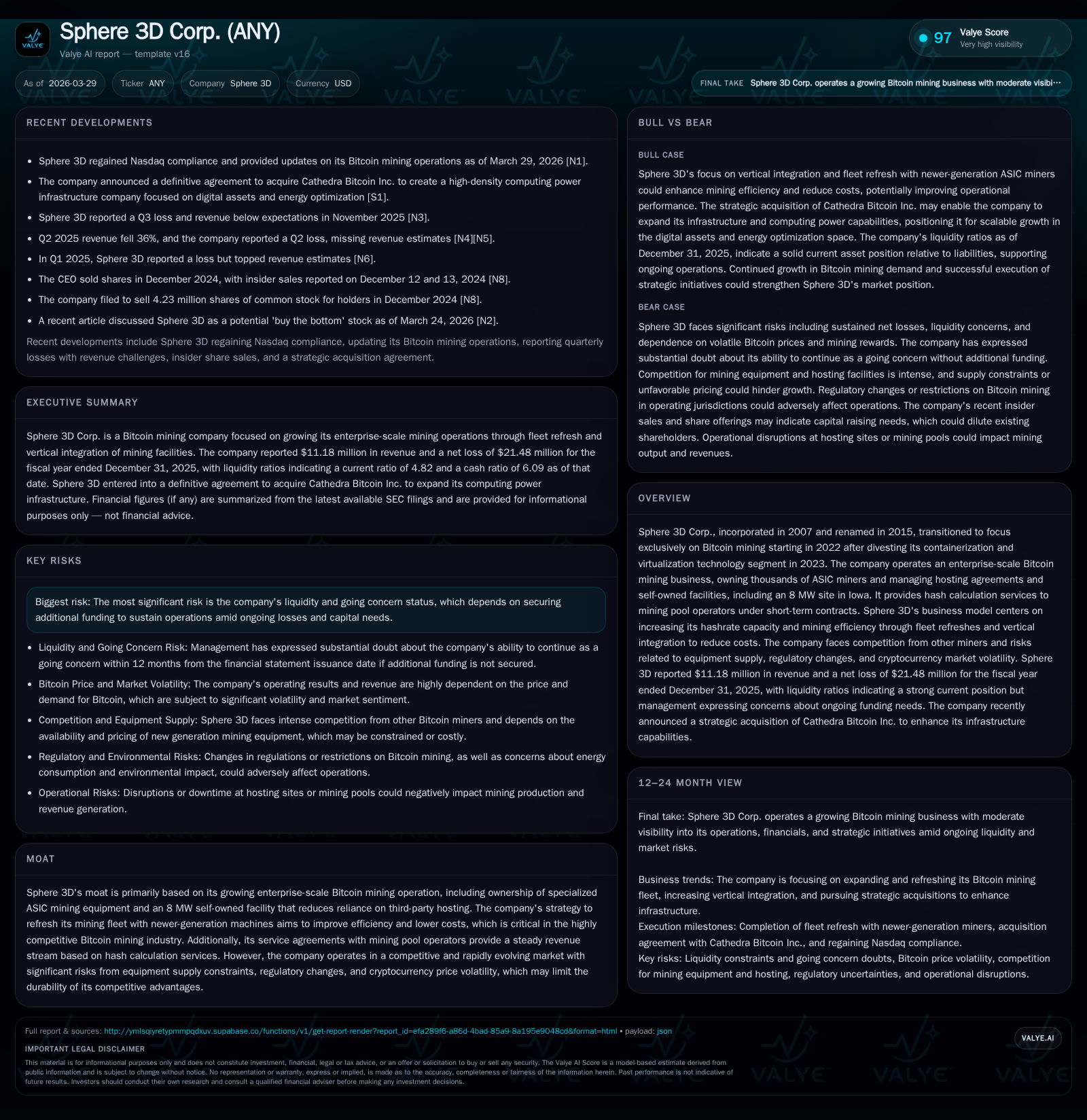
Since initiating Bitcoin mining operations in 2022 and divesting legacy containerization assets in 2023, Sphere 3D has focused on expanding and optimizing its mining fleet and infrastructure. Revenues declined from $21.9 million in 2023 to $11.18 million in 2025, impacted by the 2024 halving event and volatile cryptocurrency markets. The company’s strategic focus on fleet refreshes with more efficient ASIC miners and ownership of an 8 MW Iowa mining facility reflects a vertical integration strategy to lower operational costs. Operating losses remain significant, with negative cash flows highlighting liquidity risks. Capital raises, including warrant inducements and an ATM equity facility, support near-term operations while a pending business combination aims to accelerate scalable growth [F1][S1][S5][N1].
Historical Performance: Transitioning to Bitcoin Mining
Sphere 3D Corp., incorporated in 2007 and renamed in 2015, fundamentally transformed its business by launching Bitcoin mining operations in January 2022 [S1]. By December 2023, it divested its containerization and virtualization segment, focusing exclusively on cryptocurrency mining thereafter [S1].
This transition coincided with substantial revenue fluctuations and persistent net losses reflecting challenges typical for emerging miners.
Historical performance (annual)
| FY | Rev ($mm) | Net ($mm) | CFO ($mm) | OpInc ($mm) | Rev YoY | Net YoY |
|---|---|---|---|---|---|---|
| 2025 | 11 | -21 | -16 | -22 | -32.7% | |
| 2024 | 17 | -5 | -21 | -24.2% | ||
| 2023 | 22 | -7 | -30 | +260.5% | ||
| 2022 | 6 | -193 | -31 | -158 | -1015.2% |
Source: SEC companyfacts cache [F1].
Capital returns and efficiency (annual)
| FY | FCF ($mm) | ROE% |
|---|---|---|
| 2025 | -24 | -92.2 |
| 2024 | -14 | |
| 2023 | -8 | |
| 2022 | -48 | -552.9 |
Source: SEC companyfacts cache [F1].
*Note: Earlier years include significant impairments related to legacy operations impacting operating income [F1].
Revenues peaked in FY2023 but declined as the company recalibrated post the April 2024 Bitcoin halving event that halved block rewards across the network [S1]. Despite falling revenues (-32.7% FY24-25), net losses narrowed compared to prior periods due to cost controls [F1]. However, operating cash flow deteriorated markedly (-252.2% YoY), indicating elevated cash burn amid substantial investments in new equipment [F1].
Mining Operations & Efficiency Enhancements
At year-end FY2025 Sphere owned approximately 12,600 miners but only about 4,200 were active with a total hash rate capacity near 0.73 exahash per second (EH/s) [S1]. This reduction reflects a strategic "fleet refresh" replacing ~7,700 older miners with newer models offering significantly better power efficiency.
Average energy efficiency improved from 27.1 joules per terahash (J/th) in FY2024 to an expected ~19.0 J/th for calendar year 2026 [S1]. This efficiency gain is critical given electricity costs dominate mining expenses.
Mining output dropped from approximately 286 BTC mined in FY2024 to about 112 BTC in FY2025 (-61%), primarily due to the halving event and transition away from higher-cost hosting sites during fleet refreshes [S1]. The company anticipates increasing hash rate capacity later as refreshed miners are deployed.
Revenue Decline Amid Market & Regulatory Pressures
The April 2024 halving event directly reduced miner rewards network-wide impacting Sphere’s revenues alongside volatile Bitcoin prices and macroeconomic pressures [S1][N2]. Transitioning operations away from third-party hosted sites caused temporary production dips.
Regulatory uncertainty around energy consumption has also influenced site selection; jurisdictions like New York have imposed moratoria on proof-of-work mining citing environmental concerns though Sphere mines primarily in Missouri, Texas and Iowa where no material restrictions currently exist [S4][S9][S16].
Vertical Integration via Self-Owned Facilities
Sphere’s ownership of an Iowa facility with an eight megawatt (MW) capacity since March 2025 represents a key step toward vertical integration aimed at lowering reliance on third-party hosting fees and stabilizing fixed costs such as electricity rates [S1].
Controlling infrastructure enables operational efficiencies including customized cooling for ASIC hardware aligning with industry best practices for cost management amid competitive pressures [S7].
Capital Structure & Liquidity Considerations
Ongoing losses combined with capital-intensive fleet upgrades strain liquidity.
Funding activities included:
- A warrant inducement program generating gross proceeds of $4.1 million used for miner upgrades [S5],
- An At-the-Market equity offering program yielding net proceeds of $0.7 million providing flexible capital access [S11].
Despite these measures cash declined slightly to $3.7 million at FY25-end with free cash flow negative approximately $23.6 million annually (operating cash flow minus capex) highlighting significant funding needs ahead [F1].
Management expressed substantial doubt about continuing as a going concern absent additional financing underscoring liquidity risk typical among crypto miners navigating bearish cycles [S5][N1]. A reverse stock split effective February 2026 restored Nasdaq compliance but did not materially alter cash flow dynamics [S6][S1].
Regulatory & Industry Risks
State-level regulatory variability poses ongoing risks especially if new licensing or money transmitter regulations apply to Sphere’s operations or if environmental policies tighten given high energy demands of mining [S9][S17][S16].
Potential reclassification of cryptocurrencies under securities laws could impose additional compliance burdens or restrict activities.
Competitive pressures intensify as institutional miners vie for limited low-cost power and data center infrastructure raising barriers for expansion [S7].
Strategic Business Combination with Cathedra Bitcoin Inc.
In March 2026 Sphere agreed to acquire Cathedra Bitcoin Inc., a firm specializing in high-density compute infrastructure optimized for digital assets and energy efficiency innovations [S1][S3][S26]. This all-stock transaction aims to create a vertically integrated platform accelerating scalable deployment through combined assets and synergies.
Benefits include consolidated power procurement leverage and enhanced compute performance via co-developed hardware-software stacks targeting energy reductions crucial amid margin pressures.
Outlook: Key Metrics & Monitoring Points
No explicit guidance provided; future performance will hinge on:
- Hash rate growth reflecting further miner deployments,
- Realizing targeted energy efficiency improvements near ~19 J/th,
- Sustained operation at owned facilities reducing hosting costs,
- Execution of capital raises preserving liquidity,
- Navigating regulatory developments favorably,
- Successful closing and integration of Cathedra acquisition unlocking synergies.
Stakeholders should monitor these operational milestones considering the evolving cryptocurrency mining landscape.
This analysis integrates publicly filed financial data with management disclosures emphasizing factual information on Sphere 3D Corp.’s transformation into specialized bitcoin mining amid challenging market conditions without speculation on investment outcomes.
Disclaimer: This is research-only, informational analysis and not investment advice. It may include AI-generated interpretation and general industry context. Always verify important details using primary sources.

Comments