
Crown Reserve Acquisition Corp. I's SPAC Model Hinges on Timely Business Combination Completion
The company leverages its management team’s broad expertise and a robust trust-account capital base to identify and execute a business merger within a tight timeframe.
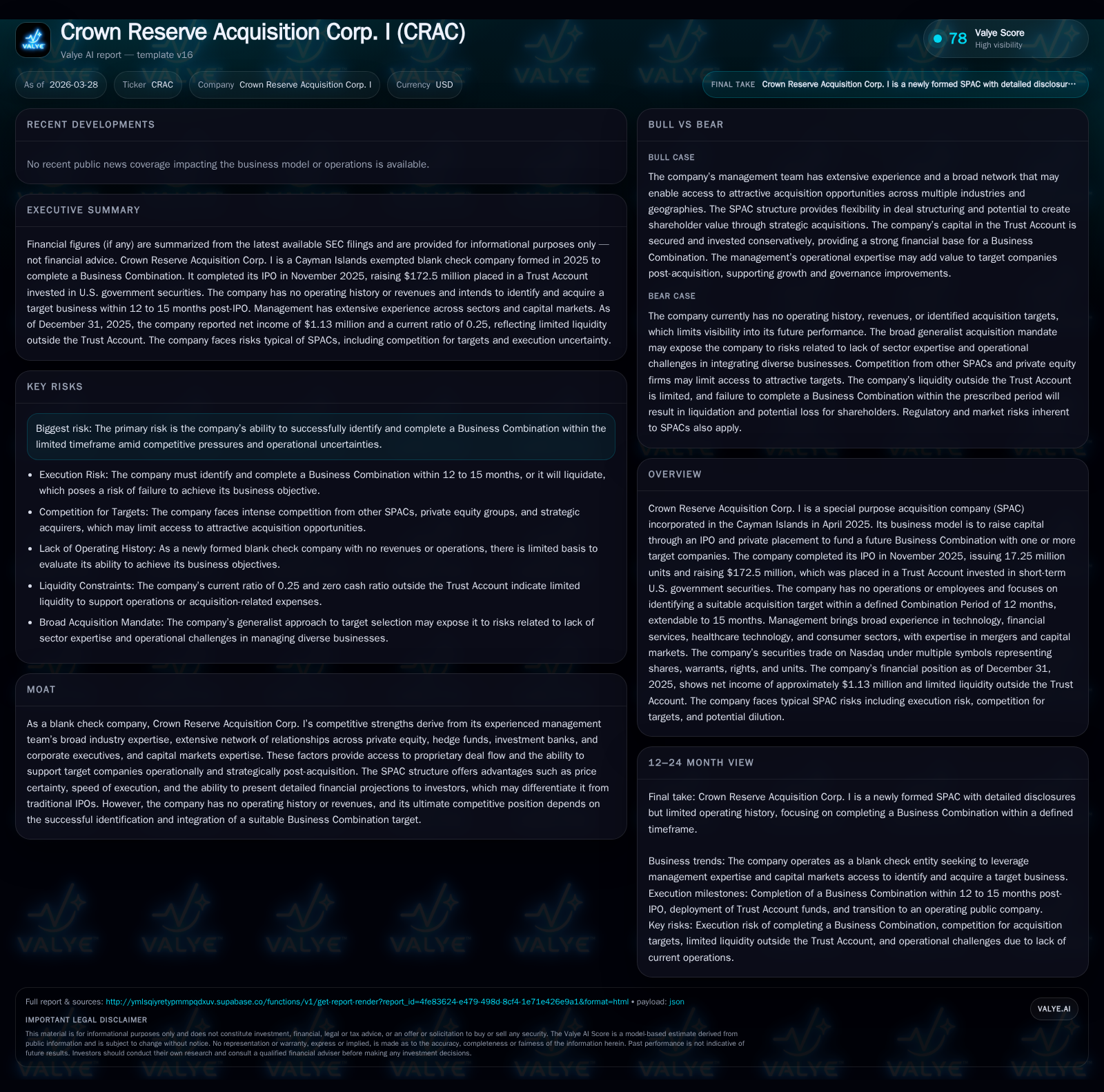
Crown Reserve Acquisition Corp. I is a Cayman Islands-based special purpose acquisition company (SPAC) formed in April 2025 and publicly listed in November 2025, raising $172.5 million through its IPO. Its business model revolves around completing a qualifying Business Combination within a 12-month period, extendable to 15 months under certain conditions. While the company lacks operating revenues or history, it emphasizes management depth across multiple sectors and access to proprietary deal flow to distinguish itself in the competitive SPAC market. Key risks stem from the compressed timeline for identifying targets and executing transactions, coupled with shareholder voting mechanics that could impact transaction approval and redemption outcomes.
Company Overview
Founded on April 29, 2025 as a Cayman Islands exempted company, Crown Reserve Acquisition Corp. I ("Crown Reserve," "CRAC") operates as a special purpose acquisition company (SPAC). The company has no operating history, employees, or revenues as it awaits completion of a Business Combination [S1][S3].
Historical Growth and Performance
CRAC completed an initial public offering (IPO) on November 10, 2025, raising $172.5 million by selling 17.25 million units at $10 each [S1][S28]. Each unit comprised one Class A ordinary share, one-half of one redeemable warrant exercisable at $11.50 per share, and one right convertible into fractional shares upon consummation of a Business Combination [S1]. Concurrently, CRAC completed a private placement of 375,000 units at $8 each for $3 million purchased by the Sponsor and Polaris Advisory Partners [S1][S14]. Proceeds from both offerings were placed in a Trust Account invested exclusively in U.S. government securities or money market funds investing solely in such securities [S23]. As of December 31, 2025, the Trust Account held approximately $173.4 million including about $0.9 million earned in dividends [S23].
Operating results reflect typical SPAC characteristics: zero revenue and an operating loss primarily related to non-cash fair value adjustments on warrants [F1]. The company reported an operating loss of approximately $127k but recognized net income of about $1.13 million for the fiscal year ended December 31, 2025 due mainly to these accounting effects [F1].
Historical performance (annual)
| FY |
|---|
| 2025 |
Source: SEC companyfacts cache [F1].
Table reflects nascent financial metrics consistent with SPAC formation stage.
Future Growth Prospects
CRAC's growth outlook depends entirely on completing a qualifying Business Combination within the prescribed Combination Period—initially set at 12 months from IPO closing (November 10, 2026), automatically extendable to 15 months if an agreement is executed within that window [S28][S21]. Failure to consummate the transaction within these timelines mandates liquidation of the Trust Account with pro rata distributions returned to public shareholders [S16][S13].
Target companies are sought based on criteria emphasizing compelling growth profiles, scalable platforms capable of meaningful expansion either organically or via add-on acquisitions, and attractive risk-adjusted returns [S6][S20]. The management team's extensive experience spans technology, financial services, healthcare technology, and consumer sectors [S3][S6], leveraging broad networks across private equity firms, hedge funds, investment banks, family offices, consultants, and corporate executives to source proprietary deal flow opportunities [S8][S6].
CRAC retains flexibility regarding financing strategies for its Business Combination—able to utilize cash from the Trust Account combined with equity or debt instruments structured to optimize the target’s capital structure [S8]. However, as of the latest filings there is no third-party financing secured.
Guidance and Milestones
While CRAC has not provided specific forward-looking numeric guidance given its SPAC status [N/A], key forthcoming milestones include:
- Completion of the Business Combination before November 10, 2026 (or February 10, 2027 if extended).
- Obtaining shareholder approvals when required by law or Nasdaq rules.
- Commencement of public trading for the combined entity on Nasdaq following transaction close.
- Exercising redemption rights available to public shareholders upon closing.
- Ensuring that any acquisition represents at least approximately 80% of the Trust Account value at signing [S21].
The Board will apply rigorous due diligence leveraging management expertise prior to approving any transaction [S16]. Delay beyond prescribed deadlines triggers mandatory liquidation distributions.
Capital Allocation & Returns
Capital raised through IPO and private placement proceeds remains segregated primarily within the Trust Account earmarked for merger financing purposes [S23]. No dividends or share repurchases have been declared or executed consistent with typical SPAC capital allocation during formation stages [F1].
The Sponsor holds approximately 4.31 million Founder Shares acquired nominally for about $0.006 per share subject to lock-up restrictions lifting only after one year post-Business Combination or upon achievement of specified stock price thresholds [S13][S14]. Private Placement Units held by insiders also carry lock-ups extending at least thirty days post-combination.
Public Warrants are accounted for as liabilities measured at fair value with mark-to-market fluctuations impacting earnings until exercised or expired [S12]. Upon consummation:
- Public shareholders may redeem shares for cash equal to their pro rata share of the Trust Account plus accrued interest [S10][S13].
- Rights convert automatically into Class A ordinary shares.
- Founder shares convert but remain subject to lock-up provisions limiting immediate liquidity.
No debt has been issued yet; any future indebtedness would require lender waivers protecting Trust Account assets from creditor claims ensuring redemption values are preserved for public shareholders [S19].
Industry Context Analysis
The SPAC market remains highly competitive amid increasing regulatory scrutiny and investor skepticism regarding sustainable value creation. Crown Reserve differentiates itself through experienced leadership capable of sourcing proprietary deals and navigating complex transactions faster than traditional IPOs while providing price certainty via pre-funded Trust Accounts.
SPACs offer advantages such as accelerated liquidity events for private companies relative to traditional IPOs vulnerable to market volatility risk but face challenges including limited operational history transparency and pressure from fixed deal timelines that have resulted in some sponsors failing to consummate deals.
CRAC’s intent to drive operational improvements post-combination aligns with best practices among successful sponsors who add strategic value beyond capital infusion alone.
Risks Summary
Key risks include:
- Failure to complete an acquisition within stipulated deadlines forcing liquidation of Trust Account funds,
- Possible absence of shareholder vote depending on transaction structure potentially leading to shareholder dissatisfaction,
- Challenges evaluating private targets due to limited available information,
- Earnings volatility stemming from warrant liability fair value remeasurement,
- Lack of operational control prior to Business Combination completion since CRAC currently has no employees,
- Potential conflicts among officers/directors owing fiduciary duties elsewhere that may divert opportunities away from CRAC,
- Market conditions affecting financing availability or shareholder approval prospects,
- Dilution risks associated with multiple security classes including warrants and rights.
Conclusion
As an early-stage SPAC with substantial funds securely held in trust but no operational history or revenues yet realized, Crown Reserve Acquisition Corp. I exemplifies typical strengths and challenges inherent in blank check companies: seasoned management paired with strong deal pipeline access versus pressing deadlines requiring successful transaction execution. Monitoring progress toward signing an acquisition agreement before critical deadlines will be essential indicators for future valuation developments.
Disclaimer: This analysis is based solely on information available up through March 27, 2026 filings and does not constitute investment advice.
Disclaimer: This is research-only, informational analysis and not investment advice. It may include AI-generated interpretation and general industry context. Always verify important details using primary sources.

Comments