
Launchpad Cadenza Acquisition Corp I’s Strategic SPAC Race Toward Blockchain and Fintech Targets by 2027 Deadline
A newly formed SPAC with $230 million in trust aims to capitalize on fintech and blockchain infrastructure sectors by completing a Business Combination within two years.
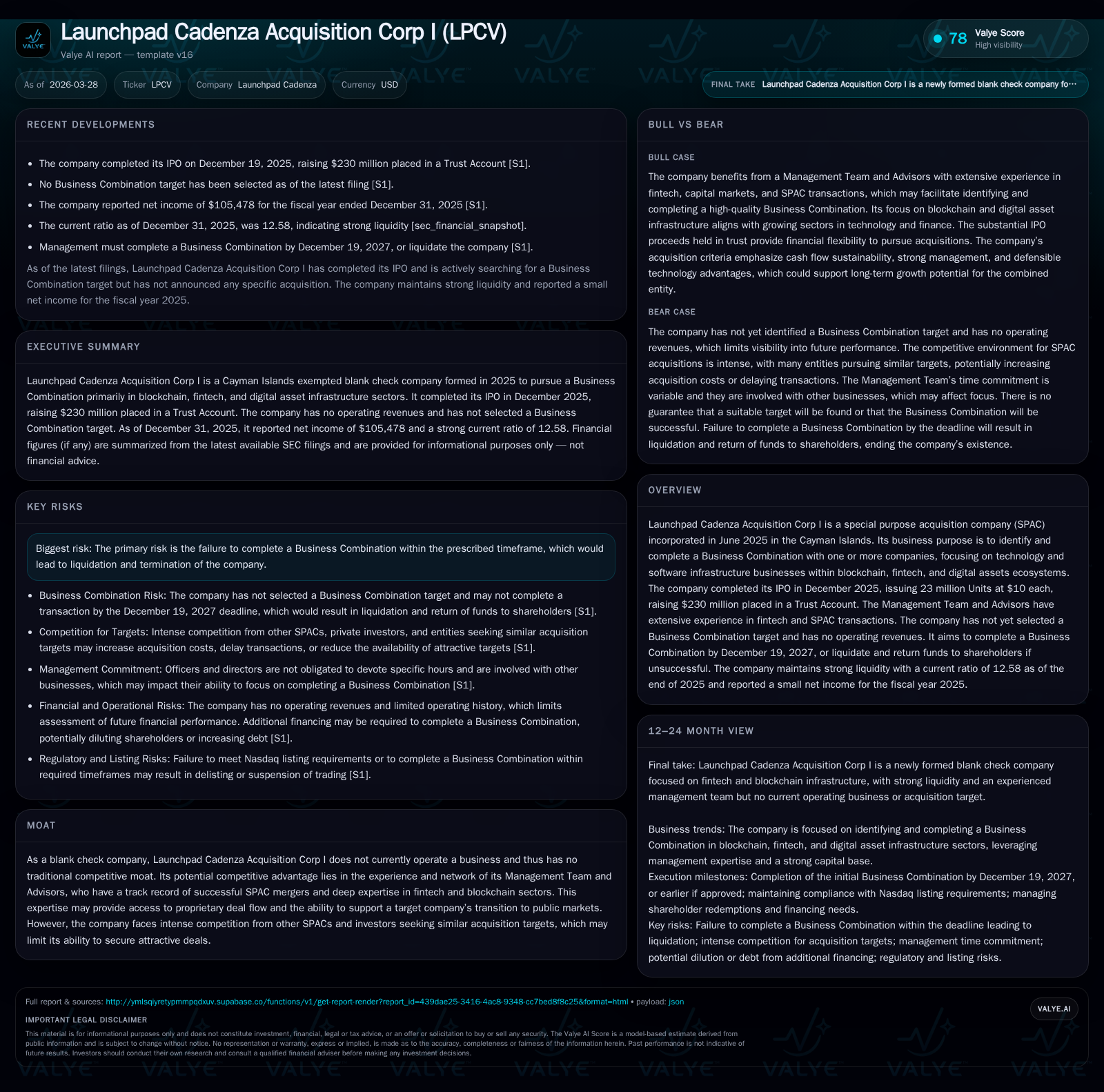
Launchpad Cadenza Acquisition Corp I (LPCV) launched its IPO in December 2025, raising $230 million allocated to a Trust Account, as it pursues a merger with a target in blockchain, fintech, or digital asset infrastructure. The company is currently pre-revenue and operates as a blank check entity under Cayman Islands jurisdiction, with no completed acquisitions yet. Its experienced management team is banking on proprietary deal flow and sector expertise to identify platforms with sustainable cash flow and defensible technology advantages while facing intense competition from numerous SPACs. The key risk remains failure to consummate a Business Combination by the December 2027 deadline, triggering liquidation and shareholder return of trust funds.
Company Overview and Formation
Launchpad Cadenza Acquisition Corp I (ticker: LPCV) is a Cayman Islands-exempted special purpose acquisition company (SPAC) formed on June 27, 2025. The company’s sole objective is to identify and consummate one or more Business Combinations primarily within the technology ecosystem focusing on blockchain technology, financial technology (fintech), and digital asset infrastructure businesses [S1]. It specifically targets companies building next-generation financial services infrastructure such as digital asset custody solutions, on-chain analytics platforms, compliance and identity frameworks, tokenization technologies, and institutional trading or settlement systems.
The company's management emphasizes that although their primary focus is these sectors reflecting their core expertise in fintech and Web3 technologies, they remain open to opportunities outside these areas if value creation prospects present themselves [S1]. This open mandate enhances strategic flexibility but also intensifies competition.
IPO Details and Financial Position
Completing its Initial Public Offering (IPO) on December 19, 2025, Launchpad raised gross proceeds of $230 million through the sale of 23 million Units at $10 per Unit [S1]. Each Unit consisted of one Class A Ordinary Share plus one-third of one Public Warrant exercisable at $11.50 per share. Concurrently, through private placement agreements, the Sponsor and Cantor purchased approximately 4.1 million Private Placement Warrants at $1.50 each producing an additional $6.17 million in gross proceeds [S1].
All IPO proceeds were placed into a Trust Account managed by Continental acting as trustee. As of December 31, 2025, approximately $230.2 million was held in trust excluding working capital funds outside this account [S20]. This structure safeguards investor capital pending completion of an acquisition.
The company reported a current ratio of approximately 12.58 as of year-end 2025 reflecting substantial liquidity relative to short-term liabilities ($1.36 million current assets vs $108k current liabilities) [F1]. Operating income was negative $126,500 driven primarily by administrative startup costs while net income was modestly positive at about $105,478 attributable mostly to interest income earned from Trust Account investments [F1]. Given the blank check status before any mergers or revenues generated by acquired operations, results are consistent with expectations for early-stage SPACs.
Historical performance (annual)
| FY |
|---|
| 2025 |
Source: SEC companyfacts cache [F1].
Note: Revenue was zero as expected; small operating loss reflects administrative startup expenses.
Management Team and Sector Expertise
The leadership includes Max Shapiro (CEO), Jurgen van de Vyver (CFO), supported by advisors Ryan Gilbert and Shami Patel along with Chairman Kumar Dandapani—each bringing deep experience spanning venture capital investing, fintech operations, capital markets structuring, and prior SPAC transactions [S18]. Their collective track record includes navigating complex fintech merger deals as well as operational scaling of technology-enabled financial services firms.
This expertise allows better access to proprietary deal flow within blockchain ecosystems—an advantage over other SPACs reliant solely on broad market targets or conventional search processes. Additionally, their network supports potential post-merger assistance to transition target firms publicly.
Industry Context: Competition Among SPACs
The number of SPACs pursuing business combinations has surged recently creating a highly competitive landscape especially within sought-after tech niches like blockchain infrastructure [S4][S6]. The intense demand pressures valuations upward causing prospective target companies to negotiate favorable terms which could increase transaction costs or complicate deal execution timelines.
Launchpad acknowledges competing interests not only from peer SPACs but also private investors including individuals and investment partnerships chasing similar acquisition themes [S4]. This dynamic underlines the importance of strong due diligence discipline coupled with management’s ability to differentiate launchpad’s proposition through deal structuring capability and technical insight.
Acquisition Criteria: What Launchpad Looks For
Key qualities desired in acquirees include:
- Ability to sustain free cash flow growth showing consistent margin integrity;
- Recurring revenue streams with platform dynamics that allow scalable customer acquisition and cross-selling;
- Strong management teams proven at executing growth strategies publicly;
- Clear benefits derived from being public including capital access advantages;
- Defensible competitive moats enabled via technological innovation yielding pricing power or timing advantage versus peers [S4][S6].
While these form guidance parameters for candidate evaluation, Launchpad reserves strategic discretion to deviate when compelling opportunities arise [S4][S6].
Risks Pertinent to Launchpad’s Business Model
The primary risk remains inability to close an initial Business Combination prior to the deadline on December 19, 2027 [S1]. Failure triggers automatic liquidation where funds held in the Trust Account minus dissolution expenses will be returned pro rata to Public Shareholders with redemption priced near initial Unit value [$10] plus accrued interest less applicable taxes [S22][S29]. The Sponsor waives redemption rights on founder shares thereby absorbing a loss if liquidation occurs without combination closure [S12][S26].
Other risks include:
- Potential delays or challenges in securing attractive merger targets due to heightened competition from other SPACs;
- Financing gaps if aggregate cash consideration plus redemptions exceed trust assets leading to need for equity or debt raises which could dilute shareholders or impose restrictive covenants [S20];
- Market volatility impacting shareholder vote participation potentially affecting approval thresholds for transactions [S21][S27];
- Legal/regulatory risks specific to fintech/blockchain sectors as they evolve;
- Dilution risks associated with founder share anti-dilution provisions triggered upon additional share issuances around Business Combination events [S13][S15][S26].
Shareholder Rights & Redemption Mechanisms
Public Shareholders retain the right to redeem all or part of their shares upon completion of the Business Combination at a pro rata price based on Trust Account value approximately equal to $10.01/share as of Dec 31, 2025 [S26][S29], irrespective of voting behavior towards the transaction proposal [S19]. Certain mechanisms limit excessive block redemptions beyond 15% without prior consent aiming to prevent minority holders from obstructing deals via disproportionate redemption demands [S21][S28].
Procedures require physical or electronic delivery of share certificates via transfer agents ahead of vote deadlines enabling efficient processing. Costs linked to this process are nominal but typically borne by brokers facilitating transfers where applicable [S25][S29].
Capital Allocation & Use Of Proceeds Expectation
As a shell entity without ongoing operations or organic revenue generation pre-acquisition, all capital raised remains parked in low-risk securities within the Trust Account earning modest interest awaiting deployment into suitable deal structures [F1][S26][S20]. Post combination capital allocation strategies will depend entirely on negotiated terms with target businesses potentially factoring equity swaps combined with cash consideration aimed at balancing dilution versus providing working capital for target growth needs.
Sponsor remuneration consists largely of deferred fees payable post-Business Combination along with reimbursement arrangements for office/services agreements set at fixed monthly amounts totaling roughly $25k collectively before combination closure—a typical cost profile among SPACs during formation phases [S7]. Dividends and buybacks have no applicability absent operations or surplus cash flows.
Outlook & What To Monitor Going Forward (Analysis)
Key milestones include identification and announcement of an acquisition target followed by proxy solicitation materials outlining transaction terms likely filed with SEC within the coming months given typical SPAC timelines approaching mid-combination period randomness.
Investors will want to track:
- Progress announcements regarding potential targets especially within blockchain/fintech segments,
- Timing and nature of shareholder voting mechanics whether tender offer style redemption elections versus proxy vote required approvals,
- Any indications regarding secondary financings either pre- or post-acquisition which might dilute original shareholders,
- Market reception reflected in trading volumes/prices around event dates,
- Compliance particularly adherence to Nasdaq's 36-month deadline rule impacting listing status if extensions aren’t secured.
Given its late-stage IPO closeness (Dec ‘25) relative to now (Q1 ‘26), initial deal sourcing activities should be underway though none announced publicly yet.
If successful completing a quality technology platform merger within these constraints would validate management’s sector specialization thesis but failure risks triggering liquidation putting pressure on shareholders losing anticipated exposure.
Disclaimer: This report does not constitute investment advice or recommendations. It is intended solely for informational purposes based on available regulatory filings as of March 27, 2026.
Disclaimer: This is research-only, informational analysis and not investment advice. It may include AI-generated interpretation and general industry context. Always verify important details using primary sources.

Comments