
Daedalus Special Acquisition Corp: Strategy and Capital Deployment Before First Merger
This analysis examines DSAC’s foundational SPAC structure, management expertise, and strategic focus on consumer AI amid early-stage execution challenges.
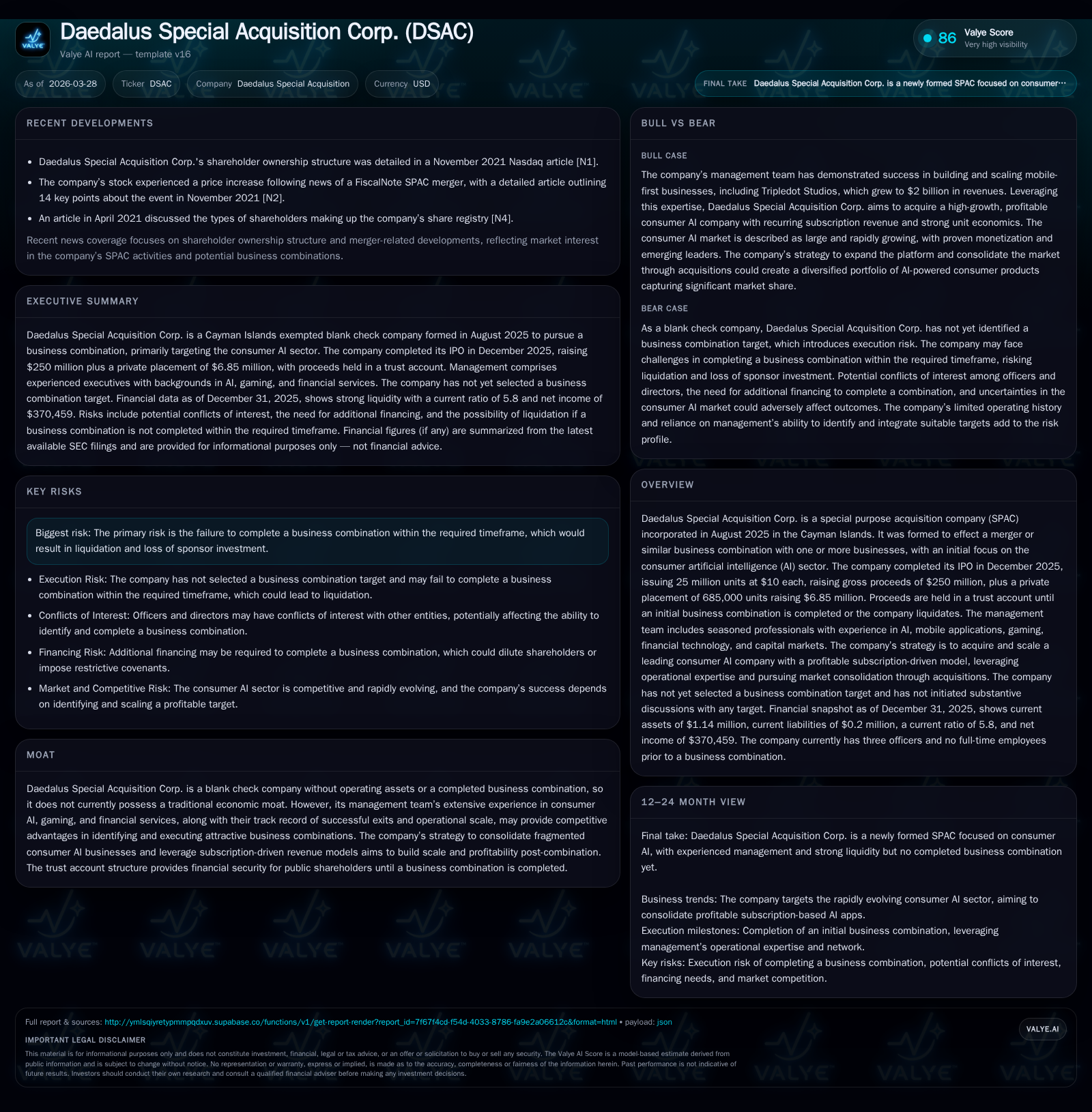
Daedalus Special Acquisition Corp (DSAC), incorporated in August 2025 as a Cayman Islands SPAC, raised $256.85 million through its December 2025 IPO and private placement to pursue an initial business combination primarily within the consumer AI sector. The company’s management team brings deep operational and M&A experience in AI, gaming, and fintech, positioning it to identify and scale high-quality consumer AI businesses via an anchor acquisition followed by market consolidation. Despite limited operating history and ongoing target identification, DSAC has secured a strong capital base held in trust and laid out a strategy centered on profitable subscription-driven models. Key risks include the ticking regulatory clock to complete a deal within 24 months (potentially extendable) and dilution if additional funding is needed. Moving forward, critical milestones revolve around target selection progress and successful transaction execution.
SPAC Model and IPO Capital Structure: Foundation for Growth
Daedalus Special Acquisition Corp was formed on August 7, 2025 as a Cayman Islands exempted company specifically to effectuate one or more business combinations [S1]. It completed its initial public offering (IPO) on December 10, 2025, issuing 25 million units priced at $10 each. Each unit comprises one Class A ordinary share and one-fourth of one redeemable warrant exercisable at $11.50 per share [S1][S16]. The IPO generated gross proceeds of $250 million. Additionally, a private placement of 685,000 units was consummated simultaneously at the same price point, raising a further $6.85 million from the sponsor and underwriters [S1][S16].
To safeguard public shareholders’ interests until the initial business combination closes or liquidation occurs, all IPO proceeds plus the private placement funds are deposited into a trust account invested in U.S. government securities or equivalents [S1][S16][S26]. Interest income from this trust account flows to DSAC but only up to minimal amounts necessary for tax obligations and dissolution expenses [S26]. This trust structure is standard among SPACs listed on NASDAQ like DSAC, where units began trading under ticker "DSACU", ordinary shares as "DSAC", and warrants as "DSACW" following January 29, 2026 separation of components trading [S10].
The underwriters partially exercised their overallotment option for 2.5 million additional units during IPO close but left some portion unexercised before expiration [S11]. The sponsor initially held founder shares (8.33 million after forfeiting some shares related to overallotment) that carry anti-dilution rights designed to preserve sponsor economics when additional financing is raised [S10][S21]. This capital structure provides DSAC with approximately $256.85 million as dry powder within the trust account plus operational flexibility toward funding an acquisition.
Management Team Expertise Driving Merger Prospects
DSAC’s leadership team plays a pivotal role given its blank check status without operations or identified targets yet. The management combines domain expertise across artificial intelligence (AI), consumer technology, fintech, mobile gaming, mergers & acquisitions (M&A), and capital markets knowledge [S1].
Co-CEO Husnu Akin Babayigit notably co-founded Tripledot Studios, which scaled from zero revenue to approximately $2 billion annually with 25 million daily active users globally before executing multiple accretive acquisitions including Applovin's game assets for $800 million [S15][S23]. He has been recognized with industry lifetime achievement awards reflecting his operational acumen in mobile-first growth strategies.
Other executives include Orkun Kilic (Co-CEO) with a background in financial engineering and corporate finance alongside Nimika Karadia (CFO) possessing nearly two decades of fund operations experience including CFO/COO roles at investment firms [S24]. Their combined networks extend deeply into founder-led consumer AI startups and publicly listed companies providing strategic sourcing advantages in today's competitive M&A landscape.
This fusion of operational scale experience from gaming/mobile combined with financial strategy aims to differentiate DSAC by focusing intently on consumer AI businesses that feature subscription-driven revenue models supported by scalable digital traffic acquisition techniques.
Historical Performance Snapshot: Financials Before Business Combination
As expected from an early-stage SPAC pre-acquisition entity without operating subsidiaries, DSAC’s financial statements reflect minimal operating activity beyond IPO costs.
Historical performance (annual)
| FY |
|---|
| 2025 |
Source: SEC companyfacts cache [F1].
All data as of December 31, 2025 per latest annual filing [F1]
Operating loss of roughly $193k is nominal relative to IPO proceeds and largely reflects administrative expenses incurred setting up corporate infrastructure. The reported positive net income (~$370k) originates mainly from interest earned on funds deposited within the trust account—a standard practice ensuring the cash balance grows modestly ahead of deployment [F1]. Current assets mainly consist of cash equivalents while liabilities remain low reflective of no significant debt load or operational overhead.
ROE is negative given the lack of profit-generating activities beyond interest income relative to equity base inclusive of sponsor founder shares.
Consumer AI Sector Opportunity and Competitive Positioning
The market targeted by DSAC—the consumer artificial intelligence space—is characterized by rapid exponential growth driven by generative AI applications impacting writing assistance, wellness apps, productivity tools, video/communication platforms among others [S6]. Unlike enterprise-focused AI deployments often hampered by integration complexity, consumer AI adoption benefits immediately from mobile-first distribution channels supporting fast trial/conversion cycles through app stores.
Mobile consumer apps excluding gaming increased revenues from $3.5 billion in 2014 to over $69 billion in 2023. Generative AI app downloads alone surged from near zero in late 2021 to over 1.5 billion by early 2024 reflecting explosive user demand growth [S6]. Monetization predominantly leverages recurring subscription economics often delivering margin profiles exceeding industry averages of ~20% plus rapid user base expansion over 100%+ annual growth for frontrunners.
Sector fragmentation remains acute with many undercapitalized players offering opportunity for scale consolidation using platforms well versed in user acquisition efficiency metrics such as customer acquisition cost (CAC), lifetime value (LTV), churn rate management—all familiar KPIs deployed by DSAC's leadership team via prior successes like Tripledot Studios.
This environment provides fertile ground for establishing an anchor profitable consumer AI business, expanding organically via product improvements while accelerating growth through bolt-on acquisitions—an approach embedded within DSAC’s strategic framework.
Strategic Approach to Growth Via Anchor Acquisition and Platform Expansion
DSAC outlined a strategic three-pronged approach focused on comprehensive value creation post-combination:
Anchor Acquisition: Secure an attractively valued consumer AI application exhibiting high growth momentum alongside profitable recurring subscription revenue—the foundation for future scalable cash flow generation with solid unit economics supporting sustainable margins [S4].
Platform Expansion: Apply extensive operating expertise in optimizing user acquisition channels, retention programs powered by product innovation enhancements plus monetization levers aimed at maximizing gross margins and accelerating top-line expansion post-merger [S4][S6].
Market Consolidation: Leverage the anchor’s platform as a base to identify synergistic bolt-on targets within fragmented segments replicating proven M&A playbooks akin to those successfully executed at Tripledot Studios which amassed ~$2 billion revenue scale through multiple accretive deals including notable asset purchases totaling hundreds of millions [S6].
This strategy aims not just at standalone growth but aggregates complementary businesses offering cross-selling opportunities along convergence themes amongst consumer AI applications—enabling diversification across use cases while building defensible competitive moats growing size and influence via network effects inherent in subscription ecosystems.
Potential Risks Surrounding Deal Completion Deadline and Dilution
DSAC faces the classical risks associated with blank check vehicles mandated under SEC regulations:
Business Combination Deadline: The company must consummate an initial business combination within generally 24 months post-IPO close unless shareholders approve time extensions – extensions themselves require shareholder approval coupled with redemption rights exercisable pro rata from the trust account [S7][S17]. Failure to close within this timeframe triggers automatic liquidation whereby public shareholders receive redemption approximately equal to their original subscription less dissolution expenses; concurrently founders’ shares and private placements typically expire worthless generating total loss for sponsors/investors holding these interests [S7][S19].
Dilution Risk: Should the size or nature of acquisition target(s) require cash consideration exceeding available trust funds—after accounting for public shareholder redemptions—and transaction fees/supporting working capital needs outside the trust account balance; DSAC may be compelled to issue new equity securities or debt instruments subjecting existing public shareholders to dilution risk potentially exacerbated if anti-dilution provisions attached to founder shares are triggered adversely impacting ownership percentages post-transaction execution [S5][S21][S22].
Conflicts of Interest: Officers/directors including sponsor affiliates may hold interests that could incentivize consummating suboptimal deals risking shareholder value due to founders’ evaluated interests balancing potential earnouts/returns independent from public shares performance post-merger [S18][S19].
These risks underscore the importance for timely deal identification fitting criteria attractive enough to satisfy both fiduciary obligations toward shareholders while preserving long-term value creation substance.
Capital Allocation Framework and Shareholder Implications Pre-Combination
Prior to completion of any business combination DSAC maintains stringent capital preservation discipline aligned with typical SPAC governance:
No dividends or share repurchases have been authorized or conducted given absence of standalone operating cash flows; net asset value preservation is paramount until merger consummation unlocks operating entity value accrual prospects [S8][S10][F1].
IPO proceeds (including private placement fund tranche) will be deployed substantially towards financing the target acquisition transaction considering working capital costs ancillary fees incurred directly related to closing activities plus potential forward purchase agreements or backstop arrangements if employed concurrently as bridge solutions during deal consummation phase if needed [S5][S21][S26].
Post-business combination capital allocation decisions will shift toward funding organic growth initiatives, bolt-on acquisitions pursuant consolidation strategy alongside prudent balance sheet management tailored dynamically based on operating cash flow generation and reinvestment needs inherent in scaling consumer AI products under recurring revenue models.
This disciplined framework ensures public investors retain pro rata right on deployment outcome while providing founders adequate incentives aligned proportionally once operating cash flows emerge increasing cycle robustness.
Key Milestones and Indicators to Watch Moving Forward
Although explicit forward-looking guidance remains absent due to nascent operational status typical for newly listed SPACs awaiting targeted acquisition negotiation results; several key indicators merit tracking:
- Target Identification Updates: Any disclosures regarding engagement status with prospective consumer AI candidates including letters of intent or exclusivity agreements signal progress along due diligence pipeline pathways.
- Shareholder Voting Notices/Proxy Filings: Indicative scheduling—once transaction terms finalize—will trigger mandatory voting including redemption options offering insight into market reception.
- Extension Requests: Should timing constraints require extension beyond original 24-month window—from IPO close December 2025 onward—board resolutions seeking shareholder approvals would mark critical junctures potentially reflecting complexities headwinds limiting deal closure pace.
- Financing Announcements: Any subsequent equity or debt issuances associated with acquisition funding beyond the trust funds convey deal size scaling impacting dilution assumptions previously set forth ahead.
The orchestration from present stages through completion milestones defines DSAC’s transition path transforming from a blank check entity into an operational platform competing within one of technology’s most dynamic sectors.
This report is based solely on information available through Daedalus Special Acquisition Corp.’s SEC filings and verified data caches as of March 28, 2026 ([F1], [S1]-[S29]). It does not constitute investment advice or recommendations.
Disclaimer: This is research-only, informational analysis and not investment advice. It may include AI-generated interpretation and general industry context. Always verify important details using primary sources.

Comments