
Local Bounti’s Controlled Environment Agriculture: Balancing Growth and Financial Sustainability
Local Bounti leverages its proprietary Stack & Flow Technology to expand sustainably in controlled environment agriculture while managing ongoing financial pressures.
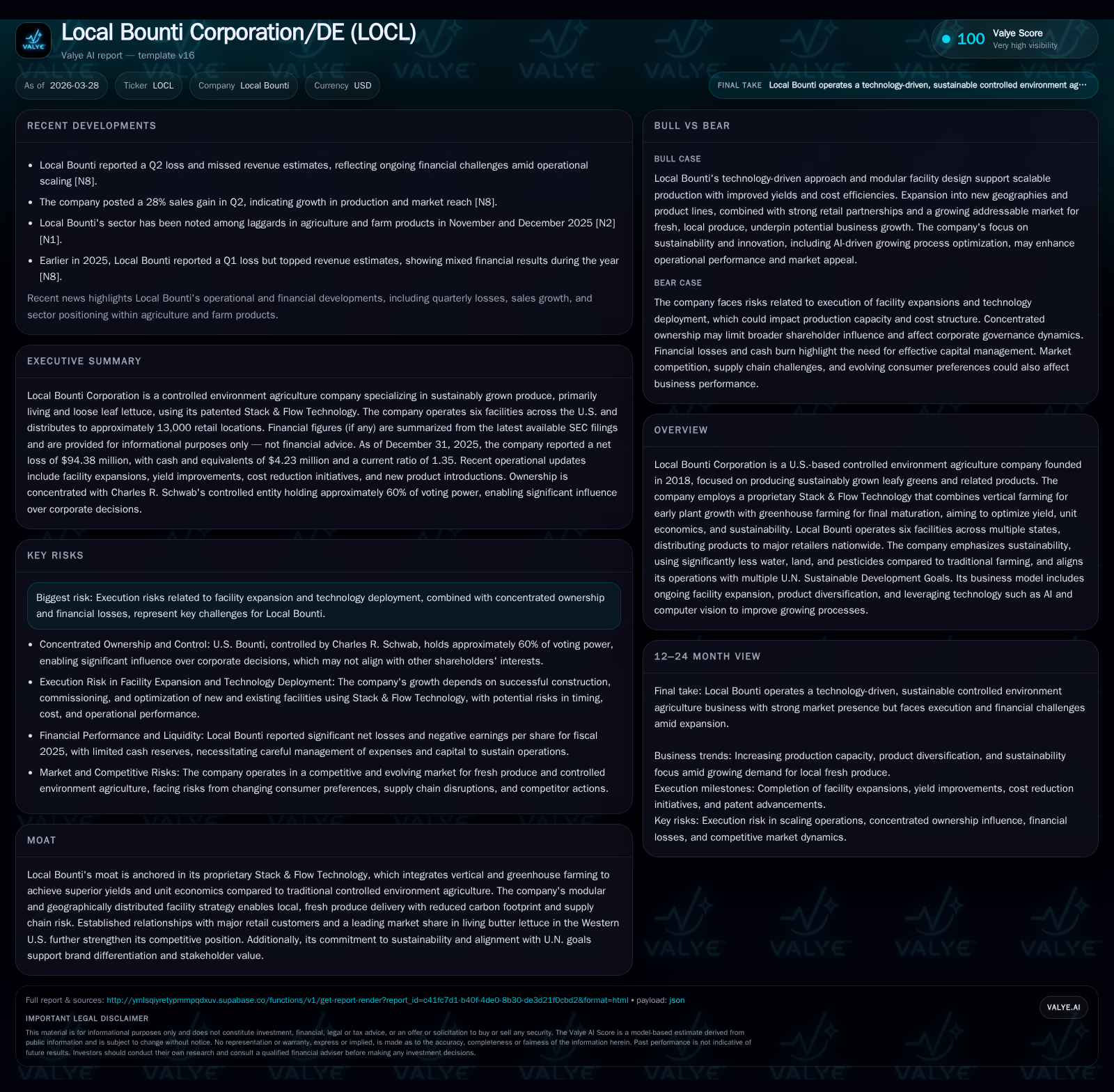
Local Bounti Corporation, a U.S.-based controlled environment agriculture (CEA) operator founded in 2018, uses patented Stack & Flow Technology—a hybrid vertical and greenhouse growing system—to produce sustainable leafy greens distributed through roughly 13,000 retail locations across 35 states. The company has steadily expanded its facility footprint via acquisitions and new builds between 2022 and 2025, increasing product variety and geographic reach. Despite improving operational efficiencies and market penetration, Local Bounti continues to report significant financial losses and negative cash flows amid heavy capital expenditures. Its balance sheet shows a sizable accumulated deficit and negative equity, offset partially by credit arrangements with Cargill Finance and convertible notes. Execution risks tied to scaling operations, funding needs, regulatory exposures, and concentrated ownership remain key challenges for the company’s path forward.
Charting Past Performance and Growth Drivers
Local Bounti's financial history over the past four fiscal years demonstrates significant investment aimed at expanding its controlled environment agriculture footprint alongside ongoing operating losses characteristic of a capital-intensive business.
From FY2022 through FY2025,[F1] operating income losses narrowed modestly each year: -$94.5M (2022), -$116.9M (2023), -$58.9M (2024), to -$62.6M (2025). Net losses improved by approximately 21%, reaching about -$94.4M in 2025 after a prior $119.9M loss year.[F1]
Capital expenditures declined sharply—from $162.3M in 2023 to $82.5M in 2024 and further down to $11.6M in 2025—reflecting an intense build phase transitioning toward stabilization or slower expansion.[F1] These investments supported commissioning multiple facilities and retrofitting acquired assets post-Pete's acquisition.[S1][S2]
Operating cash flow remained negative but improved slightly from -$48.8M (2022) to -$27.1M (2024), then dipped moderately again to about -$30.3M (2025).[F1] This sustained negative free cash flow (~-$41.9M FY25) evidences ongoing funding requirements even as operational scale increases.
Growth drivers include the acquisition of Hollandia Produce Group ('Pete’s') which expanded production capacity notably by adding two California greenhouses plus the Georgia facility operational since mid-2022.[S1][S2][S9] Newly built Washington and Texas facilities completed operations starting early 2024 broadening geographic reach.[S1][S13]
Product expansions—such as arugula blends launched early 2025,[S1][S18] salad kits gaining retail traction,[S1] and baby leaf portfolio additions—complement the core living butter lettuce crop dominant in the West Coast market (~80% share).[S11][S21]
Historical performance (annual)
| FY | Net ($mm) | CFO ($mm) | OpInc ($mm) | Capex ($mm) | Net YoY |
|---|---|---|---|---|---|
| 2025 | -94 | -30 | -63 | 12 | +21.3% |
| 2024 | -120 | -27 | -59 | 82 | +3.3% |
| 2023 | -124 | -33 | -117 | 162 | -11.7% |
| 2022 | -111 | -49 | -95 | 56 |
Source: SEC companyfacts cache [F1].
Capital returns and efficiency (annual)
| FY | FCF ($mm) | ROE% |
|---|---|---|
| 2025 | -42 | 56.8 |
| 2024 | -110 | 119.3 |
| 2023 | -195 | -812.0 |
| 2022 | -105 | -91.5 |
Source: SEC companyfacts cache [F1].
Note: Dollar values are absolute; YoY percentages approximate based on [F1].
Decoding the Stack & Flow Technological Edge
Local Bounti's proprietary Stack & Flow Technology® combines vertical farming during early plant stages ('Stack') with traditional greenhouse cultivation for subsequent maturation ('Flow'). This hybrid system optimizes environmental conditions including temperature, humidity, CO2 levels, nutrient delivery, and pH balance across growth phases.[S1][S2][S11]
The approach achieves higher yields per square foot than classic vertical or purely greenhouse models by leveraging vertical stacking where feasible while preserving quality during final grow-out phases.
The company reports using approximately 90% less water and land relative to outdoor conventional agriculture alongside substantially reduced pesticide/herbicide use.[S1][S17] Produce is non-GMO certified with consistent quality that supports longer shelf life through significantly lower bacterial counts compared with field-grown crops.[S11]
Modular environmental controls reduce energy consumption typical of lighting-heavy vertical farms while accelerating crop cycles by optimizing photosynthesis efficiency tailored at each stage.[S17]
Computer vision integrated with AI helps monitor plant health indicators enabling proactive adjustments to inputs such as nutrients or lighting spectra,[S11] highlighting digital agriculture trends within mature CEA operations.
Expansion Milestones and Market Penetration Dynamics
The Pete's acquisition in 2022 added two California greenhouses plus a Georgia site which became operational mid-2022 followed by a significant expansion through 2023 integrating Stack & Flow Technology that doubled production rates.
Additional greenfield developments completed in Washington State and Texas during early-to-mid-2024 bring total operating sites to six nationwide.[S1][S13]
Products reach approximately 13,000 retail locations across 35 states with marquee customers including Walmart, Target, Kroger, Albertsons, and Sam's Club—all benefiting from a trusted brand associated with freshness, sustainability, and local sourcing.
Living butter lettuce remains the flagship product with an ~80% controlled environment market share in the Western U.S., supported by new Grab & Go salads,[S1][S21] arugula introduced early 2025,[S18] plus family-sized Caesar salad kits showing strong velocity gains.[S1]
Strategic agreements like the Sam’s Club offtake ensure defined purchase volumes supporting Georgia/Texas output scale-up.[S2]
Geographical diversification mitigates supply chain disruptions typical of single-region harvest risks emphasizing controlled post-harvest freshness benefits compared with field-grown produce logistics.
Analyzing Financial Health and Capital Allocation
At December 31st, 2025:[F1]
- Cash & equivalents totaled approximately $4.2 million.
- Current assets were about $22 million versus current liabilities near $16.3 million yielding a current ratio around 1.35x indicating liquidity buffer.
- Long-term debt stood at $302 million under a senior credit facility amortizing through end-2035 with flexible interest payment options.[S6][S7]
- Convertible note with U.S. Bounti for $10 million principal includes conversion rights at $2.50/share offering potential dilution but enhanced capital flexibility.[S10][S12]
- Total equity was negative approximately $166 million reflecting accumulated deficits near half a billion dollars due to multi-year net losses.[F1]
A simple ROE calculation is distorted by negative equity accounting effects but illustrates challenges interpreting returns amid deep accumulated losses.[F1]
Cash flow analysis shows continued negative operating cash generation (~-$30 million FY25)[F1], driven by labor-intensive operations plus energy/equipment maintenance costs necessary for quality output.
Capital expenditures fell sharply last year—only $11.6 million spent versus prior years’ heavy investments exceeding $80–160+ million—consistent with maturation of recent facilities but highlighting reliance on external financing for growth distinct from internal liquidity.
No dividends or buybacks have been declared or expected given capital constraints; allocation prioritizes infrastructure growth combined with R&D into efficiency gains via AI/automation aiming at reducing labor overheads long term.[S20][S24]
Navigating Operational Risks and Execution Challenges
Key risks include:
- Concentrated ownership dominance: U.S. Bounti/Schwab controls >55% voting power influencing governance decisions that may diverge from minority interests.[S4]
- Construction delays or cost overruns especially retrofitting acquired sites requiring technology upgrades introduce timing uncertainties affecting capacity ramps.[S14]
- Inflationary pressures increasing costs for energy inputs/equipment maintenance/labor risks impairing productivity given skilled horticultural workforce dependencies.[S16]
- Regulatory compliance uncertainty owing to emerging standards enforced federally (FDA/USDA/EPA/FTC) plus state/local jurisdictions affecting labeling/practices introduces risk of fines or operational interruptions.[S14][S16]
- Intellectual property litigation risks exist though no material lawsuits currently; potential defense costs could divert resources.[S4][S5]
- Facility-specific risks such as damage or disruptions could cause service interruptions given limited number of active plants.[S14]
Managing these risks requires vigilant governance balancing deployment agility with cost discipline amid volatile agri-tech input pricing today.
Growth Prospects and Strategic Outlook
While specific guidance is not disclosed beyond filings,[N/A] qualitative drivers support continued growth:
- Geographic expansion plans include Midwest presence contingent on retailer optimization discussions.[S13]
- Rollout of Stack & Flow technology upgrades aims for margin improvements via yield uplift plus input cost reduction.
- Product line extensions into specialized greens—arugula blends/basil/co-located packaging for private label contracts—broaden addressable markets beyond core lettuce products.[S18][S21]
- Adoption of advanced data analytics/AI-driven remote monitoring may incrementally reduce labor costs enhancing unit economics over time.[S11]
- Deepening partnerships with national grocers underpin volume stability supporting scaling production capabilities.
Challenges include achieving economies of scale amidst inflationary environments while managing new capacity commissioning without excessive overhead burdens especially if sales mix shifts toward lower-margin SKUs given consumer price sensitivities observed broadly.
What Investors Should Monitor Going Forward
Key indicators include:
- Margins by SKU as yield improvement technologies roll out tracked quarterly where available.
- Operating leverage realization comparing sales growth vs SG&A along with R&D vs commercial spend breakdowns.
- Financing events including credit facility amendments or convertible note conversions impacting shareholder composition.
- Facility throughput scaling velocity post commissioning potentially observable via shipment disclosures.
- Customer contract renewals/new wins among major retailers like Sam’s Club offsetting competitive pressures.[S3]
- Litigation or regulatory developments impacting IP protection or compliance penalties affecting valuation sentiment.
- Labor market conditions affecting recruitment/retention given reliance on skilled horticultural workers managing complex environments.
In sum Local Bounti remains positioned technologically within evolving CEA sectors leveraging distinctive hybrid Stack & Flow innovation coupled with strategic geographic reach targeting sustainable produce demand niches albeit challenged by ongoing financial losses requiring disciplined financing management alongside execution rigor.
This report is prepared solely for informational purposes reflecting publicly filed data as of March 28th, 2026 without providing any investment recommendation or advice. Analysis is based exclusively on disclosed SEC filings [F1][S#].
Disclaimer: This is research-only, informational analysis and not investment advice. It may include AI-generated interpretation and general industry context. Always verify important details using primary sources.

Comments