
Capital Structure and Growth Pathways for Spartacus Acquisition Corp. II Post-IPO
A newly formed SPAC with $230 million in trust navigates early-stage growth leveraging management expertise while facing structural and deal-timing risks.
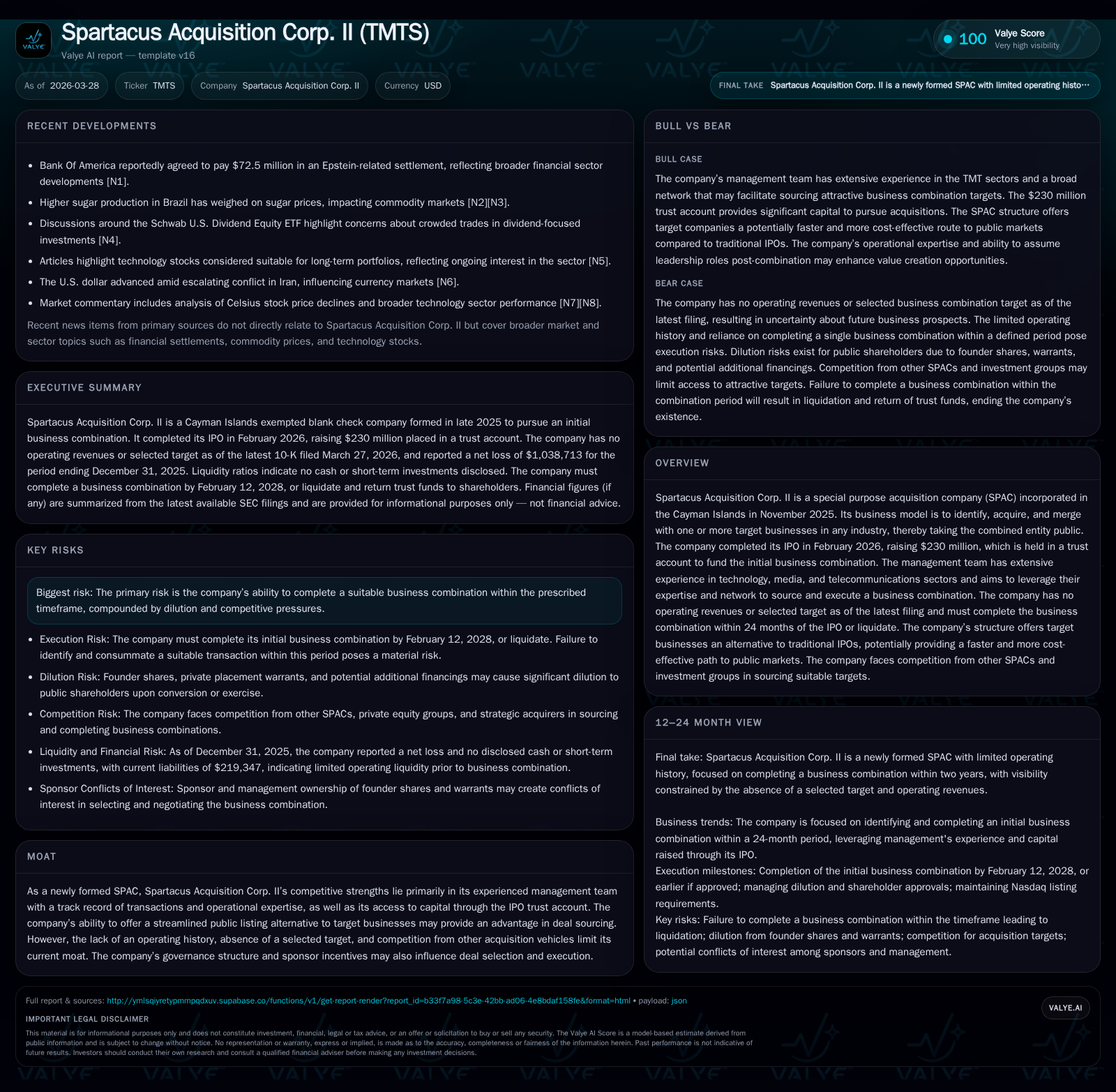
Spartacus Acquisition Corp. II emerged from its February 2026 IPO with $230 million earmarked in a trust account, structured to fund its initial business combination within 24 months. Although not yet generating revenue or having a designated acquisition target, the company’s seasoned management team—rooted in telecommunications, media, and technology (TMT) sectors—provides potential deal-sourcing advantages. The SPAC’s capital structure reflects typical early-stage negative operating income and outsized ROE figures driven by equity accounting effects. Key challenges include executing a suitable business combination before the February 2028 deadline amid competitive bidding and shareholder dilution risks inherent to SPAC structures.
Inception and IPO: Laying the Groundwork with $230 Million in Trust
Spartacus Acquisition Corp. II was incorporated on November 4, 2025 as a Cayman Islands exempted company explicitly created as a special purpose acquisition company (SPAC) aimed at effecting one or more business combinations without initial operating activities [S1][S22]. Its IPO launched on February 12, 2026, completing the sale of 23 million public units priced at $10 each. Gross proceeds amounted to $230 million including full exercise of the overallotment option resulting in additional units issued [S1][S3]. Concurrently, the company sold approximately 4.125 million Private Placement Warrants for $1 each to its Sponsor [S1].
Critically, $230 million comprised mostly of the IPO proceeds ($225.875 million) plus private placement proceeds ($4.125 million) was deposited into a trust account under trustee Continental Financial Services. This trust secures the capital for future acquisition(s) while protecting investors legally until completion of an initial business combination or liquidation event [S1][S22].
The two-year Combination Period set by corporate charter requires Spartacus to consummate a qualifying transaction by February 12, 2028 or return trust funds to shareholders upon liquidation [S1]. The structure gives it capital firepower typical of mid-sized SPACs enabling flexible deal negotiation leverage.
Management Team Expertise and Market Positioning in the TMT Sectors
Spartacus’s management boasts seasoned leadership focused on the technology, media and telecommunications (TMT) spheres—a sector complex characterized by rapid innovation cycles combined with high capital intensity and strong network effects. Chairman Peter D. Aquino alongside CEO Igor Volshteyn have over 25 years collectively transacting within these industries through a variety of operational roles and strategic investments [S1][S7][S28].
Their history spans dozens of completed transactions involving sourcing proprietary deal flow via extensive global networks integrating relationships with corporate boards, private equity groups, financial sponsors and industry specialists [S7][S29]. This operational expertise—uncommon among many SPAC sponsors who often focus solely on capital raising—positions Spartacus uniquely in not just investing but potentially driving post-merger value creation through leadership involvement and rapid integration capacity.
While no specific acquisition target has yet been identified as of latest reports, this background supports expectations that Spartacus can competitively engage attractive targets by aligning operational acumen with capital efficiency.
Current Financial Snapshot: No Revenue, Yet High ROE Ratios Reflecting Capital Structure
Being a blank check entity pre-combination, Spartacus has not generated operating revenue nor realized profits. Its financial statements reflect minimal operational activity with expenses related mainly to organizational costs and IPO-related fees.
As of fiscal year ending December 31, 2025—coinciding with formation activities—the company reported:
Historical performance (annual)
| FY |
|---|
| 2025 |
Source: SEC companyfacts cache [F1].
The exceptionally elevated ROE figure exceeding 3,400% is an accounting artifact arising from a very low equity base combined with net losses common across nascent SPACs prior to deal completion. These distortions highlight that traditional profitability metrics must be interpreted cautiously for such entities before operational payload is onboarded via merger.
Cash outside the trust account is limited (~$1 million), earmarked largely for administrative costs including claims reserves or potential litigation provisions; total liabilities remain nominal reflecting lean cost structure typical for shell companies pending transaction execution [F1][S9].
Target Search and Business Combination Timeline Constraints
Following IPO closure in February 2026, Spartacus entered its mandated two-year window by which it must complete an initial business combination or cease operations through liquidation distributing trust funds pro rata to shareholders [S1][S28]. The lack of any publicly disclosed target as of March 2026 underscores the early stage nature of its search process.
The Nasdaq listing rules further impose a maximum three-year requirement known as the Nasdaq 36-Month Requirement but contractually Spartacus limits itself to two years unless extended by shareholder vote via Amended Articles approval—such extension would trigger redemption rights for public shareholders thereby diluting cash available for combination consideration [S28].
The compressed timeframe pressures management to evaluate multiple candidates rapidly while balancing valuation discipline against the risk that failure triggers compulsory liquidation erasing sponsor economics [S14]. Delay risks are exacerbated by competition from numerous other SPACs (some with larger capitalization or sector specialization), traditional private equity funds bidding aggressively for sought-after assets, along with strategic acquirers typically offering speed advantages through direct purchasing power [S25][S27].
Capital Allocation Strategy: Trust Account Use, Potential Dilution, and Financing Flexibility
Spartacus holds approximately $230 million in a trust account dedicated exclusively for financing its initial business combination transaction(s) [S1][F1]. This capital forms the core purchasing power accessible either solely in cash or blended alongside issuance of Class A Ordinary Shares and warrants.
According to filing disclosures:
- The company may supplement trust funds via equity-linked securities issuances or debt financings such as forward purchase agreements or backstop arrangements. These tools allow agility if redemptions force unexpected increases in cash requirements during deal close [S4][S12][S18].
- Such financings introduce dilution risk diminishing public shareholders’ ownership percentages.
- No dividends or share repurchases have occurred or are planned pre-combination consistent with typical SPAC profiles aiming instead at preserving cash for acquisition activities [F1][S9].
- Restrictions exist on sponsors and insiders regarding transferability and lock-up periods around Founder Shares ensuring alignment during transition phases post-business combination closing [S20][S21].
- Sponsor also holds Private Placement Warrants exercisable post-combination that may accelerate dilution depending on stock price performance after merging [S1][F1].
Beyond regulatory safeguards mandating redemption rights at per-share prices approximating $10 plus interest held in trust accounts provide downside protection against deal failures but constrain balance sheet fluidity leading to occasional friction in negotiating complex transactions requiring tailored financing packages.
Risks and Compliance Considerations Surrounding SPAC Sponsor Incentives
Operationally Spartan in scale today with no revenue base leaves Spartacus exposed primarily to execution risks surrounding identification and closing of an acceptable business combination within prescribed periods [S6][F1]. Failure obligates prompt liquidation which erases sponsor investment although providing net-vs-gross recovery backstops investor capital.
Sponsor incentives can sometimes misalign against public shareholders insofar as founders hold shares which convert into controlling stakes only after successful closings often at significantly discounted prices relative to public investors' full-risk capital deployment level introducing potential conflicts during negotiations on valuation terms [S14][F1].
Moreover:
- Sponsors’ influence over deal selection can impact quality especially where they hold minimal economic exposure outside deferred fees.
- Competitive pressure intensifies due diligence rigor requirements concurrently increasing financing complexity.
- Legal considerations govern disclosure obligations affecting timing sensitivity vis-à-vis market trading patterns addressing insider trading concerns under SEC scrutiny practices unique to blank-check companies demonstrated through recent regulatory guidance bodies overseeing expanding SPAC markets.
What Investors Should Monitor Next: Deal Announcements and Redemption Activity
Looking ahead (analysis), critical junctures will revolve around:
- Formal announcement dates signaling selection of definitive merger partner(s).
- Release of proxy materials describing transaction rationale detailing valuation metrics facilitating shareholder informed votes.
- Redemption election levels providing insight into public investor sentiment regarding perceived deal attractiveness versus risk tolerance.
- Timing on shareholder meetings could influence market volatility as public participants gauge accretion/dilution scenarios embedded within negotiated terms.
- Potential amendments extending Combination Period subject to shareholder approvals relaxing time pressure while conversely reducing liquidity cushion within Trust Account reserves impacting subsequent trading dynamics.
Given historical variability observed across broader SPAC cohorts post-SPAC boom era—marked by rising skepticisms about fairness in sponsor economics—attention paid toward transparency standards around governance decisions will prove paramount.
This analysis synthesizes data available from SEC filings up through March 27, 2026 ([F1],[S#]) alongside current industry knowledge about SPAC mechanics and market dynamics relevant for stakeholders evaluating Spartacus Acquisition Corp. II’s trajectory absent any investment recommendation or price forecast.
Disclaimer: This is research-only, informational analysis and not investment advice. It may include AI-generated interpretation and general industry context. Always verify important details using primary sources.

Comments